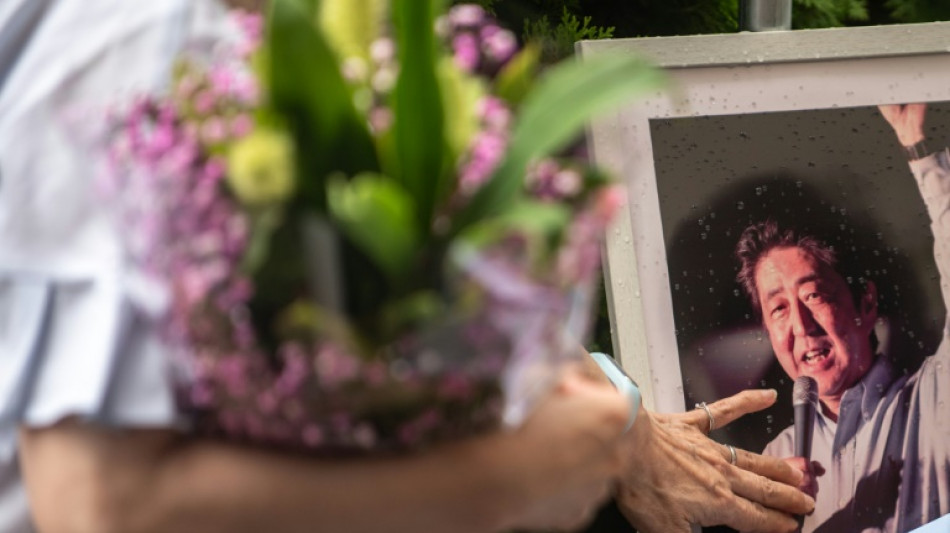
Japan prosecutors indict Abe murder suspect after psych review / Photo: Philip FONG - AFP

 Gauteng Health Department Warns of Rising Antibiotic Resistance Threat

 Bishop Museum Races to Save Rare Megamouth Shark Specimen

 InterContinental Hotels Group PLC Announces Transaction in Own Shares - November 26

 Raheem Sterling Receives Suspended Sentence After Lamborghini Crash

 Luxembourg Pay Rise Delayed as Regional and World Headlines Develop

 Audience to Choose the Set List at Luxembourg's First FAMIL Jukebox Night

 Twickenham Grounds Team Prepares Pitch for Six Matches in Three Days

 Black Friday Discounts Cut Prices on Two Top-Rated Wiper Blades

 TCC Network Linked to 200% Surge in Global School Attacks

The man accused of killing former prime minister Shinzo Abe was indicted on Friday, a Japanese court said, after a lengthy psychiatric review found him fit to stand trial.
Tetsuya Yamagami was detained immediately after the former Japanese premier was gunned down last July while giving a campaign speech in the western city of Nara.
The 42-year-old spent months undergoing a psychiatric assessment, which ended earlier this week with his transfer to a police station.
Yamagami faces charges of murder and violation of arms control laws, Nara District Court spokesman Kenichiro Nomura told AFP. He could face the death penalty if convicted.
Yamagami has admitted killing Abe, according to local media, and images taken at the scene show him holding and firing an apparently homemade weapon.
He reportedly targeted Abe over the former leader's ties to the Unification Church, the global sect whose members are sometimes referred to as "Moonies".
Yamagami is believed to have resented the church over large donations his mother made that bankrupted his family.
Abe, who was given a rare state funeral, was not a member of the church but had addressed an affiliated group, as have other well-known speakers such as Donald Trump.
Founded in Korea in 1954 by Sun Myung Moon, the church rose to global prominence in the 1970s and 80s.
The group, officially known as the Family Federation for World Peace and Unification, has denied wrongdoing and has pledged to prevent "excessive" donations from members.
- Investigation ordered -
Investigations after Abe's death revealed close ties between the church and many conservative ruling lawmakers, including a minister who has resigned.
The assassination also increased scrutiny on Abe's alleged long-standing family ties to the sect -- especially those of his grandfather, former prime minister Nobusuke Kishi, who was photographed shaking hands with Moon.
The revelations angered the public and helped push approval ratings for Prime Minister Fumio Kishida's administration to new lows.
Kishida has ordered a government investigation that could see the Unification Church lose its tax-exempt status in Japan, although it could still continue to operate.
His government has also passed legislation tightening rules around religious donations.
Details that have emerged about Yamagami's childhood, including his mother's alleged neglect of her children to carry out church activities, have built anger against the organisation and spurred sympathy for Yamagami among some members of the Japanese public.
Donations of cash, clothing, food and books flooded into the Osaka detention centre where he was held during his psychiatric evaluation.
Some 15,000 people also signed a petition calling for prosecutors to go easy on him, according to local media.
Abe was Japan's longest-serving prime minister and one of the country's most recognisable political figures, known for cultivating international alliances and his "Abenomics" economic strategy.
He resigned in 2020 over recurring health problems, but remained a key political voice and was campaigning for his ruling party on the day of his assassination.
Ch.P.Lewis--AT
