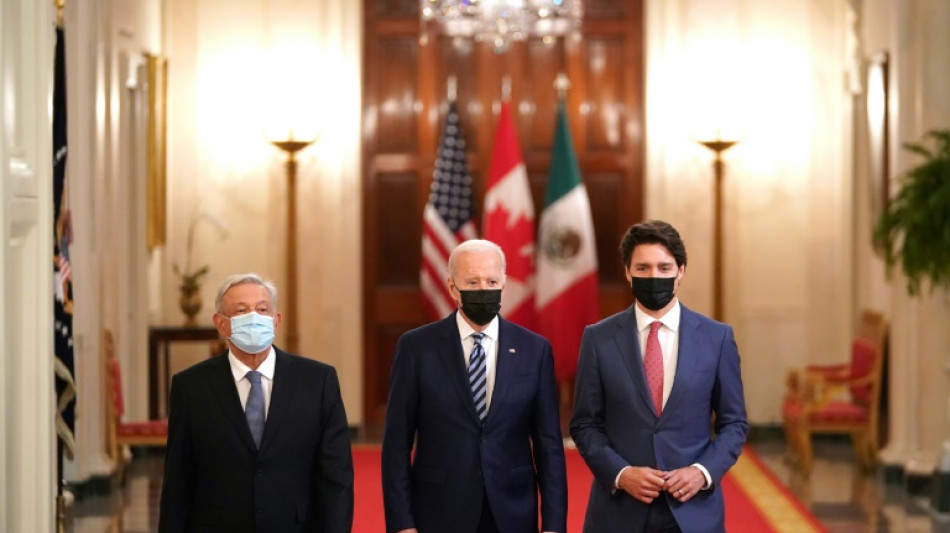
Economy takes center stage at North American summit / Photo: MANDEL NGAN - AFP/File

 Gauteng Health Department Warns of Rising Antibiotic Resistance Threat

 Bishop Museum Races to Save Rare Megamouth Shark Specimen

 InterContinental Hotels Group PLC Announces Transaction in Own Shares - November 26

 Raheem Sterling Receives Suspended Sentence After Lamborghini Crash

 Luxembourg Pay Rise Delayed as Regional and World Headlines Develop

 Audience to Choose the Set List at Luxembourg's First FAMIL Jukebox Night

 Twickenham Grounds Team Prepares Pitch for Six Matches in Three Days

 Black Friday Discounts Cut Prices on Two Top-Rated Wiper Blades

 TCC Network Linked to 200% Surge in Global School Attacks

The leaders of the United States, Mexico and Canada are expected to set aside simmering trade tensions and pursue deeper economic integration at talks on Tuesday that will also cover migration and climate change.
Mexican President Andres Manuel Lopez Obrador will host his US counterpart Joe Biden and Canadian Prime Minister Justin Trudeau for three-way talks known as the "Three Amigos" summit.
While efforts to tackle migration and drug smuggling dominated a bilateral meeting between Lopez Obrador and Biden on Monday, the focus is expected to shift to the economy when Trudeau joins them.
Reinforcing regional economic ties "allows the United States to be the manufacturing powerhouse that President Biden has talked about but also is a win-win for Mexico and Canada," White House National Security Advisor Jake Sullivan told reporters.
Furthermore, it "reduces our dependencies on other countries and other parts of the world who don't necessarily share the same values that we share with our partners here in North America," he added.
Mexico hopes to benefit from Washington's efforts to reduce its reliance on Asia-based manufacturers.
Last year, the Latin American nation was invited by the United States to join a multi-billion dollar push to boost semiconductor manufacturing to compete with China.
Biden revived the "Three Amigos" talks in 2021, seeking to restore normalcy to the three-way partnership after his predecessor Donald Trump shelved the regional summit.
But relations between Lopez Obrador and Biden have not been entirely smooth.
Mexico faces a formal trade complaint from the United States and Canada under a North American trade deal.
Washington and Ottawa say Lopez Obrador's push to boost the state's role in the energy industry hurts foreign investors and hinders the development of clean energy.
While Biden and Trudeau may raise their concerns with Lopez Obrador in private about the energy reforms, in public they are likely to emphasize the potential for closer economic cooperation.
- Clean energy push -
The White House announced ahead of the summit that the three countries would organize "the first-ever trilateral semiconductor forum" to shape government policies and increase investment in supply chains.
They will also expand resource mapping to gather details on minerals vital for clean energy technologies.
Other steps include drawing up a plan for operating standards and the installation of electric-vehicle chargers along international borders and developing a North American clean hydrogen market.
The countries also pledged to expand "legal pathways and other humane measures" to address irregular migration, and to reduce methane emissions from solid waste and wastewater to combat climate change.
On Monday signs of discord emerged between the United States and Mexico in their approaches to dealing with surging migrant arrivals at their shared border.
At the start of bilateral talks, Lopez Obrador called for increased US investment, which should help stem migration.
"It is time to end this oblivion, this abandonment, this disdain for Latin America and the Caribbean," Lopez Obrador said.
Biden defended Washington's record, saying it had spent "tens of billions of dollars" in the past 15 years alone that had benefited the region.
"The United States provides more foreign aid than every other country just about combined," he said.
"Unfortunately, our responsibility just doesn't end in the Western Hemisphere," Biden added.
Amnesty International urged the North American leaders to make the rights of refugees and migrants a "top priority" at their talks and to "stop implementing inhuman shared migration policies."
"As the number of people fleeing violence and persecution continues to grow, protecting the human rights of migrants and refugees is of critical importance," said Erika Guevara-Rosas, Amnesty's Americas director.
On Thursday, Biden announced an expansion of powers to expel people showing up at the border without clearance.
At the same time, a legal, strictly enforced pathway will be created for up to 30,000 migrants a month from Cuba, Haiti, Nicaragua and Venezuela.
Another priority for Biden is tackling what he called "the plague of fentanyl," referring to the often-deadly opioid smuggled across the border by Mexican drug cartels.
Biden and Trudeau will also hold bilateral talks, with the Haitian government's appeal for an international intervention force in the crisis-hit Caribbean nation among possible items on the agenda.
burs-dr/md
E.Rodriguez--AT
