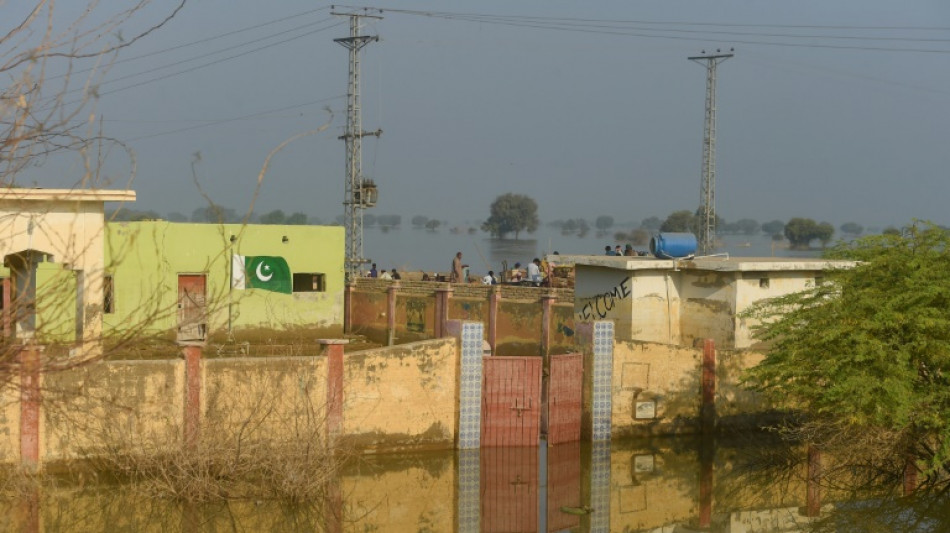
Pakistan flood recovery needs 'massive' investment: UN / Photo: Asif HASSAN - AFP

 Gauteng Health Department Warns of Rising Antibiotic Resistance Threat

 Bishop Museum Races to Save Rare Megamouth Shark Specimen

 InterContinental Hotels Group PLC Announces Transaction in Own Shares - November 26

 Raheem Sterling Receives Suspended Sentence After Lamborghini Crash

 Luxembourg Pay Rise Delayed as Regional and World Headlines Develop

 Audience to Choose the Set List at Luxembourg's First FAMIL Jukebox Night

 Twickenham Grounds Team Prepares Pitch for Six Matches in Three Days

 Black Friday Discounts Cut Prices on Two Top-Rated Wiper Blades

 TCC Network Linked to 200% Surge in Global School Attacks

The UN chief called Monday for "massive investments" to help Pakistan recover from last year's devastating floods and better resist climate change, as financial pledges poured in.
"No country deserves to endure what happened to Pakistan," UN Secretary-General Antonio Guterres told an international conference in Geneva, which is seeking billions of dollars to support recovery from the disaster.
Guterres opened the one-day event appealing to the world to help Pakistan bounce back from floods which submerged a third of the country, killing more than 1,700 people and affecting more than 33 million others.
Pakistan's Prime Minister Shehbaz Sharif told the conference his country was "racing against time" to deal with towering needs.
"This is the greatest climate disaster in our country's history," agreed Foreign Minister Bilawal Bhutto Zardari, decrying a "colossal calamity."
According to Pakistan's so-called Resilient Recovery, Rehabilitation and Reconstruction Framework, which it will officially present during Monday's conference, it will need $16.3 billion over the next three years.
Pakistan's government has said the country should be able to cover half the cost, but is urging the international community to fund the rest.
- 'Life-line' -
"I am asking for a sustained international support plan. I am asking for a new lifeline," Sharif said.
Countries appeared to heed that call, with hundreds of millions of dollars promised even before the pledging part of the conference had begun.
Speaking via video-link, French President Emmanuel Macron told the conference that his country would contribute 360 million euros ($384 million).
He also said France was prepared to join an international support group being created to help Pakistan implement its plan, and said it would also provide an additional 10 million euros in emergency aid.
European Commission chief Ursula von der Leyen said the European Union was contributing 500 million euros towards Pakistan's reconstruction, as she announced a fresh injection of 10 million euros in humanitarian assistance.
Months after the rains stopped, the situation in Pakistan remains dire.
Eight million people were displaced, millions of acres of agricultural land were ruined and around two million homes destroyed, while nine million more people were pushed to the brink of poverty.
Guterres said Pakistan and its people responded to "this epic tragedy with heroic humanity".
"We must match the heroic response of the people of Pakistan with our own efforts and massive investments to strengthen their communities for the future," he told the conference.
- Loss and damage -
The UN chief said the international community had a particular responsibility to help Pakistan, which has been "doubly victimised by climate chaos and a morally bankrupt global financial system."
With representatives of the World Bank and a range of multilateral development banks listening on, he slammed a system that "routinely denies middle-income countries the debt relief and concessional financing needed to invest in resilience against natural disasters."
Monday's event is broader than a traditional pledging conference, as it seeks to set up a long-term international partnership focused not only on recovery, but also on boosting Pakistan's climate resilience.
Pakistan, with the world's fifth-largest population, is responsible for less than one percent of global greenhouse gas emissions but is one of the nations most vulnerable to extreme weather caused by global warming.
Guterres said Pakistan's "monsoon on steroids" proved the need for the agreement reached at the UN climate summit in November to create a "loss and damage" fund, which is aimed at covering the climate-related destruction endured by developing nations less responsible for global warming than wealthy polluters.
"If there is any doubt about loss and damage, go to Pakistan," he said.
"There is loss. There is damage."
Ahead of the conference, Achim Steiner, head of the UN development agency, told AFP that Pakistan would face "extraordinary amounts of misery" if the world did not step up and help.
"Today the waters may have partially receded," he told Monday's conference, "but what remains is a monumental reckoning for the entire world."
E.Rodriguez--AT
