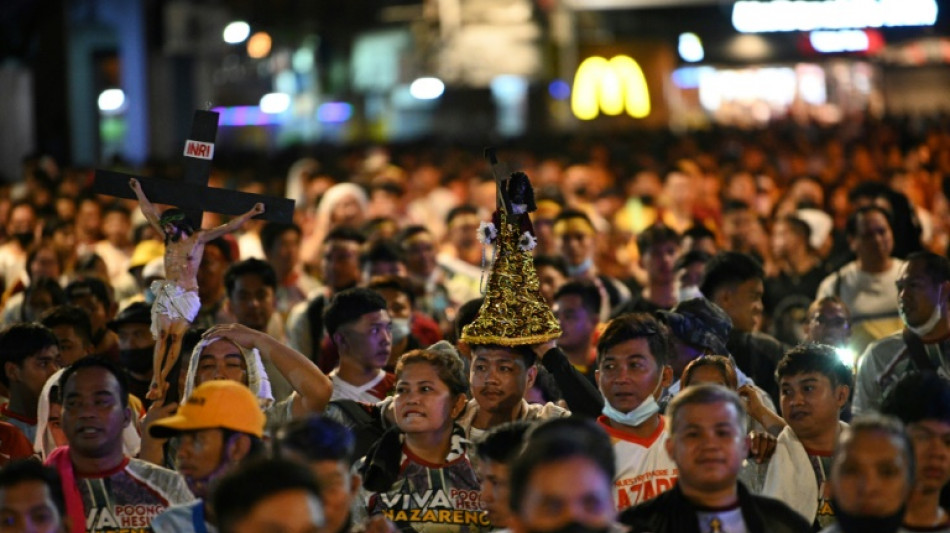
Thousands of Filipinos march in reverence of Catholic icon / Photo: Ted ALJIBE - AFP

 Gauteng Health Department Warns of Rising Antibiotic Resistance Threat

 Bishop Museum Races to Save Rare Megamouth Shark Specimen

 InterContinental Hotels Group PLC Announces Transaction in Own Shares - November 26

 Raheem Sterling Receives Suspended Sentence After Lamborghini Crash

 Luxembourg Pay Rise Delayed as Regional and World Headlines Develop

 Audience to Choose the Set List at Luxembourg's First FAMIL Jukebox Night

 Twickenham Grounds Team Prepares Pitch for Six Matches in Three Days

 Black Friday Discounts Cut Prices on Two Top-Rated Wiper Blades

 TCC Network Linked to 200% Surge in Global School Attacks

Tens of thousands of Catholic faithful walked through the streets of Manila early Sunday in reverence of a historic statue of Jesus Christ, which is believed to have miraculous powers.
The "walk of faith", which church officials estimated attracted more than 80,000 people, began after a midnight mass for the so-called Black Nazarene statue.
Many Filipinos believe touching or getting close to the statue can lead to the healing of otherwise incurable ailments and other good fortune.
Evangeline Rugas, 59, was among the worshippers attending the open-air mass where a replica of the icon has been on display.
She was "praying for a miracle" for her five-year-old nephew who suffers from seizures and cannot walk.
"Nothing is impossible for the Black Nazarene," Rugas told AFP as she sat on a plastic sheet laid on the ground.
The original wooden statue was brought to the Philippines in the early 1600s when the nation was a Spanish colony.
Many Filipinos believe it got its dark colour after surviving a fire aboard a ship en route from Mexico.
This year's parade replaced the traditional frenzied procession, which used to involve hundreds of thousands of believers thronging a life-sized statue as it was pulled through the streets on a float.
One of the biggest displays of Catholic devotion in the Philippines, it was cancelled for two years in a row due to Covid-19.
This year's event was held a day before the feast of the Black Nazarene, which falls on January 9, and without the venerated statue in the hope of reducing crowd numbers and the risk of infection.
The roughly six-kilometre (3.7-mile) route ended at Quiapo Church, where the Black Nazarene is enshrined.
Mask-wearing devotees, some carrying candles or small replicas of the Black Nazarene, poured through narrow streets in the early hours of the morning.
Mercy Dayrit, 70, said she had prayed "day and night" to the Black Nazarene after she was diagnosed with breast cancer in 2016.
She was declared "cancer free" last year, which she attributes to the icon.
"So many miracles happen," Dayrit said.
In the weeks leading up to Sunday's walk, the statue was taken to churches around the city and nearby provinces to give worshippers the chance to see and touch it in the hope of avoiding a huge crowd on the feast day.
Ch.Campbell--AT
