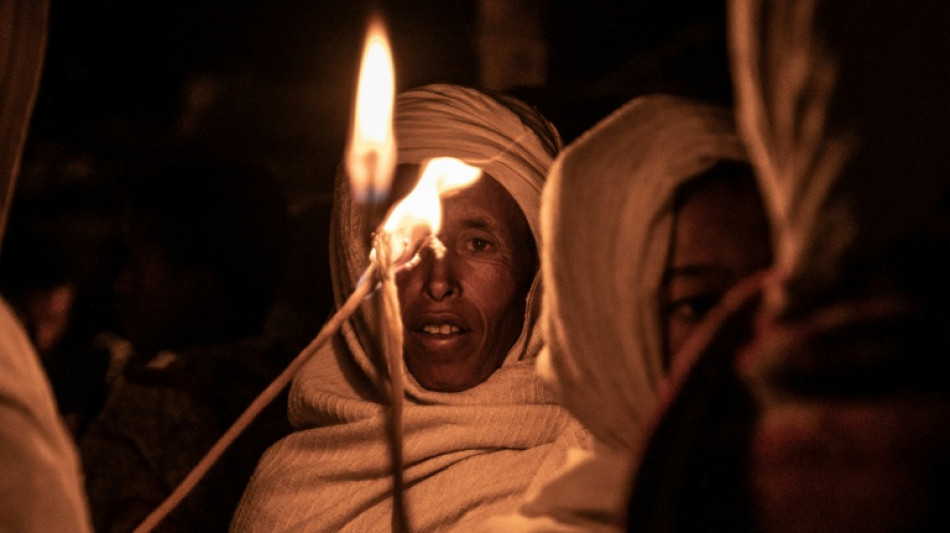
After peace deal, Orthodox Ethiopians keep a Christmas of hope / Photo: Amanuel Sileshi - AFP

 Gauteng Health Department Warns of Rising Antibiotic Resistance Threat

 Bishop Museum Races to Save Rare Megamouth Shark Specimen

 InterContinental Hotels Group PLC Announces Transaction in Own Shares - November 26

 Raheem Sterling Receives Suspended Sentence After Lamborghini Crash

 Luxembourg Pay Rise Delayed as Regional and World Headlines Develop

 Audience to Choose the Set List at Luxembourg's First FAMIL Jukebox Night

 Twickenham Grounds Team Prepares Pitch for Six Matches in Three Days

 Black Friday Discounts Cut Prices on Two Top-Rated Wiper Blades

 TCC Network Linked to 200% Surge in Global School Attacks

"I was able to come this year because there is peace," says Asme Mamo as he joins crowds of worshippers celebrating Orthodox Christmas in the historic Ethiopian town of Lalibela.
Two months after a ceasefire deal between the Ethiopian government and Tigray rebels to end two years of devastating war, Africa's largest Christian site is alive with excitement and religious fervour as the faithful flock to Lalibela for the festivities.
A white tide of tens of thousands of worshippers of all ages, draped in their immaculate "netela" (a shawl covering the head and shoulders), thronged the UNESCO World Heritage Site and its magnificent rock-hewn 12th and 13th century churches.
In recent years, the crowds were much sparser in the Amhara town, one of Ethiopia's holiest and most storied places.
Lalibela lies only 40 kilometres (25 miles) as the crow flies from Tigray, where the conflict erupted between government forces and the Tigray People's Liberation Front (TPLF) in November 2020, spilling over periodically into neighbouring regions.
The town itself was at the centre of a fierce struggle between the warring sides, changing hands four times during the fighting, although the ancient churches appear to have been spared the scars of war.
Seized by Tigray rebels in an offensive in mid-2021, it was recaptured by pro-government forces on December 1, 2021, before falling back into the hands of TPLF fighters 10 days later. The rebels finally left Lalibela at the end of December that year after they announced a withdrawal to their Tigray stronghold.
A surprise peace deal was signed last November 2 in the South African capital Pretoria to silence the guns in northern Ethiopia and allow the gradual resumption of humanitarian aid and the restoration of basic services -- communications, electricity, banking, transport -- in Tigray, long cut off from the outside world.
- 'So many people' -
"I wanted to come last year but I couldn't because of the war," says Asme, who travelled from Wolkait in western Tigray, a disputed area claimed by both the Amhara and Tigrayan ethnic groups.
"I didn't expect so many people to be here," says the 30-year-old science teacher of Amhara origin.
The Pretoria agreement has allowed traffic to resume in northern Ethiopia, so Asme came to Lalibela by bus with fellow pilgrims from his home village.
Others arrived on foot from surrounding villages, by car, or by plane from the capital Addis Ababa and abroad from countries such as Britain, German and the United States.
Asme described the atmosphere of the festival as "special".
"Even the greetings among each other are unique because people have missed each other. Everybody is excited about peace."
Lalibela's high priest Kengeta Belay said he was "overwhelmed" by the numbers joining the celebrations.
"This is the benefit of peace. People are coming from all four directions to worship freely without fear of anything... My joy is boundless."
"I have been attending the festivities for over 40 years. I was born and raised here and became a priest. This year's celebration is the biggest crowd of pilgrims I've ever seen," smiled the 55-year-old clergyman, just minutes before the start of a night of candlelit ceremonies.
- 'Prayers for freedom' -
Massed in and around Lalibela's unique complex of churches -- but also on surrounding hills and even in trees, the faithful sang, prayed, ate, slept or enjoyed long discussions with their fellow pilgrims.
Songs, psalms and ululations rang out from Saint Mary's church, the oldest of the 11 stone houses of worship and the heart of celebrations for Genna (Christmas in Amharic).
With her eyes closed and her head bent over a prayer stick, Bethlehem said she was savouring the "peaceful and joyful atmosphere" of the festivities.
"Our country was unstable in the past few years, there was war. Thanks to God, all that has passed," said the young banker from Addis Ababa, who did not want to give her family name or age.
"Today, I witnessed that peace is worth more than anything. My prayer and my wish is that God grants freedom for my country, for myself, and for all of us."
T.Wright--AT
