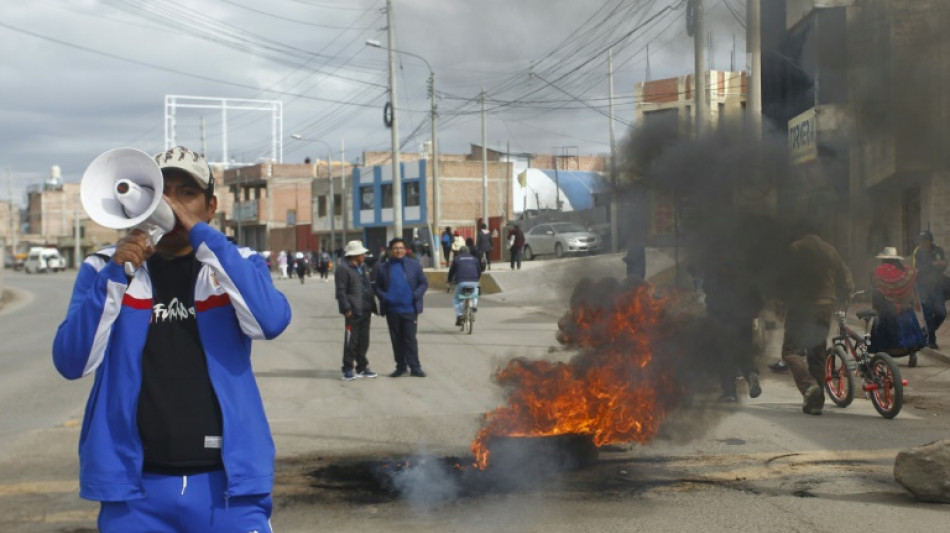
Peruvians clamor anew for president's removal / Photo: Juan Carlos CISNEROS - AFP

 Gauteng Health Department Warns of Rising Antibiotic Resistance Threat

 Bishop Museum Races to Save Rare Megamouth Shark Specimen

 InterContinental Hotels Group PLC Announces Transaction in Own Shares - November 26

 Raheem Sterling Receives Suspended Sentence After Lamborghini Crash

 Luxembourg Pay Rise Delayed as Regional and World Headlines Develop

 Audience to Choose the Set List at Luxembourg's First FAMIL Jukebox Night

 Twickenham Grounds Team Prepares Pitch for Six Matches in Three Days

 Black Friday Discounts Cut Prices on Two Top-Rated Wiper Blades

 TCC Network Linked to 200% Surge in Global School Attacks

After a fortnight-long break, Peruvians took to the streets again on Wednesday, blocking roads countrywide to demand the resignation of President Dina Boluarte, who took over from her ousted predecessor in December.
Protesters used stones and burning tires to barricade main routes in the southern regions of Puno, Cusco, Apurimac and Arequipa, as well as Junin in the center, chanting for Boluarte to leave.
She took over on December 7 as the South American country's first woman president following the impeachment and arrest of Pedro Castillo after he tried to dissolve Congress and rule by decree.
Castillo, a leftist former rural school teacher and union leader, faced vehement opposition from Congress during his 18 months in office, and had been the subject of numerous criminal investigations into allegations of widespread graft.
His ouster sparked nationwide protests, with Peru's rights ombudsman reporting 22 people killed in clashes and more than 600 injured.
Boluarte's government declared a 30-day nationwide state of emergency, while she attempted to calm the uproar by seeking to bring forward elections.
The demonstrations died down over the holiday period, but by Wednesday the protesters had remobilized.
"There are ten blockades, mainly around Puno," government spokesman Alberto Otarola told reporters in Lima, where a crisis center was erected.
In Arequipa, police sought to break up hundreds of protesters using tear gas.
Dozens also gathered in the capital, Lima.
"The airports are functioning normally," said Otarola.
As a precaution, train services between the town of Cusco and the Inca citadel of Machu Picchu were suspended indefinitely Tuesday and some 2,000 tourists escorted from the heritage site.
In the first wave of protests, thousands of tourists found themselves stranded at Machu Picchu and Cusco for days due to road, railway and airport blockades.
Public buildings and airports expecting protests were being guarded by police and soldiers deployed under the state of emergency.
From Lima, Boluarte called Wednesday for an end to the protests she blamed for "delays, pain, economic losses" and appealed instead for "peace, calm, unity to promote development of the homeland."
Protest leader Milan Knezvich, in the mountainous Apurimac region, vowed the struggle will continue.
"No one will want to talk to her. As long as Mrs Dina Boluarte does not resign, this will continue," he told Exitosa radio.
The new government has agreed to bring forward elections set for 2026 to April next year, but many want voting to happen even sooner.
On Tuesday, marches were held in various parts of Peru against the planned restart of the anti-Boluarte protests.
O.Ortiz--AT
