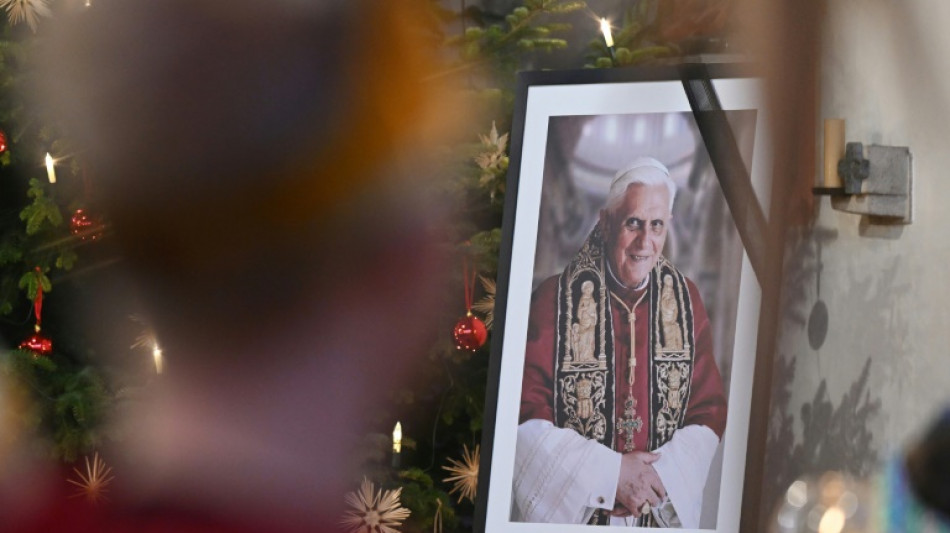
Popes through history: felled by illnesses and intrigues / Photo: KERSTIN JOENSSON - AFP

 South Korea says 'serious shortage' of rooms with Asian Games days away
 Table tennis siblings with China-born parents vow to usher in 'Japan's era'
 Bougainville leader says violence won't stop Panguna mine re-opening

 South Korea aims to save seniors lost in digital age
 Russia's Stalin-admiring provincial leader waging an ultra-conservative crusade
 Marcelo Gallardo appointed as new Ecuador head coach
 'Widow's Bay' and 'The Pitt' tipped for success at Emmy Awards
 For club and comfort: Rodman makes it to Shelton's US Open final
 Houthis say Saudi Arabia launched over 50 strikes against them in 24 hours
 'Fed up': Thousands march against Sinaloa Cartel violence

 AAHOA Officially Launches New Folio-Powered Marketplace to Simplify Purchasing for Members

 Controversial Zverev: from tennis nearly-man to multiple Grand Slam winner
 Swedish left-wing cheers far-right decline amid tight election race

 Yamal double helps Barca beat Levante, Atletico triumph
 Sassuolo stun Juve, Lobotka eases pressure on Allegri with Napoli winner
 Bills beat Texans and Ravens roll Colts in NFL openers
 US fight off spirited France to win 12th World Cup

 Drivers give cool reception to new Madring circuit

 Maresca makes flawless Man City start to leave Man Utd trailing

 Dozens arrested in major anti-LGBTQ raids in Turkey

 Leftwing opposition seen leading Sweden election, far-right losing ground
 Senegal goalkeeper Mendy retires from international football

 Carrick 'worried' by decision to award Man City winner

 Lobotka eases pressure on Allegri with Napoli winner
 Trump watches as Lowry wins Irish Open in record-breaking style
The peaceful death of Benedict XVI in a monastery in the Vatican contrasts with the painful, violent or sometimes mysterious deaths of many of his predecessors.
Here are some striking examples:
- John Paul II's long ordeal -
Benedict's predecessor, John Paul II, died on April 2, 2005 in the Vatican aged 84, after a long illness that turned the end of his 26 years at the helm of the Catholic Church into an ordeal.
After two successive hospitalisations and a tracheotomy in February 2005, John Paul II's condition had worsened abruptly a few days before his death, following a urinary infection, sepsis and cardiac arrest.
He mostly lost his speech after the tracheotomy and managed to utter a few words in public on March 13, before returning to the Vatican. He later remained silent.
On his last Good Friday, he was filmed from behind in his apartments so that the faithful could see him following the Way of the Cross via video.
The one-time sportsman's pontificate was marked by a slew of health issues.
He was weakened by Parkinson's disease and by the after-effects of injuries sustained in the attempted assassination carried out by Turkish extremist Mehmet Ali Agca on May 13, 1981 in Saint Peter's Square.
He also battled cancer in the intestine and two fractures, one in the shoulder and one in the femur.
- Sudden death of John Paul I -
His predecessor, John Paul I, nicknamed "the good pope" or "the smiling pope", was one of the most ephemeral popes in history.
Elected in August 1978 at the age of 65, he died 33 days and six hours later, apparently from a heart attack, although no autopsy was carried out to confirm the causes of his death.
Books have speculated that the pope might have been assassinated because he wanted to put the church's affairs in order, particularly the financial embezzlement of Monsignor Paul Marcinkus.
Marcinkus, the then-head of the Vatican bank, was suspected at the time of links with the mafia.
No official inquiry has confirmed the suspicions.
- The mysterious death of Alexander VI Borgia in 1503 -
The death of Alexander VI, who was pope from 1492 to 1503, was also subject to intense speculation.
On August 6, 1503, after a dinner with his son Cesare at a cardinal's house, both went down with a fever.
A first theory attributed the illness to malaria, which was prevalent in Rome at the time.
The other hypothesis was that the pope would have wanted to get rid of some of his enemies and would have himself poisoned the wine, inadvertently falling into his own trap.
Johann Burchard, a close associate of the pope who was present at his death, said: "His body swelled so much that we couldn't put it in the coffin we were meant for him. He was temporarily rolled into a carpet while his apartments were looted."
- Formosa, exhumed for trial in 897 -
Known as the "corpse council", the posthumous trial of Pope Formosa (891-896) is testament to the chaos that prevailed in the ninth century in Rome and the Vatican.
In 897, on the orders of Pope Etienne IV, a sworn enemy of Formosa, his corpse was exhumed, clad in papal ceremonial clothing and sat on a throne to be judged.
The verdict said the deceased was not worthy of the pontificate.
All his actions were annulled and orders issued by him were declared invalid.
Papal ceremonial clothes were ripped from his body, the three fingers of his right hand that the pope had employed in consecrations were cut off and the corpse thrown into the Tiber.
- A hammer blow to confirm the death -
Vatican protocols state in precise detail the procedure that must be followed on the death of a pope, with a senior cardinal known as a "camerlengo" ("chamberlain") given charge of day-to-day affairs until a new pontiff is elected.
Traditionally, his main role has been to certify the death, once done by tapping the pontiff's forehead three times with a special silver hammer and calling out his birth name.
The tradition fell into disuse after the death of John XXIII in 1963.
F.Ramirez--AT