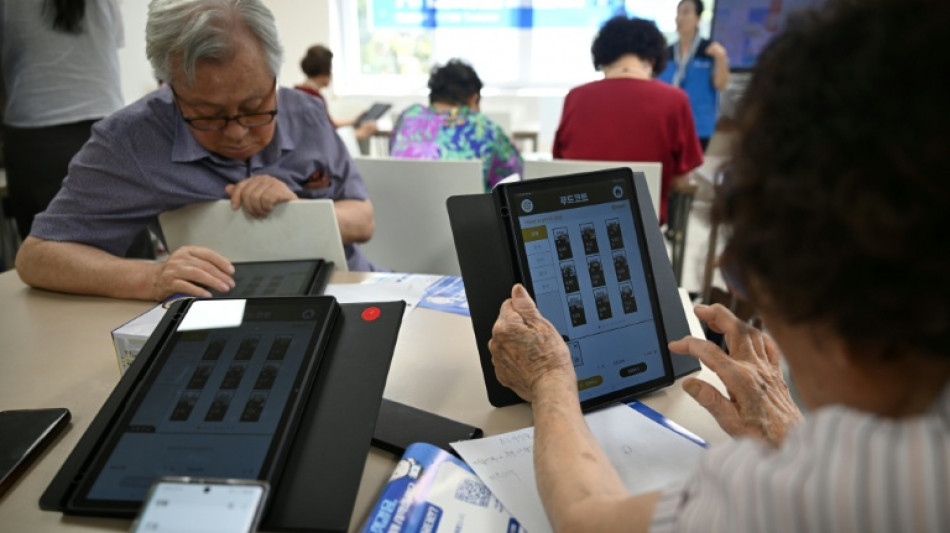
South Korea aims to save seniors lost in digital age / Photo: Jung Yeon-je - AFP

 Mehbooba Mufti urges dialogue and renewed Central Asia links for Kashmir

 Seacliff Healthcare Seeks Specialist GP in Thirroul

 US stocks fall before midterm Election Day as technology shares weaken

 BLS Polymers makes strong market debut at ₹248 per share

 Petrol and diesel prices remain broadly steady across major Indian cities
 Reliance shares remain in focus after near-12% surge

 2026 Arizona Midterms: Key Races, Ballot Measures, and Voter Deadlines

 Coal India prepares possible $1 billion Mahanadi Coalfields listing

 Julia Stiles and Ezra Sosa Share Emotional Farewell After 'DWTS' Elimination

 US Buildings Threatened by Wildfires Could Triple by 2060

 Why Pregnancy Cost Estimates Fail: A Family’s $9,000 Surprise

 US Strikes Iranian Targets in Strait of Hormuz Ahead of Midterms

 Brodeur’s Overtime Goal Secures Bethlehem’s Second Consecutive Sectional Title

 Rare 1970 Plymouth ‘Cuda 426 Hemi Listed for $400,000

 The Digital Burden: Why Instant Messaging Feels Like a Full-Time Job

 Alberta Tabled Controversial Riding Boundary Maps Amid Gerrymandering Accusations

 Hong Kong court set to sentence activist Joshua Wong in security case
 Australia raises benchmark rate to highest level in 18 years

 'The Remarried Empress' Cast Discusses Bringing Fantasy Royal Drama to Life

 Asian stocks retreat as AI worries outweigh steep oil-price drop

 Hamad International Airport stages emergency drills during WATAN 2026

 Global failure to punish attacks leaves journalists at continuing risk

 Researchers Warn 'Bookkeeping Trick' Masks Beef Industry's Methane Emissions

 Climate Change Intensified Atlantic Hurricanes, Study Finds

 Qatar solar expansion opens scope for technical performance gains

A little cheer rose for 79-year-old Hwang Sun-hee after she managed to place an online order at a training session in South Korea, which has one of the world's starkest digital divides for seniors.
Age gaps in digital literacy are a global concern, yet the gulf has widened massively in the hyper-connected and fast-ageing country, prompting national campaigns to bridge it.
"You can't do anything without smartphone apps or a kiosk machine... It's too much for old folks," Hwang said at a senior community centre in Suwon, south of Seoul, during government-organised digital survival training.
The so-called grey digital divide has provided some striking examples in the nation of about 52 million, home to world-leading smartphone and memory chipmakers.
Last year, several baseball clubs began reserving a small number of tickets for on-site sales after reports that older fans, cash in hand, approached younger people at stadiums and pleaded with them to buy tickets from machines.
Nearly 90 percent of taxi drivers use ride-hailing apps, yet more than 80 percent of South Koreans over 60 still hail cabs by hand, a survey showed.
A 71-year-old retired public servant at the same training session as Hwang recalled spending over 30 minutes trying to flag down a taxi on a busy Seoul street.
The cabs kept passing him to pick up younger riders just metres away who were using smartphone apps to hail their rides.
"I felt utterly useless," the man, who gave only his surname, Park, told AFP.
- South Korea's wide divide -
The digital divide can also pose a real threat, leaving older people vulnerable to high-tech crimes such as online scams or limiting their access to medical services, experts say.
A state survey last year found that 60 percent of South Koreans over 60 struggle to use public and commercial services due to lack of digital skills -- compared with just six percent of those under 40.
"The intergenerational digital divide (in South Korea) appears wider than elsewhere," said Kim Jeung-kun, professor of senior business at Kangnam University in Seoul.
He noted that the nation's "intensely compressed" industrialisation happened in just a few decades, while it took centuries in many Western countries.
South Korea -- which had a GDP per capita below $100 in the wake of its 1950-1953 war -- is now the world's 15th largest economy, according to the IMF.
"Many of our elderly grew up at a time when many had no electricity, landline phones or proper schooling," Kim added.
The nation's older cohort is massive -- South Korea is what the UN calls a "super-aged society", where more than 20 percent of the population is over 65.
In response, South Korea's public tech training for the elderly began in 2020, when businesses and services turned online during the Covid-19 lockdown.
- A wish to be 'born young' -
Hwang, echoing others in the two-hour class, said she's made it this far by relying on her children for daily tasks she once managed herself -- including enrolling in her favourite dance class at the local community centre.
"Before, I could easily do all of these just by calling or showing up in person," Hwang said.
Officials now provide nationwide training for the "digitally vulnerable" for using mobile devices, apps, and AI. Vans packed with tech devices and mock kiosks drive to community centres and regional festivals popular among the elderly.
In 2025, over 65,000 sessions were held for some 650,000 people over 60.
Hwang gathered along with 30 neighbours for a session in August, practising how to pay hospital bills at mock kiosks, patting a prancing robot dog, or asking their phones: "Gemini, tell me about tomorrow's weather."
She has undergone similar training several times -- and said the lessons helped her confidence -- but noted she was "so envious of young people who can do all this so easily".
"I wish I had been born young in today's world," Hwang added.
B.Torres--AT