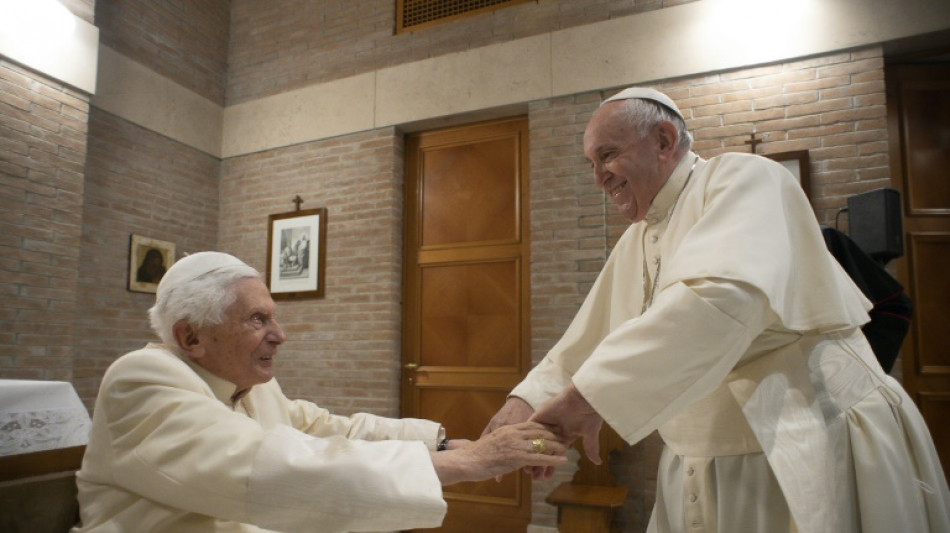
Death of ex-pope would put Vatican in uncharted territory / Photo: Handout - VATICAN MEDIA/AFP/File

 Gauteng Health Department Warns of Rising Antibiotic Resistance Threat

 Bishop Museum Races to Save Rare Megamouth Shark Specimen

 InterContinental Hotels Group PLC Announces Transaction in Own Shares - November 26

 Raheem Sterling Receives Suspended Sentence After Lamborghini Crash

 Luxembourg Pay Rise Delayed as Regional and World Headlines Develop

 Audience to Choose the Set List at Luxembourg's First FAMIL Jukebox Night

 Twickenham Grounds Team Prepares Pitch for Six Matches in Three Days

 Black Friday Discounts Cut Prices on Two Top-Rated Wiper Blades

 TCC Network Linked to 200% Surge in Global School Attacks

The death of a pope usually sets in motion time-honoured traditions, but with ex-pontiff Benedict XVI in failing health the Vatican is on unfamiliar ground.
The 95-year-old Joseph Ratzinger, who was revealed this week to be seriously ill, in 2013 became the first pontiff to quit in six centuries.
Unlike when previous popes have died, there would be no need to call a conclave to elect a new pontiff, as Pope Francis -- chosen to succeed Benedict in 2013 -- remains very much in post.
But the Vatican has refused to give details in advance on what else will happen when Benedict dies.
Most commentators expect Benedict to have a funeral at the Vatican, either in St Peter's Basilica or the huge square that sits in front of it.
"From a liturgical point of view, I think that when the funeral takes place, essentially it will be the ritual envisaged for papal funerals," liturgical expert Claudio Magnoli told AFP.
"The substantial difference is that it could be presided over by the reigning pope (Francis), while up to now it was the dean of cardinals or a designated cardinal."
Under rules set out in 1996, a pope must be buried between four and six days after his death.
How and when he is buried is usually decided by cardinals who gather from around the world, and who also organise the Vatican's nine days of mourning, known as novemdiales.
- The pope's ring -
They decide because the death of a pope traditionally creates a power vacuum at the top of the church.
However, no such vacuum would exist in this case, as Francis is in charge.
In 2005 the body of John Paul II, the last pope to die, lay in state before a funeral mass in St Peter's Square presided over by Ratzinger, then a senior cardinal.
An estimated one million people attended, alongside heads of state from around the world.
In 2020, media reports said Benedict had chosen to be buried in the former tomb of John Paul II, in the crypt of St Peter's.
The body of the beloved Polish pope was moved to the upper part of the basilica when he was beatified in 2011. He was confirmed a saint in 2014.
Benedict, a conservative intellectual, was not as popular as John Paul II, who was pope between 1978 and 2005, but his funeral is still likely to draw large crowds and dignitaries.
Traditionally, when a pope dies, his "Fisherman's Ring" -- a signet ring specially cast for each new pope which once was used to seal documents -- is also destroyed.
When Benedict left office, the face of his ring was etched with a "X" to make it unusable.
R.Garcia--AT
