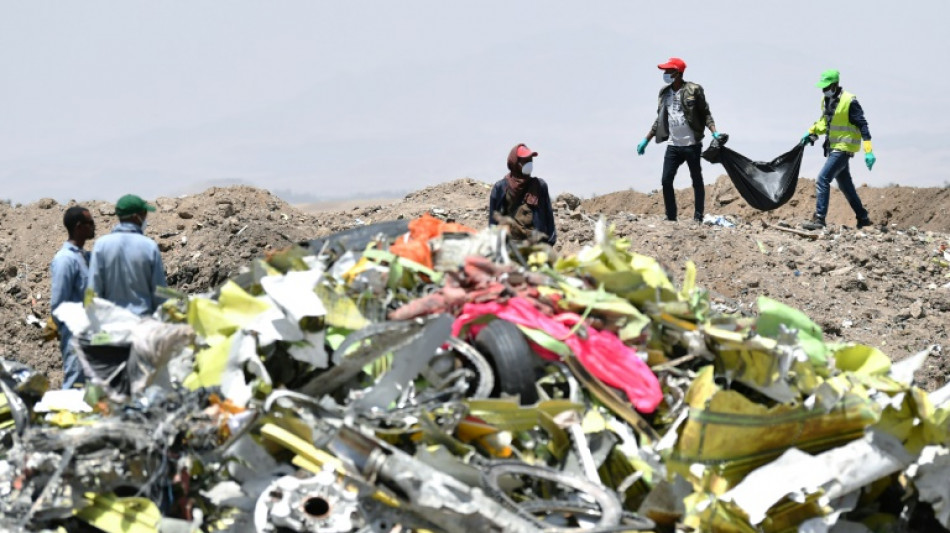
Inquiry into 2019 Ethiopian Air crash confirms software failure / Photo: TONY KARUMBA - AFP

 Bishop Museum Races to Save Rare Megamouth Shark Specimen

 Zach Hickerson Recounts Hayden Panettiere's Final Moments in New Interview

 Luxembourg Housing Petition Passes Threshold for Parliamentary Consideration

 Raheem Sterling Receives Suspended Sentence After Lamborghini Crash

 Audience to Choose the Set List at Luxembourg's First FAMIL Jukebox Night

 Luxembourg Pay Rise Delayed as Regional and World Headlines Develop

 Chennai Urbanist Sashna Develops 'Anniki' Card Game to Gamify Tamil Nadu History

 Transport Minister Defends Land Seizure Powers for Toronto-Quebec City High-Speed Rail

A 2019 Ethiopian Airlines plane crash which killed 157 people was caused by a flight software failure as suspected, the country's transport minister said Friday citing the investigators' final report.
The crash of the Nairobi-bound Boeing 737 MAX six minutes after take-off from Addis Ababa on March 10, 2019, which killed all passengers and crew aboard, triggered the global grounding of the MAX and the worst crisis in Boeing's history.
It came just months after the October 2018 crash of a 737 MAX operated by Lion Air in Indonesia, which killed 189 people when it crashed moments after leaving Jakarta airport.
Both accidents saw uncontrolled drops in the aircraft's nose in the moments before the planes crashed, which investigators have blamed on the model's anti-stall flight system, the Maneuvering Characteristics Augmentation System, or MCAS.
The Ethiopian investigators had already pointed out in a March 2020 progress report that the design of the MCAS system "made it vulnerable to undesirable activation".
"The airplane's left angle of attack (AOA) sensor failed immediately after take-off, sending faulty data to the flight control system," Transport Minister Dagmawit Moges told reporters.
"The erroneous data entered triggered Maneuvering Characteristics Augmentation System (MCAS), which repeatedly pitched the nose of the airplane down to the point and the pilot lost control."
The final report will be published in the coming days, the minister said, adding that it "is in line with the preliminary report".
After the twin crashes, the delivery and production of the 737 MAX was suspended and all existing aircraft were grounded for 20 months, before being gradually allowed to fly again from late 2020 after Boeing made the necessary corrections.
In January 2021, Boeing agreed to pay $2.5 billion to settle a US criminal charge over claims the company defrauded regulators overseeing the 737 MAX.
In September, US securities officials fined Boeing $200 million over the aviation giant's misleading assurances about the safety of the 737 MAX airplane following the two deadly crashes.
M.O.Allen--AT

