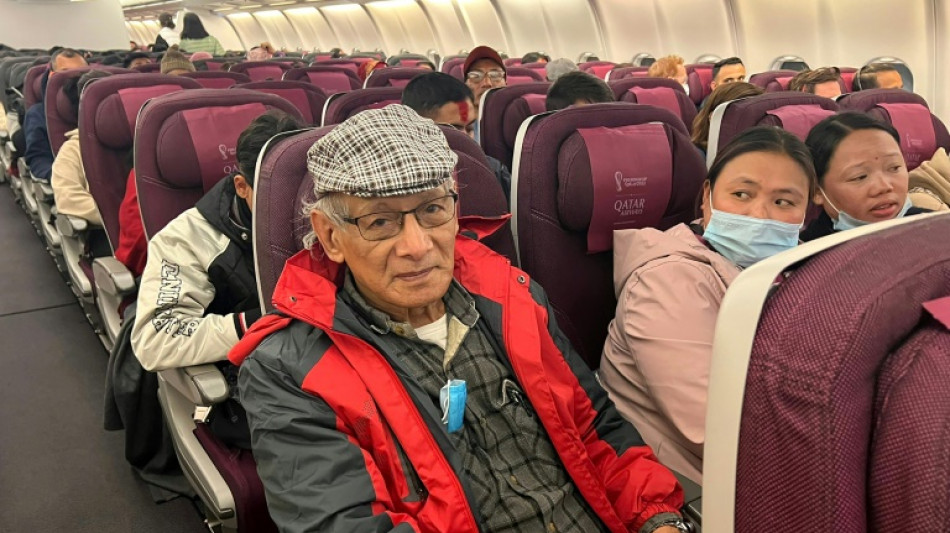
Serial killer Charles Sobhraj tells AFP 'I am innocent' / Photo: Atish PATEL - AFP

 Bishop Museum Races to Save Rare Megamouth Shark Specimen

 Zach Hickerson Recounts Hayden Panettiere's Final Moments in New Interview

 Luxembourg Housing Petition Passes Threshold for Parliamentary Consideration

 Raheem Sterling Receives Suspended Sentence After Lamborghini Crash

 Audience to Choose the Set List at Luxembourg's First FAMIL Jukebox Night

 Luxembourg Pay Rise Delayed as Regional and World Headlines Develop

 Chennai Urbanist Sashna Develops 'Anniki' Card Game to Gamify Tamil Nadu History

 Transport Minister Defends Land Seizure Powers for Toronto-Quebec City High-Speed Rail

Charles Sobhraj told AFP in an exclusive interview on Friday that he was no serial killer and that he was innocent of the two murders that he served almost 20 years for in Nepal.
Talking onboard a Qatar Airways plane on the tarmac at Kathmandu airport at the start of his deportation, the French national appeared relaxed in a tartan flat cap.
"I feel great... I have a lot to do. I have to sue a lot of people. Including the state of Nepal," Sobhraj, 78, said among bemused fellow passengers on the flight to Doha where he will change planes to Paris.
Sobhraj, who was portrayed in the Netflix/BBC series "The Serpent", has been linked to more than 20 murders across Asia in the 1970s.
Born in what was then Saigon to an Indian father and a Vietnamese mother who later married a Frenchman, he embarked on an international life of crime and ended up in Thailand in 1975.
Posing as a gem trader, he would befriend his victims, many of them Western backpackers on the hippie trail, before drugging, robbing and murdering them.
Under a cloud of suspicion, he flew to India where he was convicted of murdering Israeli tourist Alan Jacob in 1976.
He was later acquitted but remained in prison for other crimes and -- following a brief escape -- was released in 1997 and moved to France and lived as a free man.
While in Nepal in 2003 he was spotted by a journalist and eventually convicted of two murders committed almost 30 years earlier.
On Wednesday, after serving almost two decades for those murders, a Nepali court ordered him released on health grounds and he was freed on Friday.
Talking to AFP in heavily French-accented English while on his flight, he vehemently denied involvement in the two murders in Nepal.
"When I came in (went to prison), I didn't do anything," Sobhraj said.
"I am innocent in those cases, ok? So I don't have to feel bad for that, or good. I am innocent. It was built on fake documents."
He added: "The district judge, without calling a single witness ... and without giving notice (to) the accused to present an argument, he wrote the verdict."
"The courts in Nepal, from (the) district court to high court to supreme court, all the judges, they were biased against Charles Sobhraj."
Asked if he thought he had been wrongly described as a serial killer, he said: "Yes, yes. Oh yes."
Sobhraj was due to arrive in Paris early Saturday morning.
W.Morales--AT

