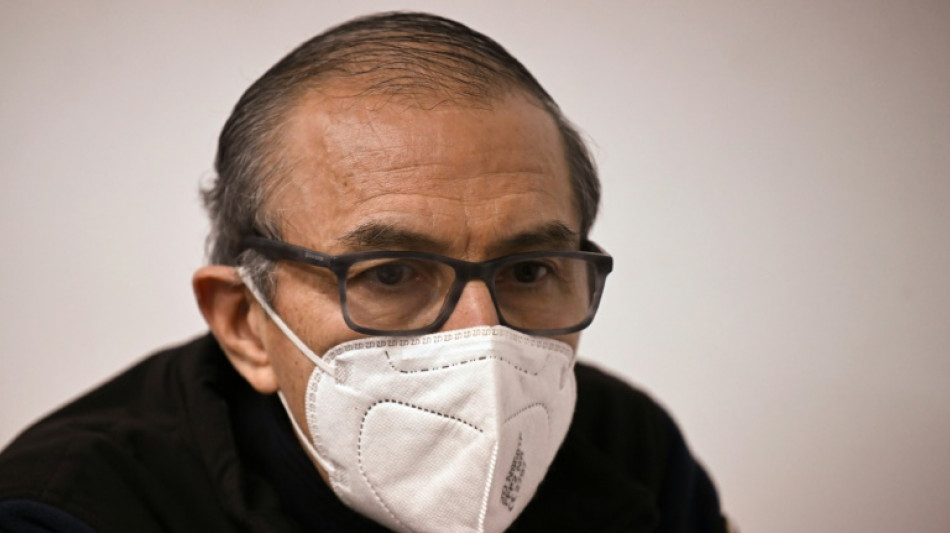
Argentine ex-policeman jailed for student's disappearance in 1976 / Photo: Luis ROBAYO - AFP

 Bishop Museum Races to Save Rare Megamouth Shark Specimen

 Zach Hickerson Recounts Hayden Panettiere's Final Moments in New Interview

 Luxembourg Housing Petition Passes Threshold for Parliamentary Consideration

 Raheem Sterling Receives Suspended Sentence After Lamborghini Crash

 Audience to Choose the Set List at Luxembourg's First FAMIL Jukebox Night

 Luxembourg Pay Rise Delayed as Regional and World Headlines Develop

 Chennai Urbanist Sashna Develops 'Anniki' Card Game to Gamify Tamil Nadu History

 Transport Minister Defends Land Seizure Powers for Toronto-Quebec City High-Speed Rail

A former Argentine police officer was sentenced to 15 years in prison Wednesday for the torture and disappearance of a student 46 years ago under the South American country's last military dictatorship.
Mario Sandoval, 69, stood accused of having participated in hundreds of abductions, torture and disappearances committed during the 1976-1983 dictatorship.
He was extradited from France in 2019 after a long period of exile and a legal battle, and put on trial for only one such case: the death of then 24-year-old architecture student and left-wing activist Hernan Abriata in 1976.
Sandoval was found guilty of "illegitimate deprivation of liberty" and "torture" of a political prisoner. He participated in the sentencing proceedings from his cell in a military prison.
Sandoval is accused of having been one of the most active agents of the notorious Navy Mechanics School (ESMA), which served as the country's largest detention and torture facility.
Some 5,000 people were sent there and most disappeared, taken by airplane on "death flights" and dumped into the River Plate. Only about 100 people detained in ESMA survived.
Survivors say Sandoval, apparently given the nickname "grilled steak" for torturing prisoners tied to a metal bed frame with electricity, was particularly active in the ESMA. He has repeatedly proclaimed his innocence.
Sandoval fled to France in 1985, two years after the military junta fell, and built a new life there as a defense and security consultant.
He taught at the Sorbonne and the Institute of Higher Latin American Studies in Paris.
He was discovered by a student at the Sorbonne after ex-ESMA prisoners recognized him from photos.
Sandoval was arrested at his home in the Paris suburbs.
Although he gained French nationality in 1997, Argentina successfully obtained Sandoval's extradition as he was not French at the time of the alleged crimes.
He had unsuccessfully petitioned France's Council of State in a bid to prevent his extradition. France agreed to his extradition to stand trial only in the Abriata case.
Since the prosecution of dictatorship figures resumed in 2006 after a decade of controversial amnesties, more than 1,000 people have been convicted of crimes against humanity.
Cases and investigations are ongoing against about another 500 people.
M.White--AT

