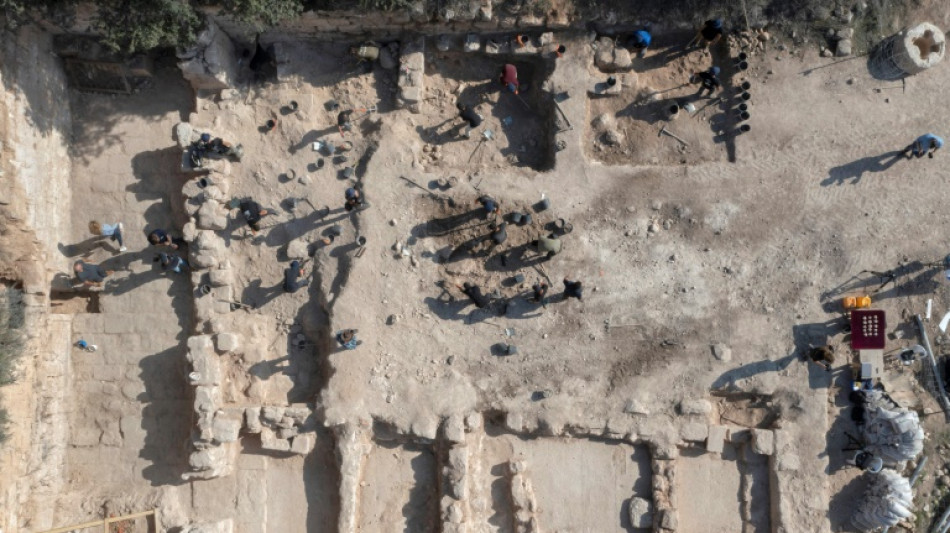
Israel unveils finds from tomb of early Christian figure / Photo: MENAHEM KAHANA - AFP

 Bishop Museum Races to Save Rare Megamouth Shark Specimen

 Zach Hickerson Recounts Hayden Panettiere's Final Moments in New Interview

 Luxembourg Housing Petition Passes Threshold for Parliamentary Consideration

 Raheem Sterling Receives Suspended Sentence After Lamborghini Crash

 Audience to Choose the Set List at Luxembourg's First FAMIL Jukebox Night

 Luxembourg Pay Rise Delayed as Regional and World Headlines Develop

 Chennai Urbanist Sashna Develops 'Anniki' Card Game to Gamify Tamil Nadu History

 Transport Minister Defends Land Seizure Powers for Toronto-Quebec City High-Speed Rail

Israel on Tuesday unveiled pilgrims' lamps and other finds from the so-called Tomb of Salome, a burial site named for a woman said to have assisted at the birth of Christ.
The tomb was discovered by grave robbers in what is now Lachish national park, west of Jerusalem, in the 1980s.
Subsequent excavations by archaeologists have uncovered a Jewish burial chamber dating back to the Roman period, that was taken over by a Christian chapel in the Byzantine era and was still drawing worshippers into the early Islamic period.
An inscription found on the walls of the grotto led the excavation team to conclude it was dedicated to Salome, a figure associated with the birth of Jesus Christ in eastern Orthodox tradition.
"In the cave we found tonnes of inscriptions in ancient Greek and Syriac," said excavation director Zvi Firer.
"One of the beautiful inscriptions is the name Salome... because of this inscription we understand this is the cave of holy Salome."
Salome's role as an assistant to the midwife at Christ's birth is recounted in the Gospel of St James, a text dropped from the versions of the New Testament used by most Western churches.
"The cult of Salome... belongs to a broader phenomenon, whereby the fifth century Christian pilgrims encountered and sanctified Jewish sites," the excavation team said.
Outside the grotto, the team found the remains of a colonnaded forecourt spanning 350 square metres (3,750 square feet), suggesting Salome was then a revered figure.
Shops selling clay lamps and other items intended for pilgrims were found around the courtyard, dating from as late as the ninth century, 200 years after the Muslim conquest.
"It is interesting that some of the inscriptions were inscribed in Arabic, whilst the Christian believers continued to pray at the site," the team said.
F.Ramirez--AT

