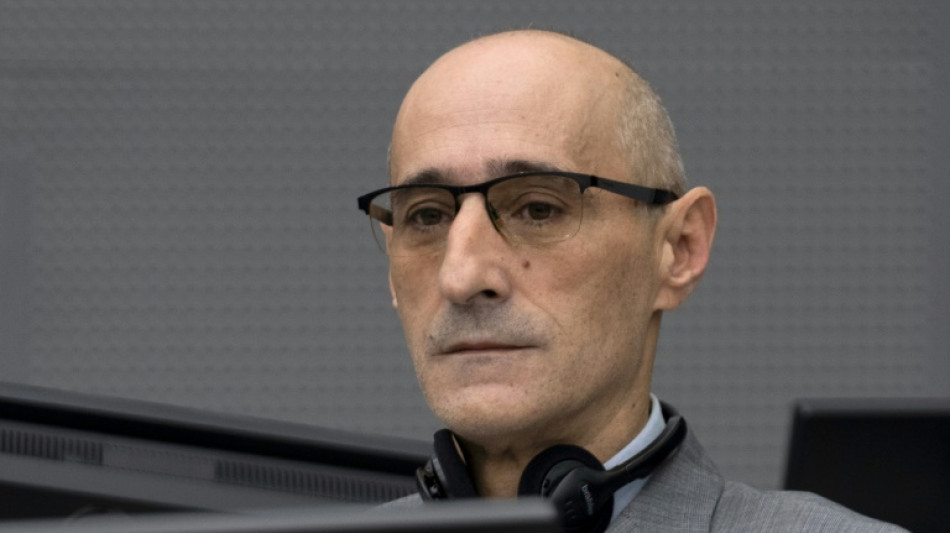
Kosovo court jails rebel commander for 26 years / Photo: Peter Dejong - ANP/AFP

 Bishop Museum Races to Save Rare Megamouth Shark Specimen

 Zach Hickerson Recounts Hayden Panettiere's Final Moments in New Interview

 Luxembourg Housing Petition Passes Threshold for Parliamentary Consideration

 Raheem Sterling Receives Suspended Sentence After Lamborghini Crash

 Audience to Choose the Set List at Luxembourg's First FAMIL Jukebox Night

 Luxembourg Pay Rise Delayed as Regional and World Headlines Develop

 Chennai Urbanist Sashna Develops 'Anniki' Card Game to Gamify Tamil Nadu History

 Transport Minister Defends Land Seizure Powers for Toronto-Quebec City High-Speed Rail

A special Kosovo court in The Hague found a former rebel commander guilty on Friday of murder and torture and jailed him for 26 years in its long-awaited first war crimes verdict.
Salih Mustafa, 50, was found guilty of abusing prisoners in a makeshift jail in a barn run by the ethnic Albanian Kosovo Liberation Army (KLA) in the 1998-1999 independence war with Serbia.
The verdict comes at a sensitive time for Kosovo, where ethnic tensions have flared again nearly a quarter-century after the war, with attackers exchanging gunfire with police at the weekend.
"The panel sentences you to a single sentence of 26 years of imprisonment," Judge Mappie Veldt-Foglia told Mustafa, who stood for the verdict and remained impassive.
Judges found that Mustafa led a guerilla group that kept at least six fellow ethnic Kosovo Albanians accused of collaborating with Serbs in a barn that was full of animal excrement.
Prisoners were beaten with baseball bats, iron batons, electrocuted, burned and denied food and water in the compound in Zllash, a village east of the capital Pristina.
Mustafa personally took part in beating two detainees.
One of the victims died, either as a result of being denied medical attention or left for advancing Serb troops to shoot dead, judges found.
He was found guilty of the war crimes of arbitrary detention, torture and murder. He was acquitted of a charge of cruel treatment because the same ground was covered by the torture charge, judges said.
"It constitutes the first war crimes judgment of this tribunal," Veldt-Foglia said at the heavily secured court.
The court operates under Kosovo law but is based in the Netherlands and funded by the EU to shield witnesses from intimidation, given that former KLA commanders still dominate political life in Kosovo.
Mustafa, who was arrested in 2020 while working as an adviser at Kosovo's defence ministry, denounced the "Gestapo" court when his trial opened last year.
- Kosovo tensions -
The trial has heard from 29 witnesses during 52 actual days in court, said the tribunal, which is formally known as the Kosovo Specialist Chambers.
It is the court's first judgement dealing specifically with war crimes charges since it was set up in 2015.
Last year it jailed two KLA veterans for intimidating witnesses, although they were not charged with war crimes.
Kosovo reluctantly passed a law to allow the creation of the court after a 2010 Council of Europe report alleged atrocities by KLA forces.
These had gone unpunished even as a number of Serbians have been convicted by other courts over the wars that ripped apart Yugoslavia in the 1990s.
The court has issued war crimes charges against several senior members of the KLA including former Kosovo president Hashim Thaci, who resigned after being indicted and is still regarded as a hero at home.
The Kosovo court in November lost its chief prosecutor, Jack Smith, after he was tapped to lead a US probe into highly sensitive investigations of Donald Trump.
The Kosovo war, which left 13,000 people dead, ended when Serbian president Slobodan Milosevic's forces withdrew after an 11-week NATO bombing campaign.
Although Kosovo declared independence from Serbia in 2008, Belgrade does not recognise it and encourages the Serb majority in northern Kosovo to defy Pristina's authority.
Tensions have rocketed in recent months in the north over Kosovo's decision to replace Belgrade-issued car licence plates with ones issued in Pristina.
K.Hill--AT

