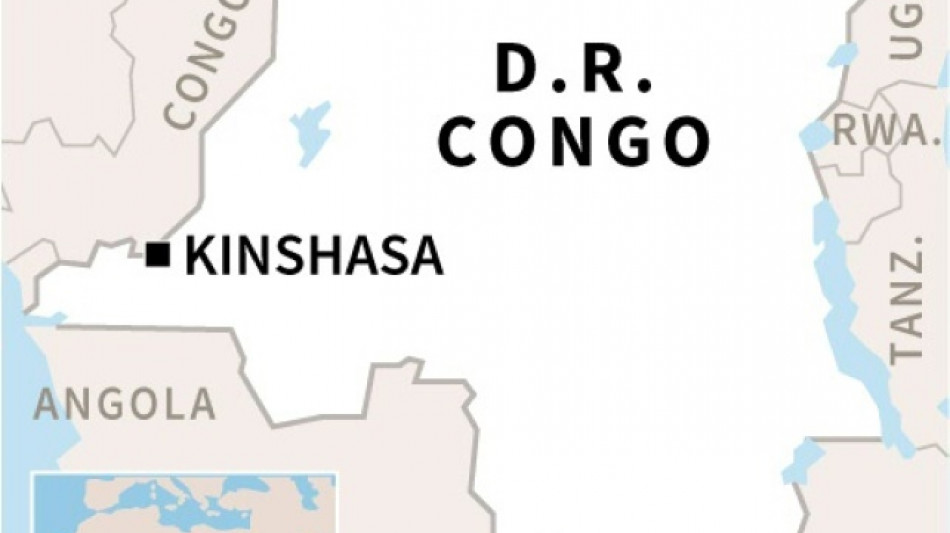
Flooding kills more than 120 in DR Congo capital / Photo: © AFP

 Bishop Museum Races to Save Rare Megamouth Shark Specimen

 Zach Hickerson Recounts Hayden Panettiere's Final Moments in New Interview

 Luxembourg Housing Petition Passes Threshold for Parliamentary Consideration

 Raheem Sterling Receives Suspended Sentence After Lamborghini Crash

 Audience to Choose the Set List at Luxembourg's First FAMIL Jukebox Night

 Luxembourg Pay Rise Delayed as Regional and World Headlines Develop

 Chennai Urbanist Sashna Develops 'Anniki' Card Game to Gamify Tamil Nadu History

 Transport Minister Defends Land Seizure Powers for Toronto-Quebec City High-Speed Rail

More than 120 people were killed Tuesday as the worst floods in years battered DR Congo's capital Kinshasa following an all-night downpour, authorities said in a provisional assessment.
Major roads in the centre of Kinshasa, a city of some 15 million people, were submerged for hours, and a key supply route was cut off.
The death toll -- which was first estimated in the late afternoon to be at least 55 -- jumped to more than 120 by nightfall.
The government has announced three days of national mourning beginning Wednesday, according to a statement from Prime Minister Jean-Michel Sama Lukonde's office.
City police chief General Sylvano Kasongo told AFP that the bulk of people dead were on hillside locations where there had been landslides.
An AFP reporter saw the bodies of nine members of the same family -- including young children -- who had died after the collapse of their home in the Binza Delvaux district.
"We were woken up at around 4:00 am (0300 GMT) by water entering the house," a relative said.
"We drained the water out, and thinking that there was no more danger we went back indoors to sleep -- we were soaked," he said.
The family went back to bed and "just afterwards, the wall collapsed".
Located on the Congo River, Kinshasa has seen a huge population influx in recent years.
Many dwellings are shanty houses built on flood-prone slopes, and the city suffers from inadequate drainage and sewerage.
A major landslide occurred in the hilly district of Mont-Ngafula, smothering National Highway 1, a key supply route linking the capital with Matadi, a port further down the Congo River and a crucial outlet to the Atlantic Ocean.
Lukonde told reporters at the scene that about 20 people there had died when "homes were swept away".
Searches are continuing for survivors, he said.
The highway should be reopened to small vehicles within the next day, but it could take "three or four days" for trucks, the prime minister said.
The streets of the up-market Gombe district -- home to government buildings and usually spared the problems affecting other areas of Kinshasa such as inadequate waste disposal and power supplies -- were also inundated.
- 'Disaster' -
In November 2019, around 40 people in Kinshasa died in floods and landslides.
Mont-Ngafula was one of the worst-hit areas, but a local resident said the flooding this time was even worse.
"We've never seen a flood here on this scale," said Blanchard Mvubu, who lives in the Mont-Ngafula neighbourhood of CPA Mushie.
"I was asleep and I could feel water in the house... it's a disaster -- we've lost all our possessions in the house, nothing could be saved."
He added: "People are building big houses and that blocks up the drains. The water can't move freely and that's what causes the floods."
Another man, who gave his name as Freddy, said everything in his home was underwater,
"Shoes, food stocks, clothes -- everything is lost, there's nothing to be saved," he said.
Close by, a young man was asking for 500 Congolese francs (24 US cents) from passers-by to carry them on his back across the submerged street.
Another man, who identified himself as a teacher, was walking barefoot in the water, holding a pair of shoes in one hand and a plastic bag containing documents in the other.
"I've got no other choice," he said. "I have to give schoolchildren an exam."
Landslides are common in Mont-Ngafula, often triggered by heavy rainfall and rampant urban development.
W.Stewart--AT

