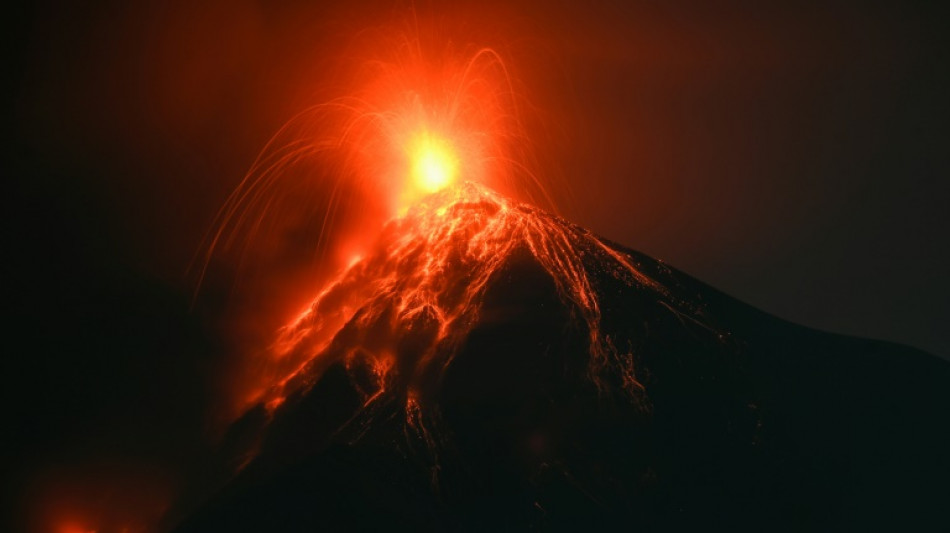
Guatemala volcano eruption eases after forcing airport closure / Photo: Johan ORDONEZ - AFP

 Bishop Museum Races to Save Rare Megamouth Shark Specimen

 Zach Hickerson Recounts Hayden Panettiere's Final Moments in New Interview

 Luxembourg Housing Petition Passes Threshold for Parliamentary Consideration

 Raheem Sterling Receives Suspended Sentence After Lamborghini Crash

 Audience to Choose the Set List at Luxembourg's First FAMIL Jukebox Night

 Luxembourg Pay Rise Delayed as Regional and World Headlines Develop

 Chennai Urbanist Sashna Develops 'Anniki' Card Game to Gamify Tamil Nadu History

 Transport Minister Defends Land Seizure Powers for Toronto-Quebec City High-Speed Rail

One of the most active volcanoes in Central America erupted over the weekend, spewing lava and ash and forcing Guatemalan authorities to briefly close the country's largest airport before activity eased on Sunday.
The volcano named Fuego -- Spanish for fire -- rumbled into activity overnight Saturday into Sunday, with molten rock oozing down its slopes and ash belching two kilometers (more than a mile) into the sky. Winds carried the ash toward Guatemala City, 35 kilometers (22 miles) away.
La Aurora international airport, six kilometers south of the capital, was temporarily closed at mid-morning, the General Directorate of Civil Aeronautics said in a statement, citing the presence of ash near the runway.
At least two incoming flights had to be diverted, aviation sources said, before it reopened around midday local time after winds changed direction and sent ash away from the facility.
In addition, a road that connects southern and central Guatemala was closed as a precaution, said Carlos Aquino, a spokesman for the highway police. It reopened Sunday afternoon as the volcano's activity subsided.
The volcano sits about 16 kilometers from Antigua, the country's picturesque former capital and biggest tourist attraction.
Fuego erupts every four to five years on average. In 2018, an eruption sent rivers of lava pouring down its sides, devastating the village of San Miguel Los Lotes, killing 215 people and leaving a similar number missing.
Authorities said they were monitoring the latest eruption closely, but that no one had been evacuated.
"With what happened in 2018, now the authorities are already more alert and more active," said Jose Sul, a resident of Alotenango, which lies at the eastern base of Fuego.
Locals saw a sudden expulsion of lava on Saturday night that reddened the sky. "People here are used to experiencing this, and they look at it as normal," Demetrio Pamal, a 28-year-old Indigenous Mayan farmer, told AFP.
Many local families have a backpack ready with food, water, a flashlight and medicine so they can evacuate for up to three days at the drop of a hat.
Sunday afternoon, the Guatemalan volcanological institute said that "activity has decreased; there are no longer pyroclastic flows or the emission of lava or eruptive columns loaded with ash."
"After several hours of relative calm, this eruptive activity can be considered over," said Roberto Merida, a technician at the volcanological institute.
Guatemala has two other active volcanoes -- Santiaguito in the west of the country and Pacaya in the south.
Fuego also adjoins the inactive Acatenango volcano -- at 3,500 meters.
Unlike South America's Andean volcanoes, Guatemala's are not snow-capped because of Central America's warmer climate.
Central America has more than 100 volcanoes, many of which are wildly popular tourist attractions, even though they occasionally cause death and destruction.
A.Clark--AT

