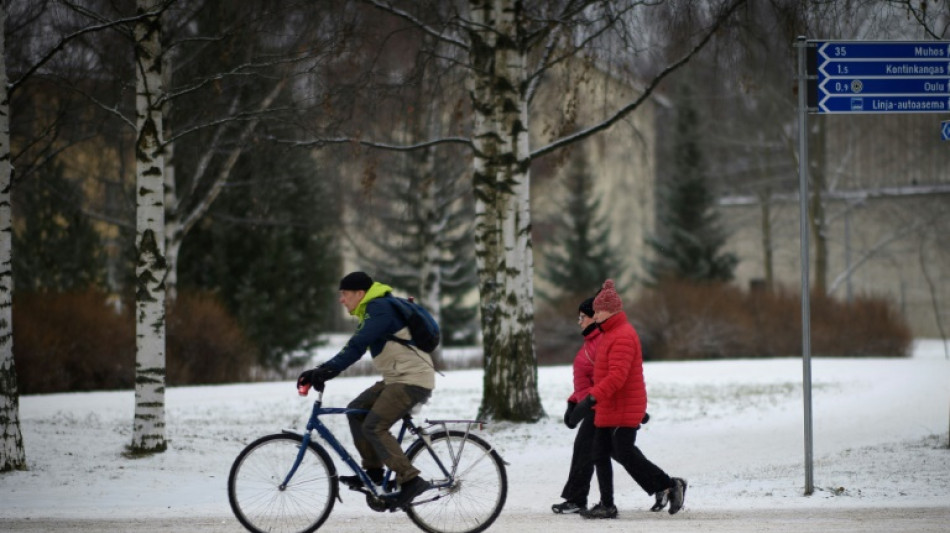
Snow problem! The icy city where nothing stops cyclists / Photo: Olivier MORIN - AFP

 Bishop Museum Races to Save Rare Megamouth Shark Specimen

 Zach Hickerson Recounts Hayden Panettiere's Final Moments in New Interview

 Luxembourg Housing Petition Passes Threshold for Parliamentary Consideration

 Raheem Sterling Receives Suspended Sentence After Lamborghini Crash

 Audience to Choose the Set List at Luxembourg's First FAMIL Jukebox Night

 Luxembourg Pay Rise Delayed as Regional and World Headlines Develop

 Chennai Urbanist Sashna Develops 'Anniki' Card Game to Gamify Tamil Nadu History

 Transport Minister Defends Land Seizure Powers for Toronto-Quebec City High-Speed Rail

Winter temperatures that drop to minus 25 degrees Celsius do not stop cyclists in the Finnish city of Oulu.
The city which calls itself the "capital of winter cycling" has become a pin-up of sustainable transport, with most children still biking to school at minus 20 degrees Celsius (minus 4 degrees Fahrenheit).
"I cycle all year around. I don't even own a car," Ari Karjalainen told AFP as he returned home after shopping for groceries.
Despite the snow, bike racks are jam-packed in downtown Oulu, with bundled-up locals leaving vapour trails in their wake as they cycle around the city in the icy air.
"Just put on enough clothes," quipped 22-year-old Mimmi Kahkonen when asked how she manages to cycle in the frosty weather.
For many locals, even the term "winter cycling" sounds odd, as biking all year round is so common despite the city being only a little more than 100 miles (160 kilometres) south of the Arctic Circle.
Many cyclists use wider winter tyres with better grip, sometimes with steel spikes, but some people bike with the same tyres year-round.
"We are so used to the winter that we don't consider it much of a challenge," Harri Vaarala, one of the city's traffic engineers, told AFP.
While the seaside city averages five months of snow and below-zero temperatures, a fifth of all journeys within Oulu are done by bike.
Part of what makes this possible is the priority its main bike lanes get over roads for snow ploughs, said Vaarala.
- Bike 'highways' -
That means that 1,000 of the 1,200 pupils at Metsokangas school bike to school throughout the winter.
In recent years, the city has opened multiple new "cycling highways", six-metre-wide roads paved in red asphalt, adding to the nearly 1,000 kilometres of existing bike lanes.
According to Vaarala, the city has made "a clear value-based decision" to support cycling, at times prioritising cyclists over motorists.
"In some cases, we have moved motorways to fit in a good quality bike lane," he said.
When the city sought out contractors for its winter maintenance, one of the conditions was that the snow plough drivers as well as their supervisors had to cycle the routes they maintain.
"This gives them a first-hand understanding of how different conditions affect cycling," Vaarala said.
The city also employs a number of "cycling agents" that report weekly on how well the bike lanes are maintained, which directly affects the contractors' bonuses.
To combat snow covering traffic signs, Oulu is also experimenting with new technological solutions to make winter cycling safer.
In some locations along bike lanes, traffic signs are illuminated on top of the snow using projectors.
F.Ramirez--AT

