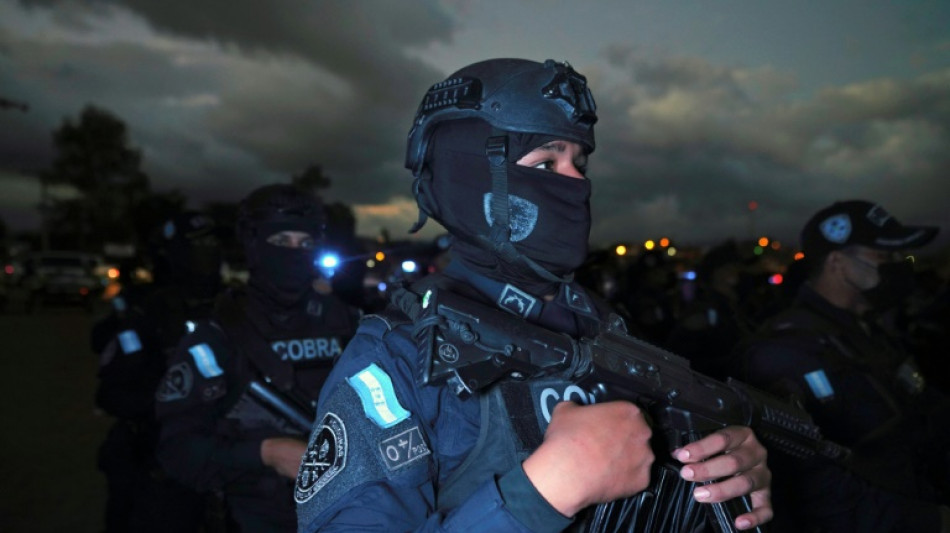
Honduras suspends rights to fight gangs / Photo: Johny Magallanes - AFP

 Bishop Museum Races to Save Rare Megamouth Shark Specimen

 Zach Hickerson Recounts Hayden Panettiere's Final Moments in New Interview

 Luxembourg Housing Petition Passes Threshold for Parliamentary Consideration

 Raheem Sterling Receives Suspended Sentence After Lamborghini Crash

 Audience to Choose the Set List at Luxembourg's First FAMIL Jukebox Night

 Luxembourg Pay Rise Delayed as Regional and World Headlines Develop

 Chennai Urbanist Sashna Develops 'Anniki' Card Game to Gamify Tamil Nadu History

 Transport Minister Defends Land Seizure Powers for Toronto-Quebec City High-Speed Rail

Honduran police on Tuesday moved en masse into poor urban areas to tackle criminal gangs "head on" after a decree by President Xiomara Castro to temporarily suspend certain rights.
The 30-day lifting of constitutional guarantees that began Tuesday allows police to make arrests without warrants in 89 districts of Tegucigalpa, the capital, and 73 districts of San Pedro Sula, the industrial capital.
President Castro, a leftist, declared last week the lifting of the constitutional rights due to what she called a "national emergency" over gang violence.
"We are going to go head on against organized crime," national police director Gustavo Sanchez told some 600 security agents at a dusty soccer pitch in Aleman, a residential district south of the capital.
The crackdown, he said at a news conference, "is to deal with the criminal structures known as Gang 18 and MS-13," a reference to the two largest transnational street gangs in Honduras.
Public pressure has built on Castro to follow in the footsteps of El Salvador, where President Nayib Bukele has brought down gang violence by rounding up thousands of young people on suspicion of gang activity.
The decree that Castro enacted on the so-called state of exception said in part: "By virtue of the serious disturbance of peace and security prevailing in the main cities of the country caused essentially by organized criminal groups... it is resolved: to suspend the guarantees established in the constitution."
Drug trafficking groups and gang members are largely responsible for a soaring rate of homicides. At 40 murders per 100,000 inhabitants, the rate in Honduras is four times higher than the world average.
M.O.Allen--AT

