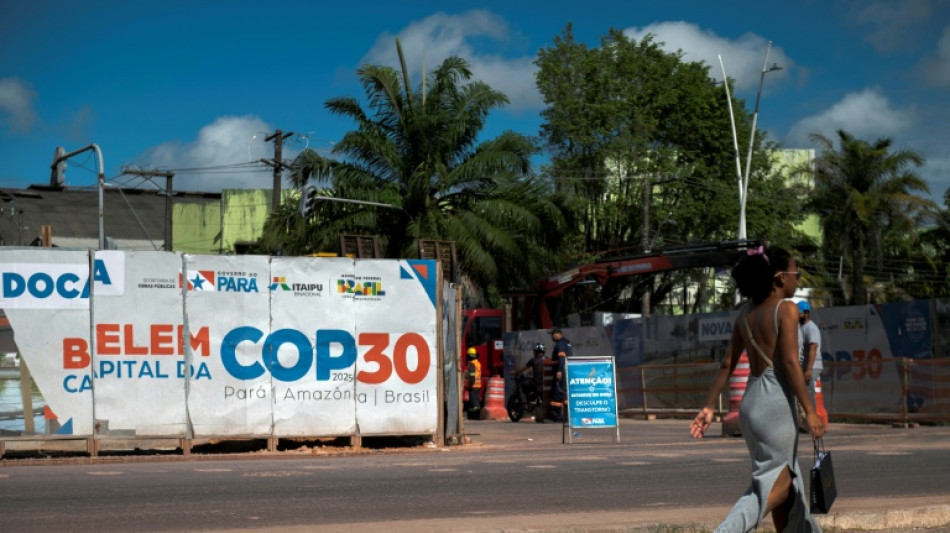
Trees, targets and trillions: what's on the agenda at COP30? / Photo: Carlos Fabal - AFP

 NBA close to picking new $12-13bn Vegas team owners: report
 LA28 Olympics torch relay to visit all 50 states
 Spain brush aside Croatia in Nations League, England down Czechs
 Trump hails 'morally binding' AI self-regulation pledge
 Yamal inspires Spain to Croatia romp on World Cup homecoming

 UN to hold fourth informal poll of secretary-general candidates
 Who are the Emiratis behind crisis-hit Manchester City?

 Singer Angelique Kidjo urges Africans to 'create together'

 Alleged Rihanna mansion shooter mentally fit for trial, says judge
 Mystery over UK airbase scare as police find petrol not explosives

 OpenAI unveils low-cost AI model, a day after shelving Astra upgrade
 Premier League confirms Man City guilty of serious financial breaches
 Brazil's Lula turns to Bad Bunny tune to criticise Trump ahead of polls
 Nigerian dancer eyes world record after seven-day marathon
 Swiss regulator concludes Julius Baer bank probe
 Brazil's patron saint pulled into latest election scrap

 Football overload leaves players near 'breaking point', warns Tebas
 Paris Eiffel Tower says chief to step down after uproar over removing women staff

 Amaze Holdings (NYSE: AMZE) Executes Binding LOI to Acquire BullionFX | Alchemy, a Decentralized Gold-Backed Financial Ecosystem for Valued at US$155 Million

 Clashes between French teens, police as school blockades intensify
 Stocks move sideways despite oil moving lower
 African leaders to gather in Egypt for business summit
 UK decides against charging foreign visitors for museums

 Dallaglio to sell England World Cup winners' medal

 Brazil come from behind to beat Australia 4-2 in friendly

This year's United Nations climate summit promises to be symbolic, marking a decade since the Paris Agreement and taking place in the environmentally vulnerable Amazon. But what is actually on the agenda?
The marathon negotiations gather nearly every country to confront a challenge that affects them all, but unlike recent editions, this "COP" has no single theme or objective.
That does not mean big polluters will get off easy, with climate-vulnerable nations frustrated at their level of ambition and financial assistance to those most impacted by a warming planet.
Here are the big issues to look for when the two-week COP30 conference starts on November 10 in the Brazilian city of Belem:
- Emissions -
The world is not cutting emissions fast enough to meet the goals of the Paris Agreement, and no amount of pomp and pageantry at COP30 will be able to sugarcoat that uncomfortable reality.
Under the climate accord, signatory nations are required every five years to submit stronger targets for cutting greenhouse gas emissions, thereby steadily raising the collective effort to reduce global warming over time.
The latest round of pledges for 2035 were due in February to give the UN time before COP30 to assess the quality of these commitments.
Most nations missed that deadline, but by early October, about 60 had turned in their revised plans. Few have impressed, and China's target in particular fell well below expectations.
The European Union, riven by infighting, cannot agree on its target, while India is another major emitter yet to finalise its pledge.
A reckoning could be coming in Belem. Brazil -- which described the latest round of pledges as "the vision of our shared future" -- is facing pressure to marshall a response.
- Money -
Money -- specifically, how much rich countries give poorer ones to adapt to climate change and shift to a low-carbon future -- is a likely point of conflict in Belem, as in past COPs.
Last year, after a fortnight of acrimonious haggling, COP29 ended unhappily with developed nations agreeing to provide $300 billion a year in climate finance to developing ones by 2035, well below what is needed.
They also set a much less specific target of helping raise $1.3 trillion annually by 2035 from public and private sources. Developing nations will be demanding some actual detail about this at COP30.
Adaptation finance -- for example, to build coastal defences to protect against rising seas -- is on the formal agenda, with a new fundraising target possibly up for negotiation as an old commitment expires.
- Forests -
Brazil chose to host COP30 in Belem because of its proximity to the Amazon, an ideal stage to draw the world's attention to the vital role of the rainforest in fighting climate change.
At COP30, the hosts will launch a new, innovative global fund that proposes rewarding countries with high tropical forest cover that keep trees standing instead of chopping them down.
The Tropical Forests Forever Fund (TFFF) aims to raise up to $25 billion from donor countries and another $100 billion from the private sector, which is invested on financial markets. Brazil has already kicked in $1 billion.
Clement Helary from Greenpeace told AFP the TFFF "could be a step forward in protecting tropical forests" if accompanied by clearer steps at COP30 toward ending deforestation by 2030.
The destruction of tropical primary forest hit a record high in 2024, according to Global Forest Watch, a deforestation monitor. The equivalent of 18 football fields per minute was lost, driven mostly by massive fires.
D.Johnson--AT