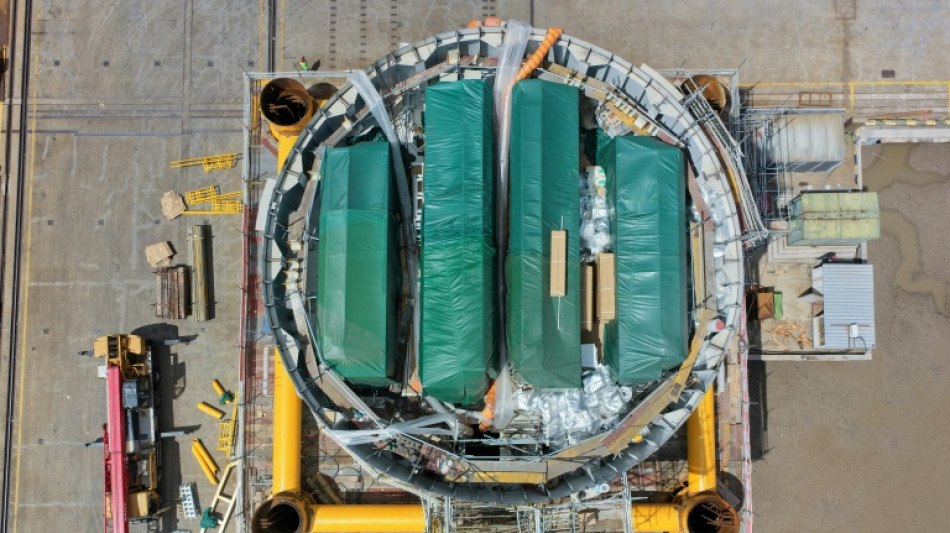
China trials 'energy-saving' underwater data centres / Photo: STR - AFP

 NBA close to picking new $12-13bn Vegas team owners: report

 LA28 Olympics torch relay to visit all 50 states

 Spain brush aside Croatia in Nations League, England down Czechs

 Trump hails 'morally binding' AI self-regulation pledge

 Yamal inspires Spain to Croatia romp on World Cup homecoming

 UN to hold fourth informal poll of secretary-general candidates

 Who are the Emiratis behind crisis-hit Manchester City?

 Singer Angelique Kidjo urges Africans to 'create together'

 Alleged Rihanna mansion shooter mentally fit for trial, says judge
 Mystery over UK airbase scare as police find petrol not explosives

 OpenAI unveils low-cost AI model, a day after shelving Astra upgrade

 Premier League confirms Man City guilty of serious financial breaches

 Brazil's Lula turns to Bad Bunny tune to criticise Trump ahead of polls

 Nigerian dancer eyes world record after seven-day marathon

 Swiss regulator concludes Julius Baer bank probe

 Brazil's patron saint pulled into latest election scrap

 Football overload leaves players near 'breaking point', warns Tebas

 Paris Eiffel Tower says chief to step down after uproar over removing women staff

 Amaze Holdings (NYSE: AMZE) Executes Binding LOI to Acquire BullionFX | Alchemy, a Decentralized Gold-Backed Financial Ecosystem for Valued at US$155 Million

 Clashes between French teens, police as school blockades intensify

 Stocks move sideways despite oil moving lower
 African leaders to gather in Egypt for business summit

 UK decides against charging foreign visitors for museums

 Dallaglio to sell England World Cup winners' medal

 Brazil come from behind to beat Australia 4-2 in friendly

Power-hungry data centres run hot, so one Chinese company is planning to submerge a pod of servers in the sea off Shanghai with hopes of solving computing's energy woes.
On a wharf near the city, workers were finishing off the large yellow capsule -- a foray into alternative tech infrastructure that faces questions over its ecological impact and commercial viability.
The world's websites and apps rely on physical data centres to store information, with growing use of artificial intelligence contributing to skyrocketing demand for the facilities.
"Underwater operations have inherent advantages," said Yang Ye of maritime equipment firm Highlander, which is developing the Shanghai pod with state-owned construction companies.
Undersea servers are kept at a low temperature by ocean currents, rather than the energy-intensive air cooling or water evaporation required by centres on land.
The technology was trialled by Microsoft off the coast of Scotland in 2018, but the Chinese project, to be sunk in mid-October, is one of the world's first commercial services of its kind.
It will serve clients such as China Telecom and a state-owned AI computing company, and is part of a broader government push to lower data centres' carbon footprint.
"Underwater facilities can save approximately 90 percent of energy consumption for cooling," Yang, vice president of Highlander, told AFP.
Projects like this are currently focused on showing "technological feasibility", said expert Shaolei Ren from the University of California, Riverside.
Microsoft never built commercially on its trial, saying after retrieving its pod in 2020 that the project had been successfully completed.
Significant construction challenges and environmental concerns have to be overcome before underwater data centres can be deployed on a mass scale, said Ren.
In China, government subsidies are helping -- Highlander received 40 million yuan ($5.62 million) for a similar 2022 project in Hainan province that is still running.
- Technical challenges -
"The actual completion of the underwater data centre involved greater construction challenges than initially expected," said Zhou Jun, an engineer for Highlander's Shanghai project.
Built onshore in separate components before being installed in the sea, it will draw nearly all its power from nearby offshore wind farms.
Highlander says that more than 95 percent of the energy used will come from renewable sources.
The most obvious challenge in placing the structure under the waves is keeping its contents dry and safe from corrosion by salt water.
The Chinese project addresses this by using a protective coating containing glass flakes on the steel capsule that holds the servers.
To allow maintenance crews access, an elevator will connect the main pod structure to a segment that remains above the water.
Ren from UC Riverside said laying the internet connection between an offshore data centre and the mainland was a more complex process than with traditional land servers.
Researchers at the University of Florida and the University of Electro-Communications in Japan have also found that sub-marine data centres can be vulnerable to attacks using sound waves conducted through water.
- Ecological unknowns -
Technical hurdles aside, the warming effect of underwater data centres on the surrounding water has raised questions about the impact on marine ecosystems.
Andrew Want, a marine ecologist at the University of Hull, said the heat emitted could in some cases attract certain species while driving away others.
"These are unknowns at this point -- there's not sufficient research being conducted yet," he said.
Highlander told AFP a 2020 independent assessment of the company's test project near Zhuhai, in southern China, indicated that the surrounding water stayed well below acceptable temperature thresholds.
However, Ren warned that scaling up centres would also scale up the heat given off.
He stressed that "for megawatt-scale data centres underwater, the thermal pollution problem needs to be studied more carefully".
Offshore facilities can complement standard data centres, Ren suggested.
"They're probably not going to replace existing traditional data centres, but can provide service to some niche segments."
P.Smith--AT