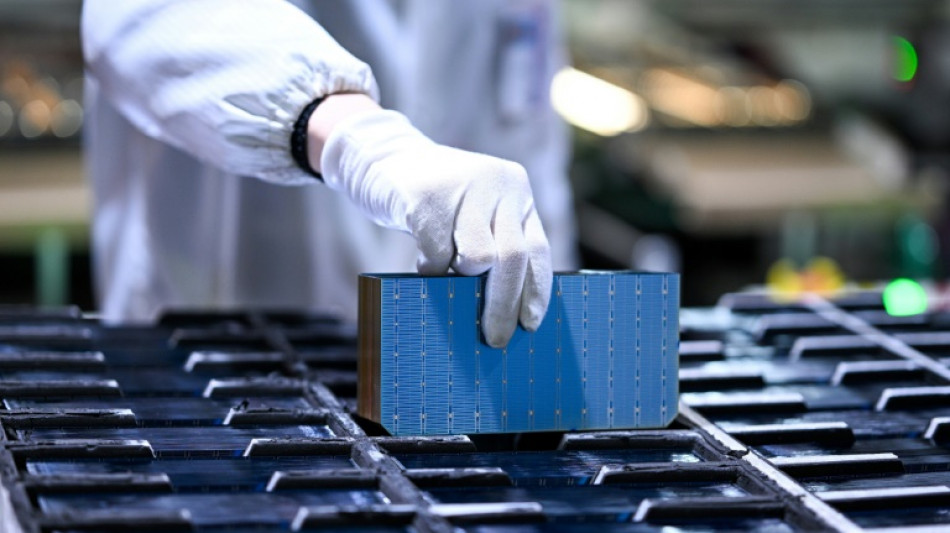
Low bar, high hopes: China unveils new climate goals / Photo: STR - AFP/File

 NBA close to picking new $12-13bn Vegas team owners: report
 LA28 Olympics torch relay to visit all 50 states

 Spain brush aside Croatia in Nations League, England down Czechs
 Trump hails 'morally binding' AI self-regulation pledge
 Yamal inspires Spain to Croatia romp on World Cup homecoming

 UN to hold fourth informal poll of secretary-general candidates

 Who are the Emiratis behind crisis-hit Manchester City?

 Singer Angelique Kidjo urges Africans to 'create together'

 Alleged Rihanna mansion shooter mentally fit for trial, says judge
 Mystery over UK airbase scare as police find petrol not explosives

 OpenAI unveils low-cost AI model, a day after shelving Astra upgrade
 Premier League confirms Man City guilty of serious financial breaches
 Brazil's Lula turns to Bad Bunny tune to criticise Trump ahead of polls

 Nigerian dancer eyes world record after seven-day marathon

 Swiss regulator concludes Julius Baer bank probe
 Brazil's patron saint pulled into latest election scrap

 Football overload leaves players near 'breaking point', warns Tebas

 Paris Eiffel Tower says chief to step down after uproar over removing women staff

 Amaze Holdings (NYSE: AMZE) Executes Binding LOI to Acquire BullionFX | Alchemy, a Decentralized Gold-Backed Financial Ecosystem for Valued at US$155 Million

 Clashes between French teens, police as school blockades intensify
 Stocks move sideways despite oil moving lower

 African leaders to gather in Egypt for business summit

 UK decides against charging foreign visitors for museums

 Dallaglio to sell England World Cup winners' medal

 Brazil come from behind to beat Australia 4-2 in friendly

China has announced its new climate action plan at a UN climate meeting -- its first ever pledge to include absolute targets for cutting planet-warming gases -- setting a goal of reducing emissions by 7–10 percent by 2035.
Here's what to know:
- Why it matters -
China is the world's second biggest economy, and since 2006, the largest polluter, now accounting for nearly 30 percent of global emissions. Paradoxically, it is also a clean energy powerhouse, rapidly shifting to renewable energy while selling the world its solar panels, batteries and electric cars.
Beijing's trajectory will be crucial to whether the world can limit end-of-century warming to 1.5C, the threshold UN scientists say is needed to avoid the most catastrophic impacts of climate disruption.
Under the Paris Agreement, countries must update their "Nationally Determined Contributions" every five years. With the year's main climate summit in Brazil fast approaching in November, expectations were running high for President Xi Jinping's announcement Wednesday at the United Nations.
China's 2021 pledge was to peak carbon dioxide emissions before 2030 and reach carbon neutrality by 2060. But it lacked near-term numerical targets, frustrating international observers.
The geopolitical context has raised the stakes: the United States has again quit the Paris accord under Donald Trump, who dismisses climate change as a "con job," while a fractious European Union has yet to set a new target.
- What it says -
Under the new plan, China pledges to:
- Cut economy-wide net greenhouse gas emissions by 7–10 percent from peak levels while "striving to do better." China's emissions are believed to have peaked in 2025. Analysts note that to align with 1.5C, Beijing would need to slash emissions by about 30 percent within a decade from 2023 levels.
For context, the United States reached its peak of CO2 emissions in 2007 and reduced them by approximately 14.7 percent a decade later.
- Raise the share of non-fossil fuels in total energy consumption to over 30 percent and expand wind and solar capacity to more than six times 2020 levels, reaching 3,600 gigawatts.
- Increase forest cover to over 24 billion cubic meters.
- Make electric vehicles the "mainstream in the sales of new vehicles."
- Expand the national carbon trading scheme to cover high-emission sectors and establish a "climate adaptive society."
- What experts think -
Observers almost universally say the targets are too modest -- but that China is likely to surpass them thanks to its booming clean technology sector.
"This 2035 target offers little assurance to keep our planet safe, but what's hopeful is that the actual decarbonization of China's economy is likely to exceed its target on paper," said Yao Zhe of Greenpeace East Asia.
Kate Logan and Li Shuo of the Asia Society highlighted the phrase "striving to do better."
"This phrasing at least sends an upward signal that Beijing is potentially open to revising its on-paper commitment based on actual progress," they wrote.
O.Gutierrez--AT