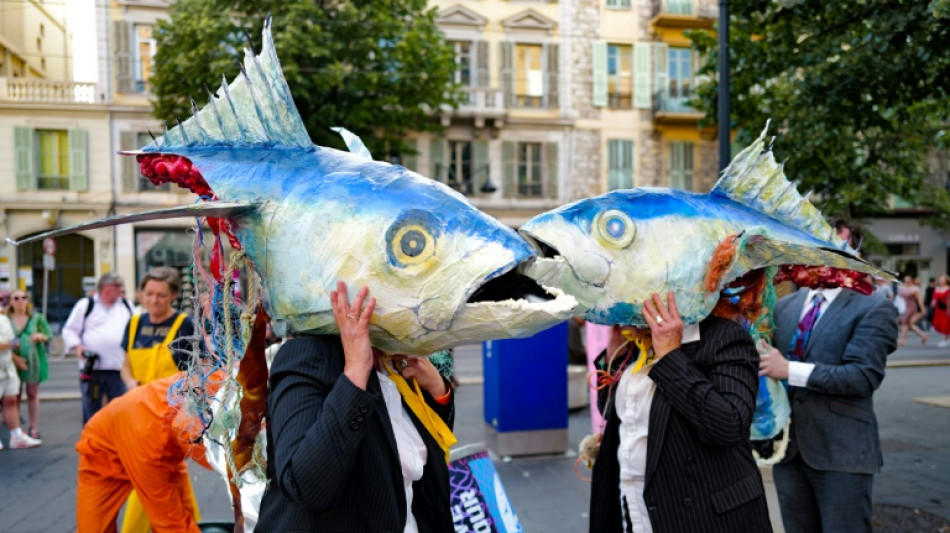
Nations advance ocean protection, vow to defend seabed / Photo: Valery HACHE - AFP

 'No limits': Marathon world record holder Sawe chasing history

 Countdown begins to biggest-ever Rugby World Cup
 Bangladesh women lose ground after quota reform

 Vietnam admits 'differing opinions' on Hanoi development

 Stocks temper gains as oil pares heavy losses, US data in focus

 New Zealand denies breaching climate commitments to EU

 Albert becomes youngest US scorer in 4-2 win over Chile

 Pirate island's plunging population shows Greece's demographic decline

 With elections ahead, Latvia's Russian-speakers reject Moscow's help

 Brazil football clubs face massive sponsorship blow from betting ban

 ChatGPT maker wants to be the App Store for AI as safety concerns grow

 Women fight fires and sexism in Indonesian Borneo

 Forsling's OT blast lifts Florida over Carolina in NHL opener

 Hurricane Polo sweeps over Mexico's Pacific coast, heads inland
 Grynspan pulls ahead in race to lead UN: diplomat

 Trump touts AI boss pledge to self-regulate

 Oil down, but stocks lower as bond yields rise

 England break down stubborn Czechs to claim first Nations League win
 UN Security Council extends Haiti anti-gang force by 6 months

 Manchester City guilty of Premier League charges: What comes next?

 Man City chief Soriano slams Premier League 'conspiracy theory'

 Hurricane Polo sweeps over Mexico's Pacific coast

 Man City must be relegated after guilty verdict says club's former chairman

 German far-right aims to lead Saxony-Anhalt govt in December

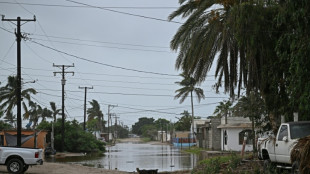 Little damage as Hurricane Polo sweeps over Mexico's Pacific coast

A global oceans summit wrapped up Friday with world leaders taking major steps toward marine protection and vowing a showdown when nations meet to negotiate rules for deep-sea mining next month.
But as a cacophony of ship foghorns sounded the close of the UN Ocean Conference in France, a lack of funding pledges and the total omission of fossil fuels disappointed some observers.
The summit was just the third -- and largest yet -- dedicated entirely to what the United Nations calls an "emergency" in the world's oceans.
More than 60 heads of state and government joined thousands of business leaders, scientists and environmental campaigners over five days in the southern city of Nice.
- Treaty tide -
There was unanimous praise for efforts to ratify the high seas treaty designed to protect marine life in the 60 percent of oceans that lie beyond national waters.
Some 19 countries formally ratified the pact at Nice, taking the overall tally to 50 -- but 60 nations are needed to bring the treaty into force.
France's oceans envoy, Olivier Poivre d'Arvor, said the numbers would be reached by September and the treaty should take effect by January, 2026.
Rebecca Hubbard, director of the High Seas Alliance, welcomed the "incredible progress" but urged "all remaining nations to ratify without delay".
The summit sought a collective lift for oceans even as countries brace for tough talks over deep-sea mining in July and a plastic pollution treaty in August.
More than 90 ministers called in Nice for the treaty to enshrine limits on plastic production -- something fiercely opposed by oil-producing nations.
The summit also rallied behind a defence of science and rules-based oversight of common resources -- most notably the unknown depths of the oceans -- in a direct rebuke of US President Donald Trump.
Trump was not present in Nice and rarely mentioned by name, but his shadow loomed as leaders thundered against his unilateral push to mine the ocean floor for nickel and minerals.
- Seabed row -
France and like-minded countries vowed to block any effort to permit deep-sea exploration at negotiations over a mining code at the International Seabed Authority next month, said Poivre d'Arvor.
"Nobody knows what is there in the deep sea... you cannot launch recklessly down this path," he said in a closing address.
UN Secretary-General Antonio Guterres urged caution, warning against turning the deep sea into "the wild west".
Leaders "made it unmistakably clear: deep-sea mining is one of the biggest threats facing our ocean, and the world is saying no", said Sofia Tsenikli from the Deep Sea Conservation Coalition.
But for all the rhetoric, a global alliance opposed to deep-sea mining only attracted four new members at Nice, rising to 37 nations.
- Missing billions -
Greece, Samoa and Colombia were among 14 nations who unveiled plans for vast new marine protected areas, taking the share of the world's oceans under conservation to more than 10 percent.
Some also announced restrictions on bottom trawling, a destructive fishing method captured in grisly detail in a new David Attenborough documentary.
Activists had pushed for a total ban on this kind of trawling, which uses heavy weighted nets dragged across the ocean floor.
Developing nations hoping their larger and wealthier counterparts would open the chequebook in Nice were disappointed.
Small island nations in particular have long complained they lack the finances required to build seawalls against rising tides and protect their waters from illegal fishers.
While private donors pledged around 8.7 billion euros ($10 billion) over the next five years, the UN says $175 billion a year is needed for sustainable ocean development.
Fossil fuels -- the main driver of climate change, ocean warming and the acidification of the seas -- were notably absent for a summit dedicated to marine protection.
"Ignoring the imperative of phasing out offshore oil and gas is not just an injustice: it is inadmissible," said Bruna Campos from the Center for International Environmental Law.
The summit closed with the unanimous adoption of a political statement, negotiated over many months, that contained no mention of coal, oil and gas.
"We must all reckon with the reality that you cannot protect the ocean without confronting the biggest root cause bringing it to the breaking point," former US special climate envoy John Kerry said in a statement.
R.Chavez--AT