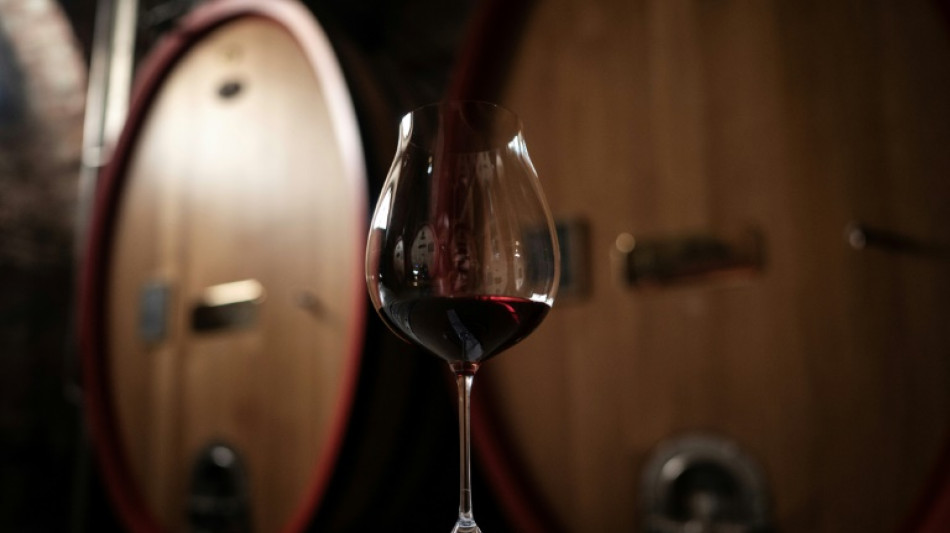
Wine consumption falls heavily into the red / Photo: MARCO BERTORELLO - AFP/File

 Dangote to launch $16bn refinery in Kenya

 North Korean leader 'extremely obese': Seoul spy agency

 Yankees and pope-backed White Sox start MLB playoffs with wins

 Malaysia's ex-PM Mahathir in hospital for observation

 'No limits': Marathon world record holder Sawe chasing history

 Countdown begins to biggest-ever Rugby World Cup

 Bangladesh women lose ground after quota reform

 Vietnam admits 'differing opinions' on Hanoi development

 Stocks temper gains as oil pares heavy losses, US data in focus

 New Zealand denies breaching climate commitments to EU

 Albert becomes youngest US scorer in 4-2 win over Chile

 Pirate island's plunging population shows Greece's demographic decline

 With elections ahead, Latvia's Russian-speakers reject Moscow's help

 Brazil football clubs face massive sponsorship blow from betting ban

 ChatGPT maker wants to be the App Store for AI as safety concerns grow

 Women fight fires and sexism in Indonesian Borneo

 Forsling's OT blast lifts Florida over Carolina in NHL opener

 Alpha Growth Management Opens Rep Office in Japan

 NBA close to picking new $12-13bn Vegas team owners: report

 LA28 Olympics torch relay to visit all 50 states

 Spain brush aside Croatia in Nations League, England down Czechs

 Trump hails 'morally binding' AI self-regulation pledge

 Yamal inspires Spain to Croatia romp on World Cup homecoming

 UN to hold fourth informal poll of secretary-general candidates

 Who are the Emiratis behind crisis-hit Manchester City?

Worldwide consumption of wine fell in 2024 to its lowest level in more than 60 years, the main trade body said Tuesday, raising concerns about new risks from US tariffs.
The International Organisation of Vine and Wine (OIV) said that 2024 sales fell 3.3 percent from the previous year to 214.2 million hectolitres.
The OIV, whose report was based on government figures, said this would be the lowest sales figure since 1961, when sales were 213.6 million hl.
Production is also at its lowest level in more than 60 years, having fallen 4.8 percent in 2024 to 225.8 million hl.
OIV statistics chief Giorgio Delgrosso said the wine industry had been hit by a perfect storm with health concerns driving down consumption in many countries while economic factors had added to troubles.
"Beyond the short-term economic and geopolitical disruptions," said the IOV's annual report, "it is important to consider the structural, long-term factors also contributing to the observed decline in wine consumption."
The OIV said that the consumer is now paying about 30 percent more for a bottle now than in 2019-2020 and overall consumption has fallen by 12 percent since then.
The United States, the world's top wine market, saw consumption fall 5.8 percent to 33.3 million hl.
Delgrosso said that tariffs ordered by US President Donald Trump, even though temporarily suspended, could become "another bomb" for the wine industry.
Sales in China remain below pre-Covid-19 levels, despite a rebound since the pandemic.
Europe, which accounts for nearly half of worldwide sales, saw consumption fall 2.8 percent last year. Even in France, one of the key global producers, 3.6 percent less wine was knocked back last year.
Spain and Portugal were among rare markets where consumption increased.
The OIV said production had been hit environmental extremes such as above average rainfall in some key regions and droughts in others.
Italy was the world's top producer with 44 million hl, while France's output fell 23 percent to 36.1 million hl, its lowest level since 1957.
Italy is also the biggest wine exporter and its trade increased because of the popularity of sparkling wines such as Prosecco.
Spain produced 31 million hl, while US wine output fell 17.2 percent to 21.1 million hl, mainly because of extreme heat.
The OIV could not predict if consumption would take off again and wine industry players, such as the French retail chain Nicolas say there is a "generational" fall in drinking.
"People do not drink in a festive way anymore and young people consume less than their parents," the company said in a statement to AFP.
But it added, "people drink less, but better" and so are ready to spend more.
N.Mitchell--AT