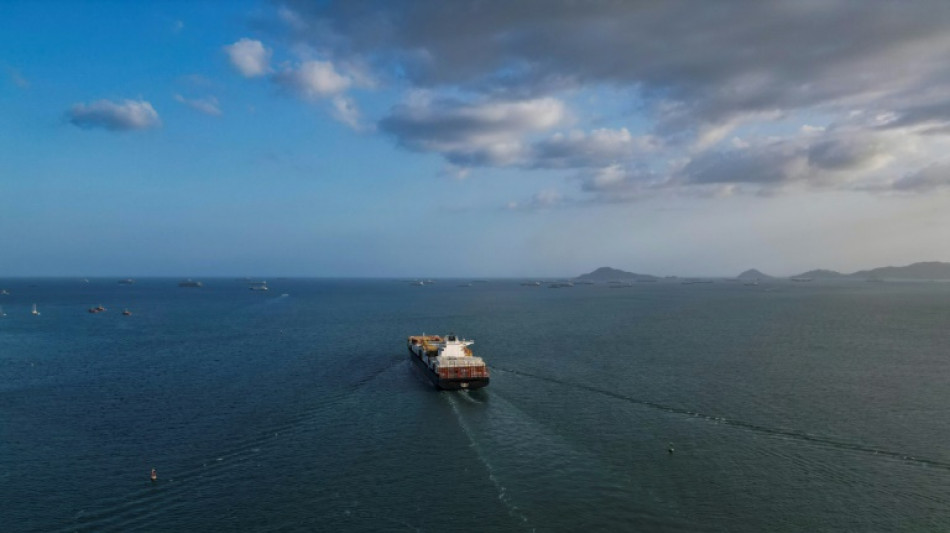
Nations divided ahead of decisive week for shipping emissions / Photo: MARTIN BERNETTI - AFP

 Dangote to launch $16bn refinery in Kenya

 North Korean leader 'extremely obese': Seoul spy agency

 Yankees and pope-backed White Sox start MLB playoffs with wins

 Malaysia's ex-PM Mahathir in hospital for observation

 'No limits': Marathon world record holder Sawe chasing history

 Countdown begins to biggest-ever Rugby World Cup

 Bangladesh women lose ground after quota reform

 Vietnam admits 'differing opinions' on Hanoi development

 Stocks temper gains as oil pares heavy losses, US data in focus

 New Zealand denies breaching climate commitments to EU

 Albert becomes youngest US scorer in 4-2 win over Chile

 Pirate island's plunging population shows Greece's demographic decline

 With elections ahead, Latvia's Russian-speakers reject Moscow's help

 Brazil football clubs face massive sponsorship blow from betting ban

 ChatGPT maker wants to be the App Store for AI as safety concerns grow

 Women fight fires and sexism in Indonesian Borneo

 Forsling's OT blast lifts Florida over Carolina in NHL opener

 Alpha Growth Management Opens Rep Office in Japan

 NBA close to picking new $12-13bn Vegas team owners: report

 LA28 Olympics torch relay to visit all 50 states

 Spain brush aside Croatia in Nations League, England down Czechs

 Trump hails 'morally binding' AI self-regulation pledge

 Yamal inspires Spain to Croatia romp on World Cup homecoming

 UN to hold fourth informal poll of secretary-general candidates

 Who are the Emiratis behind crisis-hit Manchester City?

Members of the International Maritime Organization (IMO) are divided over whether to approve a carbon tax on international shipping, ahead of a meeting starting on Monday to finalise emissions-reduction measures.
The carbon tax, the most ambitious measure on the table, would make it more expensive for shipping companies to emit greenhouse gases, encouraging them to curtail emissions.
But some member states, including China and Brazil, are proposing other measures, arguing the carbon levy would increase the cost of goods and contribute to food insecurity.
The IMO expects to come to an initial agreement by Friday next week on which mechanism to adopt to help reach carbon neutrality in shipping by 2050.
The stakes are high as shipping accounts for nearly three percent of global greenhouse gas emissions, according to the IMO.
"(It is) difficult to say what will happen next week," Fanny Pointet, sustainable shipping manager at European advocacy group, Transport and Environment, told AFP.
The United States has been notably quiet about the issue, having not commented since President Donald Trump returned to the White House.
The Pacific and Caribbean island states are leading the group pushing for a carbon tax, with support from other countries including the UK.
They argue that funds raised from a levy could be redistributed to nations most vulnerable to climate change to help adapt and mitigate its effects.
"Climate change is a terrifying lived reality for my country," said Albon Ishoda, the Marshall Islands' representative to the IMO.
- 'Terrifying lived reality' -
However, around 15 countries strongly oppose the carbon levy, arguing it would exacerbate inequalities between nations and raise the costs of goods such as palm oil, cereals and corn.
Concerns are also mounting that the European Union, once a supporter of a carbon tax, could water down the measure in favour of a carbon credit system.
Such a system would allow companies or countries to buy and sell credits representing the right to emit a certain amount of carbon dioxide.
According to University College London research, the option of no levy presents the biggest risk to meeting the shipping sector's climate goals.
It could also distort fuel prices and create an uneven playing field, favouring states with strong industrial polices, such as China, researchers said.
"The fastest and cheapest energy transition is brought about by a strong levy," combined with a global fuel standard to reduce the carbon intensity of fuels used by ships, they added.
Challenges also remain with the fuel standard system, particularly the risk of using alternative fuels such as palm oil and soybean oil, which indirectly contribute to emissions through deforestation, Pointet explained.
While Brazil defends the key role of these biofuels, more than 60 environmental protection NGOs have raised objections to their inclusion in the future shipping fuel mix.
Other potential solutions include synthetic hydrogen-based fuels, currently very expensive to produce, or the installation of wind-powered propulsion systems onboard ship.
W.Moreno--AT