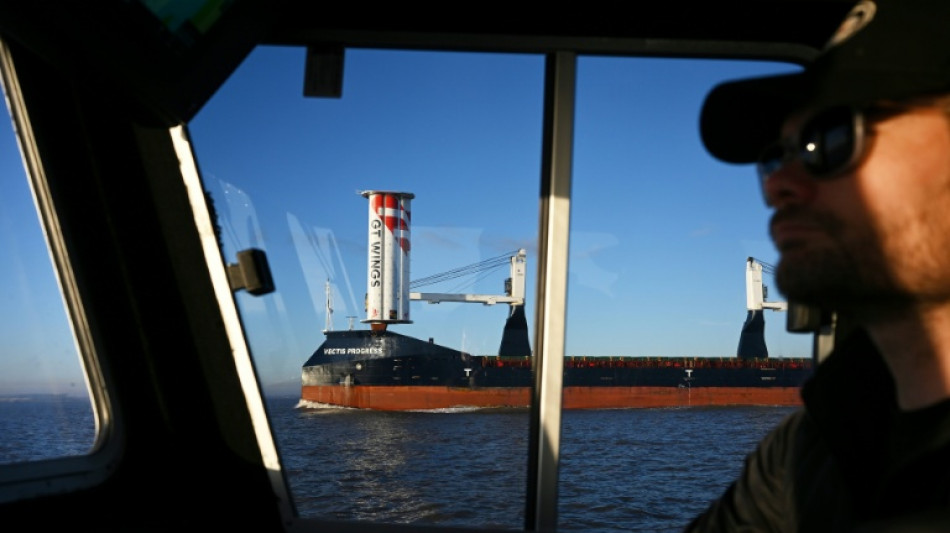
Wind-powered mast to cut emissions sets sail to Canada / Photo: Paul ELLIS - AFP

 Dangote to launch $16bn refinery in Kenya

 North Korean leader 'extremely obese': Seoul spy agency

 Yankees and pope-backed White Sox start MLB playoffs with wins

 Malaysia's ex-PM Mahathir in hospital for observation

 'No limits': Marathon world record holder Sawe chasing history

 Countdown begins to biggest-ever Rugby World Cup

 Bangladesh women lose ground after quota reform

 Vietnam admits 'differing opinions' on Hanoi development

 Stocks temper gains as oil pares heavy losses, US data in focus

 New Zealand denies breaching climate commitments to EU

 Albert becomes youngest US scorer in 4-2 win over Chile

 Pirate island's plunging population shows Greece's demographic decline

 With elections ahead, Latvia's Russian-speakers reject Moscow's help

 Brazil football clubs face massive sponsorship blow from betting ban

 ChatGPT maker wants to be the App Store for AI as safety concerns grow

 Women fight fires and sexism in Indonesian Borneo

 Forsling's OT blast lifts Florida over Carolina in NHL opener

 Alpha Growth Management Opens Rep Office in Japan

 NBA close to picking new $12-13bn Vegas team owners: report

 LA28 Olympics torch relay to visit all 50 states

 Spain brush aside Croatia in Nations League, England down Czechs

 Trump hails 'morally binding' AI self-regulation pledge

 Yamal inspires Spain to Croatia romp on World Cup homecoming

 UN to hold fourth informal poll of secretary-general candidates

 Who are the Emiratis behind crisis-hit Manchester City?

A pioneering rigid shipping mast has set off on its first journey, harnessing the wind to propel a cargo ship from England to Canada and using less fuel to help reduce emissions.
After a night of work and a short nap, George Thompson, the founder of GT Wings -- the startup that produced this 20-metre-high mast -- was back on the ship's main deck.
"We haven't had much sleep over the last few days," Thompson told AFP, as he looked out onto the shipyard workers in white helmets and fluorescent vests, still making adjustments a few hours before departure.
"This is very high-tech," said GT Wings product manager Martin Harrop, pointing to the imposing white and red structure on the bow of the cargo ship in Hull, northeastern England.
Like several other wind propulsion systems, this one works like a vertical aeroplane wing. It harnesses the wind that hits its surface to propel the ship.
However, its internal fans set it apart. They accelerate the air passing through it to speed up the ship, Harrop explained.
- America's Cup and Formula 1 -
"There was a gap in the market for a new type of technology," said Thompson, a sailing enthusiast. "One that was able to produce a lot of thrust but from a much smaller, much more compact size."
Since it was set up three years ago, GT Wings has attracted funding from private investors as well as the British government, which has invested £3.7 million ($4.8 million) as part of its maritime decarbonisation programme.
It now has nine employees, including those who have taken part in the America's Cup, a high-level sailing competition, and those from the Formula 1 racing world.
"The aerodynamics and all the science behind the America's Cup really plays a big part in what we're doing," Thompson said, adding the same was true for motor sports and Formula 1.
But building the project within 12 months was a challenge.
It required modifying the ship's structure using an additional nine tonnes of steel, installing over 7.5 kilometres (4 and a half miles) of electric cables and finding space for the AirWing.
"We had a very small footprint on the bow of the ship to install the wing, where it wouldn't impact on the ship's operation," said Simon Merritt from Carisbrooke Shipping, which owns a fleet of vessels including the cargo ship, Vectis Progress.
To overcome the lack of visibility, the company had to fit navigational cameras, a radar system on the bow and navigation lights, Merritt explained, squinting his eyes in the winter sun.
- Fuel savings -
During the first phase of the project, the company managed to use eight percent less fuel.
It now hopes to target up to 10 percent fuel savings on the vessel.
"This ship trades on transatlantic voyages between Europe and Canada, and we hope to harness more wind on these longer voyages with stronger wind conditions," Merritt said.
Depending on the price of fuel, Carisbrooke estimates that it could save nearly $1,000 per day in fuel costs.
The project is one of only around 80 ships globally that use this type of propulsion system, Thompson said.
He hopes that new European legislation -- that requires a reduction of the carbon intensity of ships -- could make technology like the AirWing more appealing.
The International Maritime Organization hopes to achieve carbon neutrality in the maritime sector by 2050 -- and is expected to present measures in April to support this aim.
"The industry was a bit slow to start," said Lise Detrimont, who runs the Wind Ship association, a specialist maritime wind power group.
"But the number of wind-related installations is expected to double every year in coming years."
M.O.Allen--AT