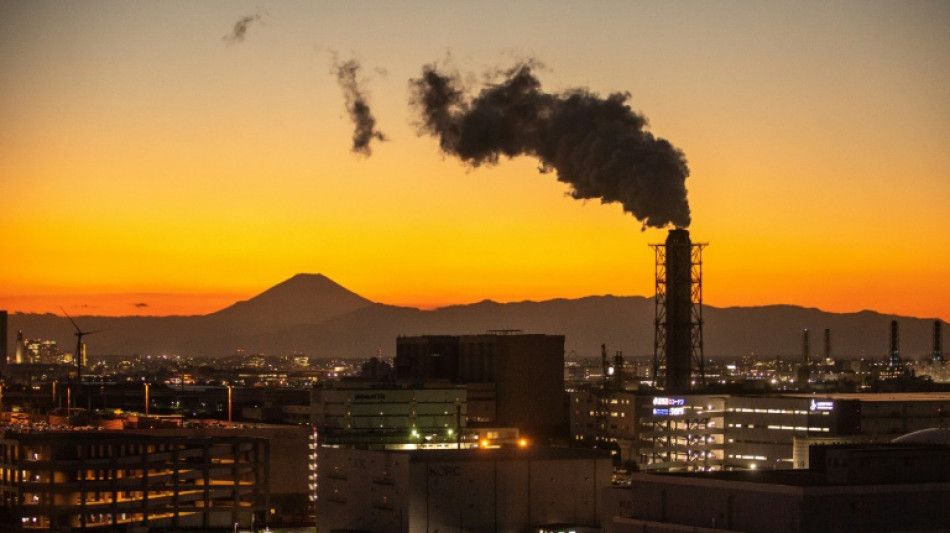
Japan sets new 2035 emissions cut goal / Photo: Philip FONG - AFP

 Dangote to launch $16bn refinery in Kenya
 North Korean leader 'extremely obese': Seoul spy agency
 Yankees and pope-backed White Sox start MLB playoffs with wins

 Malaysia's ex-PM Mahathir in hospital for observation
 'No limits': Marathon world record holder Sawe chasing history

 Countdown begins to biggest-ever Rugby World Cup
 Bangladesh women lose ground after quota reform

 Vietnam admits 'differing opinions' on Hanoi development

 Stocks temper gains as oil pares heavy losses, US data in focus

 New Zealand denies breaching climate commitments to EU
 Albert becomes youngest US scorer in 4-2 win over Chile
 Pirate island's plunging population shows Greece's demographic decline
 With elections ahead, Latvia's Russian-speakers reject Moscow's help

 Brazil football clubs face massive sponsorship blow from betting ban

 ChatGPT maker wants to be the App Store for AI as safety concerns grow

 Women fight fires and sexism in Indonesian Borneo

 Forsling's OT blast lifts Florida over Carolina in NHL opener

 Alpha Growth Management Opens Rep Office in Japan

 NBA close to picking new $12-13bn Vegas team owners: report

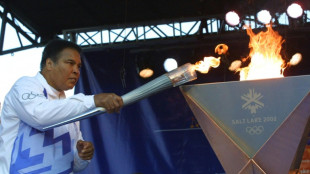 LA28 Olympics torch relay to visit all 50 states
 Spain brush aside Croatia in Nations League, England down Czechs
 Trump hails 'morally binding' AI self-regulation pledge
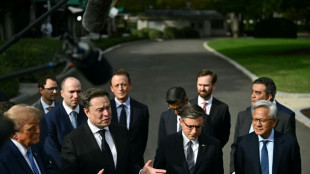
 Yamal inspires Spain to Croatia romp on World Cup homecoming

 UN to hold fourth informal poll of secretary-general candidates

 Who are the Emiratis behind crisis-hit Manchester City?

Japan Tuesday pledged to slash greenhouse gas emissions by 60 percent in the next decade from 2013 levels but climate campaigners said the revised target fell short of what was needed under the Paris Agreement to limit global warming.
Under the Paris Agreement, each country is supposed to provide a steeper headline figure to the United Nations for cutting heat-trapping emissions by 2035, and a detailed blueprint for how to achieve this.
But activists say more ambitious action is needed to limit global warming to safer levels agreed under the Paris deal.
Japan's environment ministry said it aims to slash emissions 60 percent by the 2035 fiscal year.
The world's fourth-largest economy also aims to cut emissions by 73 percent by fiscal 2040 as part of its new Nationally Determined Contribution (NDC) -- a voluntary pledge to be submitted to the UN later on Tuesday.
Japan is heavily dependent on imported fossil fuels as the world's fifth largest single-country emitter of carbon dioxide after China, the United States, India and Russia.
Nearly 200 nations had been required to deliver their fresh climate plans by February 10 but just 10 did so on time, according to a UN database tracking the submissions.
The Japanese ministry said Tuesday that its "ambitious targets (are) aligned with the global 1.5 degree Celsius goal and on a straight pathway towards the achievement of net zero by 2050".
But Masayoshi Iyoda from international environmental group 350.org noted that scientists say an emissions cut of 81 percent by 2035 is needed for Japan to honour its commitments to the 1.5 degree objective.
"This is a major failure in Japan's attempt to transition to a future of renewable energy that is fair and just," he told AFP.
Kazue Suzuki of Greenpeace Japan also called the new 2030 target "far too low", calling for a 78 percent reduction "from the perspective of our responsibility as an industrially advanced country".
- Renewable future? -
In 2016, Japan committed to a 26 percent reduction in emissions by 2030. It strengthened this in 2021 to 46 percent by 2030 compared to 2013 levels.
The Japanese government also on Tuesday approved its latest Strategic Energy Plan -- which includes an intention to make renewables the country's top power source by 2040.
Nearly 14 years after the Fukushima disaster, Japan also sees a major role for nuclear power to help it meet growing energy demand from AI and microchip factories.
So a previous pledge to "reduce reliance on nuclear power as much as possible" was dropped from the new plan.
A draft energy plan released in December had said Japan would jointly promote renewable energy and hydrogen fuel with its ally the United States.
But after President Donald Trump pulled Washington out of the Paris accord last month, the wording has been watered down, with mentions of a US-led clean economy framework deleted from the edition approved on Tuesday.
"We've made certain tweaks" following Trump's announcements, an industry ministry official told reporters Monday.
But "it doesn't mean Japan's broader efforts towards a 'green transformation' will be changed significantly", he said.
Nearly 70 percent of Japan's power needs in 2023 were met by power plants burning coal, gas and oil -- a figure Tokyo wants to slash to 30-40 percent over the next 15 years.
Almost all these fossil fuels must be imported, at a cost of around $470 million per day according to Japanese customs.
Under the new plans, renewables such as solar and wind are expected to account for 40-50 percent of electricity generation by 2040.
D.Johnson--AT