Arid Athens turns to ancient aqueduct as climate crisis bites / Photo: Angelos TZORTZINIS - AFP

 Dangote to launch $16bn refinery in Kenya
 North Korean leader 'extremely obese': Seoul spy agency

 Yankees and pope-backed White Sox start MLB playoffs with wins

 Malaysia's ex-PM Mahathir in hospital for observation

 'No limits': Marathon world record holder Sawe chasing history

 Countdown begins to biggest-ever Rugby World Cup
 Bangladesh women lose ground after quota reform
 Vietnam admits 'differing opinions' on Hanoi development

 Stocks temper gains as oil pares heavy losses, US data in focus

 New Zealand denies breaching climate commitments to EU

 Albert becomes youngest US scorer in 4-2 win over Chile

 Pirate island's plunging population shows Greece's demographic decline

 With elections ahead, Latvia's Russian-speakers reject Moscow's help
 Brazil football clubs face massive sponsorship blow from betting ban
 ChatGPT maker wants to be the App Store for AI as safety concerns grow

 Women fight fires and sexism in Indonesian Borneo

 Forsling's OT blast lifts Florida over Carolina in NHL opener

 Alpha Growth Management Opens Rep Office in Japan

 NBA close to picking new $12-13bn Vegas team owners: report

 LA28 Olympics torch relay to visit all 50 states

 Spain brush aside Croatia in Nations League, England down Czechs

 Trump hails 'morally binding' AI self-regulation pledge

 Yamal inspires Spain to Croatia romp on World Cup homecoming

 UN to hold fourth informal poll of secretary-general candidates
 Who are the Emiratis behind crisis-hit Manchester City?

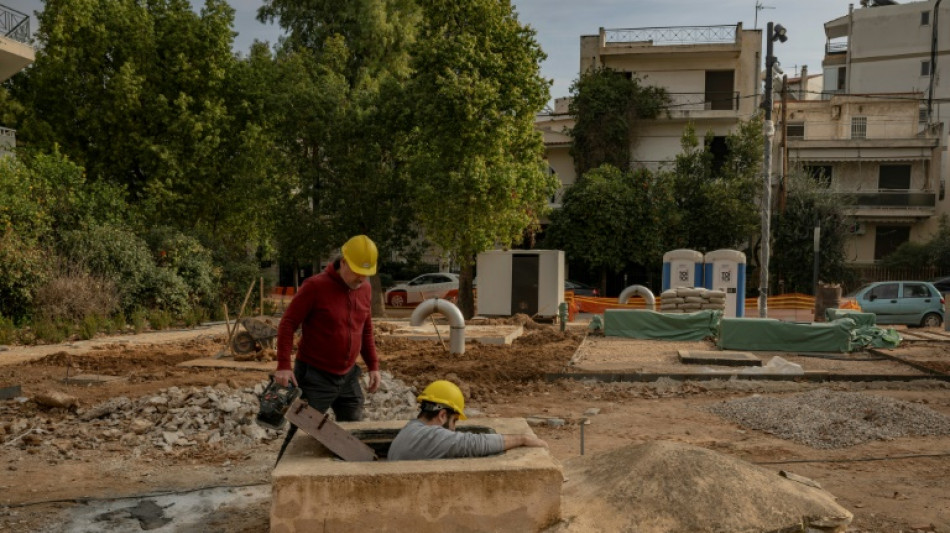
Between parked cars in a suburban street in Athens, workers fix a pump to an ancient stone well that in turn accesses an aqueduct built almost 2,000 years ago.
The Greek capital, one of Europe's hottest and most densely populated cities, is going to great lengths -- and depths -- to battle soaring summer temperatures and creaking infrastructure.
Officials are tapping European Union money to help restore access to Hadrian's Aqueduct, a 24-kilometre (15-mile) underground channel named after the Roman emperor who funded its construction in the year 140.
It is hailed by experts as an "engineering marvel".
Last year, public utility company Eydap repeatedly warned Athenians they needed to save drinking water as reserves shrank.
Eydap's Katerina Apostolopoulou, who manages the project in the Chalandri suburb, around 10 kilometres from central Athens, said the water would not be of drinking quality and instead would be used "to clean or to irrigate parks and gardens" in summer.
She pointed out that Athenians would normally need to use the drinking water network for their gardens and parks, so she hoped the new pump would help save the valuable resource.
- War shelter -
The aqueduct, which begins at the foot of Mount Parnitha, is fed by an aquifer, explained geologist Yannis Dafnos.
A gentle slope from the mountain helps the water flow down naturally into the city centre.
The Chalandri well is more than 20 metres deep and part of a network of 300 ancient wells, Dafnos said as he lifted the heavy iron cover.
George Sachinis, Eydap's director of strategy and innovation, called the aqueduct an "archaeological and engineering marvel".
He urged planners to use it to create more green spaces in a city hit hard by the climate crisis.
"It is one of the most important ancient aqueducts in Europe," he said.
The aqueduct helped supply the city for hundreds of years but fell into disuse after the Roman era.
Athenians began to reuse it at the end of the 19th century but it was abandoned again after two dams were constructed near the city.
During the Nazi occupation (1941-1944) and then the ensuing Greek civil war, one of the Chalandri wells that it is now dry was used as a shelter, said Christos Giovanopoulos, who heads Cultural Hidrant, a heritage management project at Chalandri town hall.
The restoration project is part of "the promotion of sustainable development in Athens", he said, adding that water was often wasted.
- 'Collaborates with nature' -
He said the Chalandri project aimed to promote green spaces and improve the microclimate through water recycling, while highlighting the archaeological and cultural importance of the entire monument.
A few years ago, Chalandri residents had to zigzag to avoid the well, which at the time was located in the middle of the street, Giovanopoulos said.
Now, the northern Athens suburb will be the first of eight municipalities in the Athens region to benefit from the reuse of the aqueduct's water.
An adjacent dry well has been fitted with a ladder to allow visitors to descend and view parts of the ancient conduit.
The aqueduct eventually reaches the centre of Athens at the foot of Lycabettus Hill, once the site of a Roman reservoir.
Only a few parts of the original reservoir construction remain. The existing structure with stone columns and arches is largely a reconstruction from the nineteenth century.
At the very bottom, in the ancient canal, "a few parts of the roof built by the Romans to prevent rocks from falling into the aqueduct remain", Sachinis said.
"It is an elegant piece of infrastructure that respects and collaborates perfectly with nature," he said.
"Thanks to this aqueduct, there are plans to create more green space around the original reservoir", he added.
N.Mitchell--AT