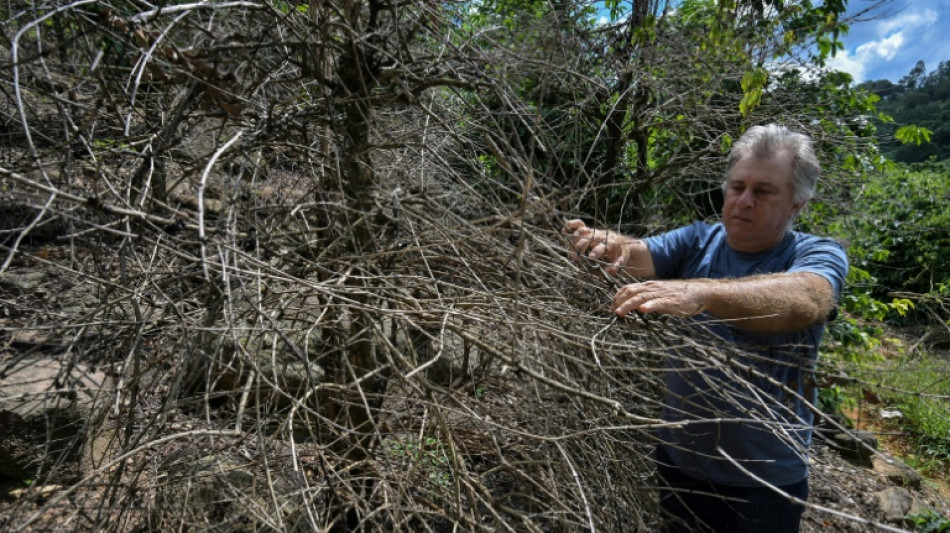
Brazil drought lights a fire under global coffee prices / Photo: Nelson ALMEIDA - AFP

 Dangote to launch $16bn refinery in Kenya
 North Korean leader 'extremely obese': Seoul spy agency

 Yankees and pope-backed White Sox start MLB playoffs with wins

 Malaysia's ex-PM Mahathir in hospital for observation

 'No limits': Marathon world record holder Sawe chasing history

 Countdown begins to biggest-ever Rugby World Cup
 Bangladesh women lose ground after quota reform

 Vietnam admits 'differing opinions' on Hanoi development

 Stocks temper gains as oil pares heavy losses, US data in focus
 New Zealand denies breaching climate commitments to EU

 Albert becomes youngest US scorer in 4-2 win over Chile
 Pirate island's plunging population shows Greece's demographic decline
 With elections ahead, Latvia's Russian-speakers reject Moscow's help

 Brazil football clubs face massive sponsorship blow from betting ban
 ChatGPT maker wants to be the App Store for AI as safety concerns grow

 Women fight fires and sexism in Indonesian Borneo

 Forsling's OT blast lifts Florida over Carolina in NHL opener

 Alpha Growth Management Opens Rep Office in Japan

 NBA close to picking new $12-13bn Vegas team owners: report
 LA28 Olympics torch relay to visit all 50 states
 Spain brush aside Croatia in Nations League, England down Czechs

 Trump hails 'morally binding' AI self-regulation pledge

 Yamal inspires Spain to Croatia romp on World Cup homecoming

 UN to hold fourth informal poll of secretary-general candidates
 Who are the Emiratis behind crisis-hit Manchester City?

Brazilian coffee producer Moacir Donizetti first smelled the smoke, and then watched in desperation as a blaze consumed his family coffee plantation last year.
The 54-year-old was one of hundreds of farmers hit by a brutal forest fire in Sao Paulo state, where years of soaring heat and erratic rains are set to drive up the cost of an espresso or latte far afield in Paris, New York or Tokyo.
Brazil, the world's largest coffee producer and exporter, experienced its hottest year on record in 2024 and a record number of forest fires.
Locals in the municipality of Caconde believe the fire broke out due to uncontrolled burning of garbage, but experts attribute its scale to drought conditions exacerbated by climate change.
"It was desperate: seeing the flames advance, destroying our plantation, coming within twenty meters of my house," said Donizetti.
His family fought the fire for four days on the remote farm in the mountains of the Atlantic Forest, losing five hectares (12 acres) of coffee -- a third of the family's production area.
Standing alongside scorched and blackened coffee crops, he estimates his land will take three or four years to produce again.
The loss is compounded by several years of unpredictable weather and disappointing harvests in Brazil.
"For about five years it has been too dry, sometimes it doesn't rain for months," said Donizetti. "It has also gotten a lot hotter, it is unbearable."
- Invest more to produce less -
In 2024, Brazil was responsible for more than a third of global coffee production.
A poor harvest in the Latin American giant significantly impacts international prices.
Arabica coffee, the most popular variety, in December reached its highest price since 1977, listed at $3.48 per pound on the New York Stock Exchange.
"I have been working in coffee for 35 years and I have never seen a situation as difficult as the current one," said Brazilian coffee grower and consultant Guy Carvalho.
"High temperatures and irregular rainfall force us to invest more to produce the same, or even less, than we did in the past," he added.
"After the last big harvest, in 2020, we have always had some weather problem."
Carvalho said that the high prices were largely explained by "frustration" over disappointing harvests between 2021 and 2024, and bleak forecasts for 2025.
Geopolitical factors such as potential US tariffs and future European Union regulation on deforestation also contributed to the higher prices.
- Adapting to changing climate -
Some Brazilian coffee producers are adopting new strategies to adapt to the increasingly unpredictable climate.
In Divinolandia, another small coffee-growing town in Sao Paulo state, producer Sergio Lange has turned to shade-grown coffee -- an ancient technique used in places like Ethiopia, the birthplace of coffee.
Planting coffee shrubs under the shade of trees protects the plants from excessive heat and allows them to ripen more slowly, producing a larger, sweeter bean with a higher market value.
Lange and 50 other colleagues have been applying a "regenerative coffee growing model" since 2022, in which the crop is planted alongside other species, grown without pesticides, and relies on a natural water source from the mountains.
"At first, productivity falls, but we expect fantastic results in four or five years," he said.
He pointed to climate change as having a "severe" impact on coffee production.
"Producers who fail to adapt will struggle to stay in business," he warned.
G.P.Martin--AT