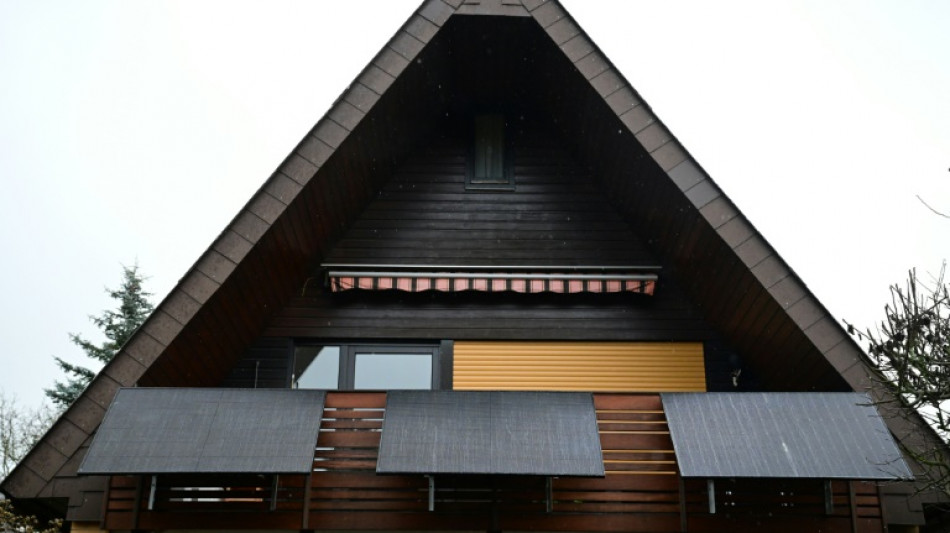
Germans turn to balcony solar panels to save money / Photo: Tobias SCHWARZ - AFP

 Dangote to launch $16bn refinery in Kenya
 North Korean leader 'extremely obese': Seoul spy agency
 Yankees and pope-backed White Sox start MLB playoffs with wins

 Malaysia's ex-PM Mahathir in hospital for observation

 'No limits': Marathon world record holder Sawe chasing history

 Countdown begins to biggest-ever Rugby World Cup

 Bangladesh women lose ground after quota reform

 Vietnam admits 'differing opinions' on Hanoi development

 Stocks temper gains as oil pares heavy losses, US data in focus

 New Zealand denies breaching climate commitments to EU

 Albert becomes youngest US scorer in 4-2 win over Chile

 Pirate island's plunging population shows Greece's demographic decline

 With elections ahead, Latvia's Russian-speakers reject Moscow's help

 Brazil football clubs face massive sponsorship blow from betting ban

 ChatGPT maker wants to be the App Store for AI as safety concerns grow

 Women fight fires and sexism in Indonesian Borneo

 Forsling's OT blast lifts Florida over Carolina in NHL opener
 Alpha Growth Management Opens Rep Office in Japan

 NBA close to picking new $12-13bn Vegas team owners: report

 LA28 Olympics torch relay to visit all 50 states

 Spain brush aside Croatia in Nations League, England down Czechs

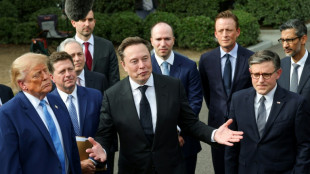 Trump hails 'morally binding' AI self-regulation pledge

 Yamal inspires Spain to Croatia romp on World Cup homecoming

 UN to hold fourth informal poll of secretary-general candidates

 Who are the Emiratis behind crisis-hit Manchester City?

As snowflakes gently settled on his balcony solar panels on a cold winter's day, Berliner Jens Sax checked his smartphone to see how much electricity they were generating.
The amount was modest now, said Sax, who admitted to being addicted to the phone notifications that keep track of the panels' output, "but we've saved 79 euros since installing them in August".
More than 800,000 such kits had been installed in Germany by the end of 2024, official data shows -- boosted by subsidies and a desire to save amid high energy costs.
That was more than double the number from a year earlier and 10 times the figure for 2022.
EmpowerSource, a consultancy, estimates that three million kits are now in operation nationwide, including those that have not been officially registered.
Installation numbers are likely an underestimate, said Leonhard Probst, a researcher at the Fraunhofer Institute for Solar Energy Systems, since the kits often remain unregistered.
Cheaper than photovoltaic roof panels and easy to install -- the panels simply plug into power sockets -- balcony solar is taking off as Germany seeks to switch to renewables.
- Covid and war -
Europe's largest economy wants 80 percent of gross power consumption to come from renewables by 2030, up from 59 percent in 2024. Solar power supplied 14.6 percent of Germany's electricity last year.
Far less powerful than roof panels, balcony solar kits cover only part of a household's energy needs and are used for tasks such as charging computers or powering dishwashers.
Probst estimates that the kits make up only about two percent of the almost 100 gigawatts of Germany's total solar capacity, but he expects that share to grow and thinks the kits could boost solar more broadly.
"There's an educational effect, it familiarises a larger number of people with solar power and might spur them to invest in more powerful systems," he said.
Oliver Lang, based in Berlin and head of solar kit company Sonnenrepublik, said the firm had grown in recent years thanks totheCovid-19 pandemic and the war in Ukraine.
"At the beginning it was niche, there was very little demand when we started selling them six years ago," he said.
"It started duringCovidwhen people had time on their hands, then the war in Ukraine began and there was a fear of electricity shortages, and then subsidies came in."
- Government subsidies -
City authorities in Frankfurt gave Christoph Stadelmann, a 60-year-old teacher, half of the 650 euros ($676) he paid for his kit at the beginning of last year.
Stadelmann expects to make his money back within three years.
"Typical roof panels, a more powerful system, start from about 15,000 euros," said Lang of Sonnenrepublik.
"They'll take 15 years to pay off."
German energy prices have stabilised after a peak in 2022 but are still among the highest in Europe.
Opinion polls show that the cost of living is one of voters' major concerns ahead of parliamentary elections on February 23.
Cost savings were more important than environmental concerns in Sax's decision to plump for balcony solar panels, he said.
Government measures have supported the boom. Kit owners now no longer need to register the devices, and people who live in apartment buildings can use them without the owner's or building manager's permission.
Supportive regulation is the main reason for Germany's tilt towards balcony solar panels, with uptake far ahead of other European countries, said Christian Ofenheusle, founder of EmpowerSource.
Mirjam Sax, married to Jens, said she would recommend balcony solar panels in spite of Germany's sometimes grey weather.
"If you've got a balcony, if you've got a bit of sun, you can put up a panel or two to see if it's worth it," she said.
"It's easy and there's a price for every budget."
A.Clark--AT