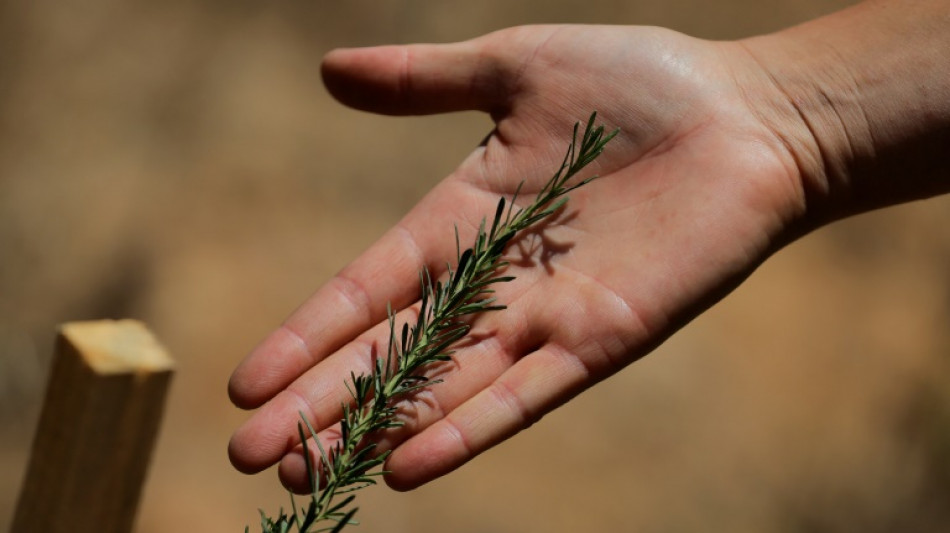
Disaster-hit Chilean park sows seeds of fire resistance / Photo: Javier TORRES - AFP

 Dangote to launch $16bn refinery in Kenya
 North Korean leader 'extremely obese': Seoul spy agency

 Yankees and pope-backed White Sox start MLB playoffs with wins

 Malaysia's ex-PM Mahathir in hospital for observation

 'No limits': Marathon world record holder Sawe chasing history

 Countdown begins to biggest-ever Rugby World Cup
 Bangladesh women lose ground after quota reform
 Vietnam admits 'differing opinions' on Hanoi development

 Stocks temper gains as oil pares heavy losses, US data in focus

 New Zealand denies breaching climate commitments to EU

 Albert becomes youngest US scorer in 4-2 win over Chile
 Pirate island's plunging population shows Greece's demographic decline
 With elections ahead, Latvia's Russian-speakers reject Moscow's help
 Brazil football clubs face massive sponsorship blow from betting ban
 ChatGPT maker wants to be the App Store for AI as safety concerns grow

 Women fight fires and sexism in Indonesian Borneo

 Forsling's OT blast lifts Florida over Carolina in NHL opener

 Alpha Growth Management Opens Rep Office in Japan

 NBA close to picking new $12-13bn Vegas team owners: report
 LA28 Olympics torch relay to visit all 50 states

 Spain brush aside Croatia in Nations League, England down Czechs

 Trump hails 'morally binding' AI self-regulation pledge

 Yamal inspires Spain to Croatia romp on World Cup homecoming

 UN to hold fourth informal poll of secretary-general candidates
 Who are the Emiratis behind crisis-hit Manchester City?

After a wildfire that devastated Chile's largest botanical garden, the century-old park has planted thousands of native trees that it hopes are less likely to go up in flames.
Last year's inferno -- considered the deadliest in Chile's recent history -- killed 136 people, razed entire neighborhoods and destroyed 90 percent of the 400-hectare (990-acre) garden in the coastal city of Vina del Mar.
Park director Alejandro Peirano thinks it is only a matter of time before the wildfires return.
"One way or another, we're going to have a fire. That's for sure," he told AFP, standing under one of the trees that survived the flames.
With authorities predicting another intense season of forest fires due to rising temperatures, the park wants to make sure it is better placed to survive.
It established a new "battle line" with trees such as litre, quillay and colliguay that are native to Mediterranean forests found in areas with hot, dry summers.
"The idea is to put the species that burn more slowly in the front line of the battle... so that fires, which will happen, don't advance so quickly," Peirano said.
- Recovery takes root -
Summer heat and strong gusts of wind meant that the February 2024 fire ripped quickly through Vina del Mar, 120 kilometers (75 miles) northwest of Santiago, leaving 16,000 people homeless.
The Vina del Mar National Botanical Garden, first designed by French architect Georges Dubois in 1918, boasted 1,300 species of plants and trees, including native and exotic ferns, mountain cypresses, Chilean palm and Japanese cherry trees.
Some came from seeds that survived the atomic bombing of Hiroshima in 1945.
The park was home to wildlife including marsupials, gray foxes and countless birds.
Weeks ago on one of the garden slopes, dozens of volunteers began to plant 5,000 native trees that are watered through an irrigation system.
In two years, the foliage is expected to be large enough to provide shade and encourage the regrowth of other species around them.
The tree planting is part of the first stage of a plan to revive the garden through a public-private partnership.
The park is also expected to be reforested with species capable of adapting to "scarce rainfall and prolonged drought," said Benjamin Veliz, a forest engineer with Wildtree, a conservation group involved in the project.
Firebreaks are also being created on the park's edges and its ravines are being cleared of dry vegetation and trash that feed fires.
Unlike eucalyptus, an exotic species that burns quickly, some native trees are able to withstand or contain flames for longer, according to research by the Federico Santa Maria Technical University (USM).
Scientific experiments have demonstrated that quillay and litre, for example, are less flammable than eucalyptus and pine, USM researcher Fabian Guerrero said.
When the inferno erupted last February, there was little firefighters could do to stop it consuming most of the park in less than an hour.
But nature is slowly healing: abundant rainfall in 2024 in central Chile -- after more than a decade of drought -- has already brought green shoots of recovery in the botanical garden.
The beauty of Sclerophyll forests resistant to summer droughts is that "trees that burn come back," Peirano said.
Ch.P.Lewis--AT