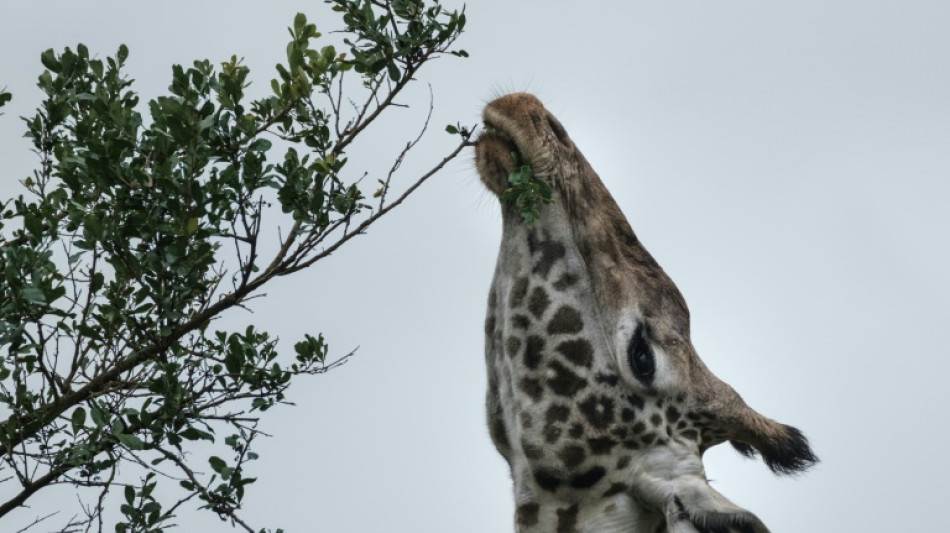
UN experts urge three 'transformations' for nature / Photo: Yasuyoshi CHIBA - AFP/File

 South Korea score late to reach Asian Games football final

 Tom Kim defies jet-lag, Kho cards ace as Asian Games golf begins

 Thai teen rocker Nene aims to tour, write music... and return to school
 Ivory Coast clamps down on harmful illegal gold rush
 Nagoya mayor says sorry for Asian Games 'inconveniences'

 G20 trade officials meet under shadow of tariffs, overcapacity

 India's fat dog vote goes viral

 Asian Games crowds in spotlight as 998 see hosts in 50,000 stadium

 The eight stadiums for the 2027 Rugby World Cup

 Thieves swipe drugs under nose of Fiji police, swap with flour

 South Korea demands North apologise for DMZ mine blasts
 In Nepal's flood zone, teachers mourn students who never returned

 US Supreme Court lifts limits on third-country deportations
 Antonelli eager to 're-establish order' as F1 returns to Malaysia

 Paw-fect candidate: Australia finds new koala rescue dog
 One third of world population exposed to harmful air pollution: monitor

 North Korea denies South's claim it was apparently behind DMZ mine blasts

 West Bank's violent settlers part of a new generation fuelled by ideology

 US-led coalition ends mission in Iraq
 Pope-backed White Sox join Braves with MLB playoff wins

 Psychology Software Tools Builds on Early Bioz Success to Expand Access to Publication-Backed Product Evidence

 Alpha Growth Management Opens Rep Office in Japan

 NBA close to picking new $12-13bn Vegas team owners: report

 LA28 Olympics torch relay to visit all 50 states

 Spain brush aside Croatia in Nations League, England down Czechs

Human societies need a radical overhaul to stop the destruction of the planet, according to the UN biodiversity expert panel's "transformative change" report released Wednesday.
The assessment, the second by the expert panel this week, says overconsumption in richer countries, a concentration of wealth and power, and a society increasingly disconnected from nature were driving ecological destruction.
It offered ideas of how to respond to "biodiversity loss, nature's decline and the projected collapse of key ecosystem functions".
Taking action will be difficult -- but not impossible, the report said.
"It is not just governments. It is not just business. It is not just civil society. It is all of us. We all need to work together," said Arun Agrawal, one of the lead authors of the report from the Intergovernmental Science-Policy Platform on Biodiversity and Ecosystem Services (IPBES).
Here are three examples of successful transformations, big and small, according to IPBES.
- Sea bounty -
In 2002 Spain suffered what was at the time its worst environmental disaster, when the Prestige oil tanker broke in two, spilling fuel that blackened swathes of the Atlantic coastline.
Fishing communities in Galicia responded to the devastation by pioneering a new way to manage a marine reserve, with fishers, scientists and the local authorities working together.
The "Os Minarzos" reserve model was "not without tensions", IPBES said.
But more than 17 years later, the area has better fishing practices, more species and higher incomes -- as well as improved trust and cooperation.
It also inspired new guidelines for the UN's agriculture body and a network of more than 20 million fishers in Europe and across parts of North and South America.
- Ant Forest -
China's largest private tree planting project, Ant Forest, is a mobile phone application that rewards users for climate friendly activities.
The app boasts that 500 million people have used its programme, which gives users "green energy points" for acts like walking or cycling to work instead of driving, and cutting down on plastic and paper.
The points grow into a virtual tree, which Ant Forest matches by planting a real tree.
"Recognising a wide range of ecological and social goals, the plants are suited to specific contexts and provide jobs in eco-agriculture and ecotourism in remote rural areas facing environmental degradation in China," the report said.
Since its launch in 2016, the project has planted 548 million trees in 13 provinces.
- 'Power of community' -
Traditional knowledge from indigenous peoples and local communities is a key aspect of the report, which highlighted the Nashulai Maasai Conservancy in Kenya.
IPBES said this "represents a new model for conservation", which tries to tackle a range of issues together, including species loss, incomes and climate change.
The conservancy involves community-managed protected areas, as well as activities like river cleaning and tree planting.
IPBES said the project has succeeded in creating areas "where both humans and wildlife thrive".
"Over a very short period of time, biodiversity reappeared," said Karen O'Brien, another of the lead authors of the report.
"The power of community, again and again in our examples, is important."
P.Smith--AT