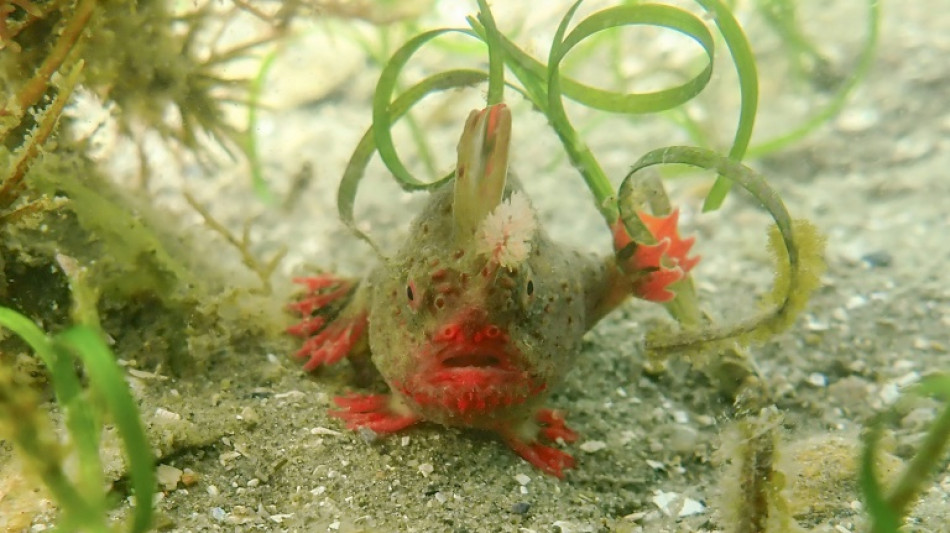
Australia scientists pluck rare handfish from ocean due to climate risk / Photo: Jemina STUART-SMITH - UNIVERSITY OF TASMANIA/AFP

 South Korea score late to reach Asian Games football final

 Tom Kim defies jet-lag, Kho cards ace as Asian Games golf begins

 Thai teen rocker Nene aims to tour, write music... and return to school
 Ivory Coast clamps down on harmful illegal gold rush

 Nagoya mayor says sorry for Asian Games 'inconveniences'

 G20 trade officials meet under shadow of tariffs, overcapacity

 India's fat dog vote goes viral

 Asian Games crowds in spotlight as 998 see hosts in 50,000 stadium

 The eight stadiums for the 2027 Rugby World Cup

 Thieves swipe drugs under nose of Fiji police, swap with flour

 South Korea demands North apologise for DMZ mine blasts
 In Nepal's flood zone, teachers mourn students who never returned

 US Supreme Court lifts limits on third-country deportations
 Antonelli eager to 're-establish order' as F1 returns to Malaysia

 Paw-fect candidate: Australia finds new koala rescue dog

 One third of world population exposed to harmful air pollution: monitor

 North Korea denies South's claim it was apparently behind DMZ mine blasts

 West Bank's violent settlers part of a new generation fuelled by ideology

 US-led coalition ends mission in Iraq

 Pope-backed White Sox join Braves with MLB playoff wins

 Psychology Software Tools Builds on Early Bioz Success to Expand Access to Publication-Backed Product Evidence

 Alpha Growth Management Opens Rep Office in Japan

 NBA close to picking new $12-13bn Vegas team owners: report
 LA28 Olympics torch relay to visit all 50 states

 Spain brush aside Croatia in Nations League, England down Czechs

Scientists have collected 25 extremely rare red handfish from the ocean off Australia, hoping to protect the struggling species from warming seas, human-caused habitat changes and ravenous urchins.
Only about 100 red handfish -- which have the appearance of a crimson and brown goldfish with stubby arms and webbed hands -- are left in the wild, living in a small section of reef off southeast Tasmania.
About eight centimetres (three inches) long, they "walk" along the sea floor on their pectoral and pelvic fins rather than swimming.
But overgrazing urchins, run-off from urban areas, disturbances from boats and rising sea temperatures have resulted in "severe habitat loss and degradation", according to the University of Tasmania's Institute for Marine and Antarctic Studies.
Scientists at the institute recently made the difficult and risky decision to take dozens of the fish out of the wild for safekeeping.
"This summer has already well exceeded previous temperature maximums," said marine scientist Jemina Stuart-Smith.
"We can only assume that this additional stressor will impact the already fragile population," she said.
On Wednesday, scientists said the 25 specimens were doing well in their temporary aquarium homes and were being closely monitored for stress or ill health.
"We have highly experienced staff looking after the fish seven days a week, and a 24-hour call-out roster," said the institute's Andrew Trotter.
"We believe they are quite safe with us -- but there is certainly a feeling of heightened responsibility among our team, given how small the wild population is."
Trotter and his colleagues are hoping to return the fish to their natural habitat when temperatures drop with the onset of the austral winter in June.
Sea temperatures off Australia have been increasing steadily since records began at the beginning of the 1900s.
Experts believe the change is being fuelled by the emission of carbon dioxide and other greenhouse gases into the atmosphere.
E.Flores--AT