Aluminum recycling in Brazil: Scraping by in a billion-dollar industry / Photo: Miguel SCHINCARIOL - AFP

 With elections ahead, Latvia's Russian-speakers reject Moscow's help

 Brazil football clubs face massive sponsorship blow from betting ban

 ChatGPT maker wants to be the App Store for AI as safety concerns grow

 Women fight fires and sexism in Indonesian Borneo

 Forsling's OT blast lifts Florida over Carolina in NHL opener

 Hurricane Polo sweeps over Mexico's Pacific coast, heads inland

 Grynspan pulls ahead in race to lead UN: diplomat

 Trump touts AI boss pledge to self-regulate
 Oil down, but stocks lower as bond yields rise

 England break down stubborn Czechs to claim first Nations League win

 UN Security Council extends Haiti anti-gang force by 6 months

 Manchester City guilty of Premier League charges: What comes next?

 Man City chief Soriano slams Premier League 'conspiracy theory'

 Hurricane Polo sweeps over Mexico's Pacific coast

 Man City must be relegated after guilty verdict says club's former chairman

 German far-right aims to lead Saxony-Anhalt govt in December
 Little damage as Hurricane Polo sweeps over Mexico's Pacific coast

 Manchester City guilty of breaking financial rules - Premier League

 FIFA boss Infantino blasted as would-be 'emperor' by UEFA's Ceferin

 Stocks move lower despite oil prices dropping

 AI driving up innovation investment: UN

 UN Security Council extends Haiti mission by 6 months

 Man Utd do not deserve medals if Man City stripped of titles: Rooney

 Vana Completes Expanded Staking as Part of the Vega Upgrade, Publishes Expanded VANA Token Economics
 Spain to cap gas price hikes, extend fuel discounts

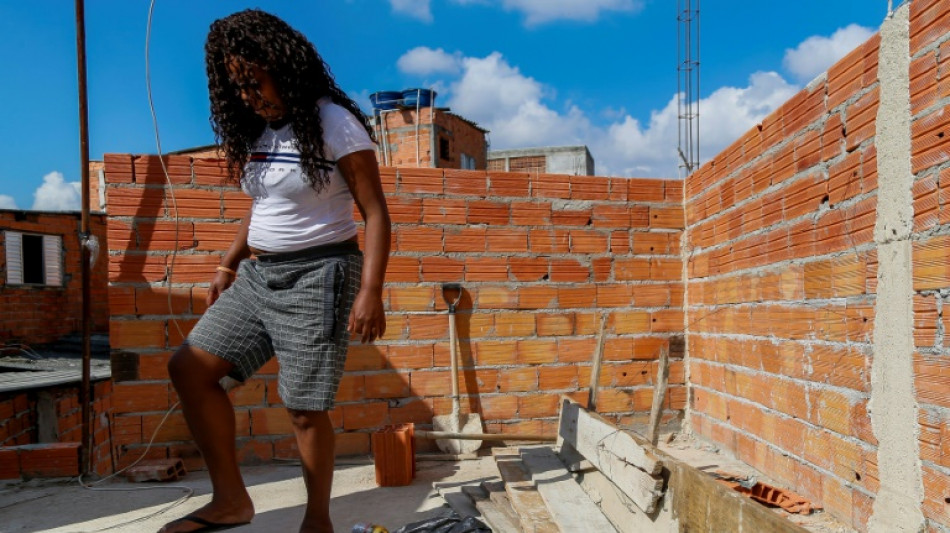
Shirlei Aparecida de Souza uses her foot to crush the empty cold drink cans she collects in the alleys of a poor Sao Paulo neighborhood: a precarious livelihood critical to Brazil's environmental protection goals.
It is thanks to about a million collectors like her that the country recycled as many aluminum cans as it produced for the first time in 2022, according to data from Recicla Latas, a recycling industry body.
Brazil is a world leader in recycling drinks cans: its new record beats out the European Union, which recycles 73 percent, and the United States with 60 percent, according to their own databases.
Recicla Latas says the country's recycling efforts have prevented about 16.5 million tons of planet-warming greenhouse gas emissions in the last 10 years.
But for Aparecida de Souza, collecting cans is a matter of survival.
She gathers them off the street, from garbage cans or landfills, and sells them to collection centers that send the cans to recycling plants.
She earns about 20 real, or just over $4, a day: "Just enough to buy the necessities, a packet of rice, black beans and sometimes meat," the 38-year-old told AFP.
With this, she supports five daughters in a working-class district of the largest metropolis in Latin America.
- 'Family tradition' -
Dressed in flip-flops, a T-shirt and shorts, Aparecida de Souza leaves the house every day at dawn to collect as many cans as she can. It takes almost 70 black rubbish bags to make a kilogram of aluminum, which sells for just over $1.
The work is a "family tradition," into which she was initiated by her mother from the age of 15, she told AFP.
"Aluminum sells for a higher price than other materials such as cardboard, and it is lighter to carry."
Aline Sousa da Silva, an activist with the Ancat association representing collectors of recyclable materials, said there is "a lot of competition" in gathering cans, which can be reused indefinitely.
The recycling rate of other materials in Brazil is much lower than that for cans: about four percent on average.
In 2022, nearly 430,000 tons of cans were recycled, according to Renato Paquet, a director at Recicla Latas, whose data is used as a reference by the Brazilian government.
That is the equivalent of about 31.8 billion cans.
- 156 cans per person -
Since 2010, when drinks manufacturers signed an agreement with Brazilian authorities, aluminum recycling numbers have skyrocketed in a country where each of its 200-odd million inhabitants consumes about 156 cans every year.
It takes "an average of 60 days" for a can bought in a supermarket to reappear on the shelves after recycling, according to Danilo Machado, logistics supervisor at the Latasa-Garimpeiro Urbano recycling company.
The industry adds some $1.25 billion to the Brazilian economy every year. But those who form its backbone live mostly precarious lives with few social protections.
On January 1, they received a special honor at the inauguration of leftist leader Luiz Inacio Lula da Silva, with Sousa da Silva among a group of activists chosen to present him with the presidential sash.
J.Gomez--AT