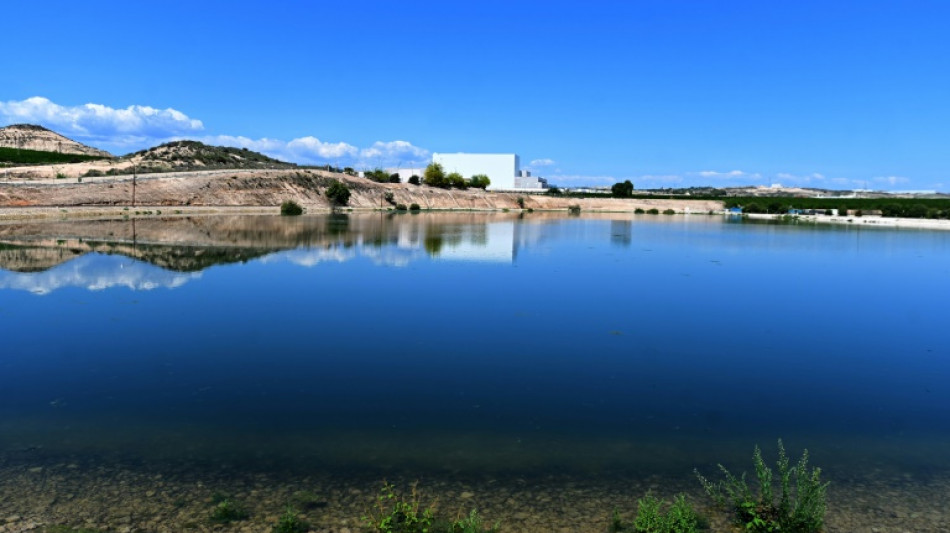
'Every drop counts': Spain's crops thrive on wastewater / Photo: JOSE JORDAN - STR/AFP

 NBA close to picking new $12-13bn Vegas team owners: report

 LA28 Olympics torch relay to visit all 50 states

 Spain brush aside Croatia in Nations League, England down Czechs

 Trump hails 'morally binding' AI self-regulation pledge

 Yamal inspires Spain to Croatia romp on World Cup homecoming

 UN to hold fourth informal poll of secretary-general candidates
 Who are the Emiratis behind crisis-hit Manchester City?

 Singer Angelique Kidjo urges Africans to 'create together'

 Alleged Rihanna mansion shooter mentally fit for trial, says judge
 Mystery over UK airbase scare as police find petrol not explosives

 OpenAI unveils low-cost AI model, a day after shelving Astra upgrade

 Premier League confirms Man City guilty of serious financial breaches
 Brazil's Lula turns to Bad Bunny tune to criticise Trump ahead of polls

 Nigerian dancer eyes world record after seven-day marathon

 Swiss regulator concludes Julius Baer bank probe

 Brazil's patron saint pulled into latest election scrap

 Football overload leaves players near 'breaking point', warns Tebas
 Paris Eiffel Tower says chief to step down after uproar over removing women staff

 Amaze Holdings (NYSE: AMZE) Executes Binding LOI to Acquire BullionFX | Alchemy, a Decentralized Gold-Backed Financial Ecosystem for Valued at US$155 Million

 Clashes between French teens, police as school blockades intensify
 Stocks move sideways despite oil moving lower
 African leaders to gather in Egypt for business summit

 UK decides against charging foreign visitors for museums

 Dallaglio to sell England World Cup winners' medal

 Brazil come from behind to beat Australia 4-2 in friendly

With rainfall increasingly scarce, irrigating crops can be a major challenge, but farmers in southeastern Spain have long relied on recycled wastewater in a model that is winning attention abroad.
"Here the water is still dirty... but by the end, it will be crystal clear and bacteria-free," said Carlos Lardin, operations manager at Esamur, the public body overseeing wastewater management in the Murcia region.
At his feet, brownish water bubbled in a de-silting tank, the first step before being sifted, filtered and then biologically treated to give it "a second life", explained the 45-year-old engineer.
Some 23 years ago, Murcia -- an arid region with chronic water shortages that claims to be the EU's leading producer of fruit and vegetables -- set itself a huge challenge of reusing wastewater to irrigate its crops.
To that end, the region built a network of 100 treatment plants that process and disinfect water from the sewage system so it can be reused on the fields.
This treatment, which involves sand filters and ultraviolet rays, ensures that the water "is not contaminated" and doesn't transfer bacteria "such as E.coli" to the fruit and vegetables, Lardin said.
- 'An important resource' -
As a result, some 98 percent of the region's wastewater is reused today, compared with an average of nine percent across Spain and five percent across the EU, government figures show.
It is an important contribution given that the central government has recently restricted Murcia's huge water transfers from the Tagus River, whose levels have been dropping dangerously.
According to Esamur, 15 percent of the region's irrigation needs are met by recycled wastewater.
It's not enough to cover the need, but it's still important, said Feliciano Guillen, head of the Ceuti irrigation organisation which allocates water resources among farmers in northeastern Murcia.
Farmer Jose Penalver, who owns 10 hectares (25 acres) of land in the hills above Campos del Rio, agreed.
"Whatever (water) can be collected is good wherever it comes from as long as it's put to good use," said the 52-year-old apricot grower.
In his fields, an automated drip-irrigation system lets him limit water use to what is strictly necessary, in this case, two hours per day.
"Without this (recycled) water, everything here would dry up," he said.
"Every drop counts."
- 'A precious resource' -
To protect its agriculture from the threat of global warming, the Spanish government in May pledged to increase the national rate of wastewater usage, releasing 1.4 billion euros ($1.5 billion) to build the necessary infrastructure.
"Water is a precious resource which can also be recycled... it's worth the effort," said Ecology Minister Teresa Ribera earlier this month, flagging the importance of working with small towns and villages who "find it difficult to make such an investment".
According to the Spanish Association for Desalination and Water Reuse (AEDyR), 27 percent of its 2,000 wastewater treatment plans can purify water to a level that can be used for agriculture.
And that figure could easily be increased with greater investment.
Cheaper than desalinating seawater, recycling wastewater has sparked interest abroad, with France's President Emmanuel Macron saying in March he wanted to increase water reuse along the same lines as Spain.
Evidence of this growing interest has been seen in Murcia, where in recent months, "many foreign delegations have come to see our facilities", said Esamur's Lardin, pointing to visitors from as far afield as Argentina and Bolivia.
"This water doesn't depend on the weather, and at very least, it guarantees a stable quantity of water for irrigation," he said.
F.Wilson--AT