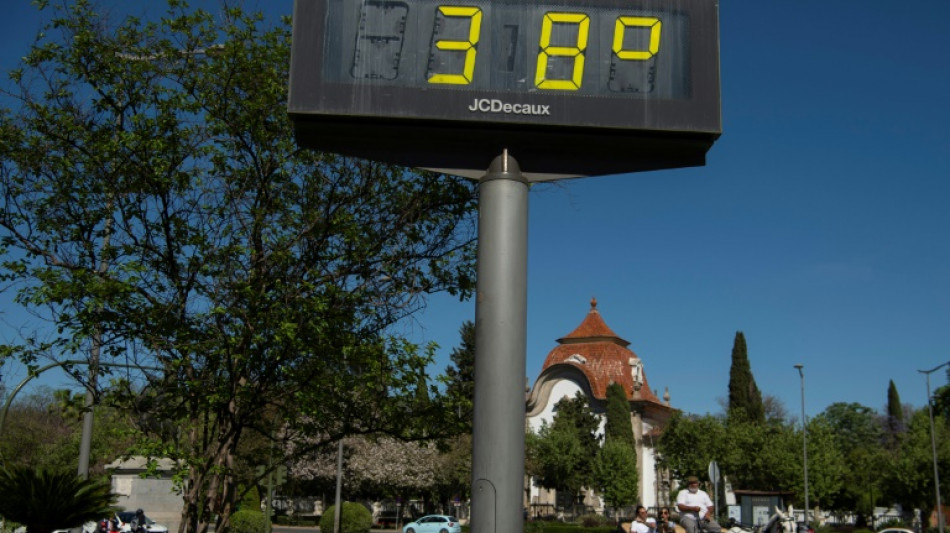
Europe is world's fastest warming continent: climate report / Photo: JORGE GUERRERO - AFP/File

 NBA close to picking new $12-13bn Vegas team owners: report
 LA28 Olympics torch relay to visit all 50 states
 Spain brush aside Croatia in Nations League, England down Czechs

 Trump hails 'morally binding' AI self-regulation pledge

 Yamal inspires Spain to Croatia romp on World Cup homecoming

 UN to hold fourth informal poll of secretary-general candidates

 Who are the Emiratis behind crisis-hit Manchester City?

 Singer Angelique Kidjo urges Africans to 'create together'

 Alleged Rihanna mansion shooter mentally fit for trial, says judge
 Mystery over UK airbase scare as police find petrol not explosives

 OpenAI unveils low-cost AI model, a day after shelving Astra upgrade
 Premier League confirms Man City guilty of serious financial breaches
 Brazil's Lula turns to Bad Bunny tune to criticise Trump ahead of polls

 Nigerian dancer eyes world record after seven-day marathon

 Swiss regulator concludes Julius Baer bank probe
 Brazil's patron saint pulled into latest election scrap

 Football overload leaves players near 'breaking point', warns Tebas

 Paris Eiffel Tower says chief to step down after uproar over removing women staff

 Amaze Holdings (NYSE: AMZE) Executes Binding LOI to Acquire BullionFX | Alchemy, a Decentralized Gold-Backed Financial Ecosystem for Valued at US$155 Million
 Clashes between French teens, police as school blockades intensify
 Stocks move sideways despite oil moving lower
 African leaders to gather in Egypt for business summit
 UK decides against charging foreign visitors for museums

 Dallaglio to sell England World Cup winners' medal

 Brazil come from behind to beat Australia 4-2 in friendly

Europe should brace for more deadly heatwaves driven by climate change, said a sweeping report on Monday, noting the world's fastest-warming continent was some 2.3 degrees Celsius hotter last year than in pre-industrial times.
Crop-withering drought, record sea-surface temperatures and unprecedented glacier melt are among the consequences laid out in a report by the World Meteorological Organization and the European Union's Copernicus Climate Change Service.
The continent, which has been warming twice the global average since the 1980s, saw its warmest summer on record last year, with countries including France, Germany, Italy, Portugal, Spain and the United Kingdom experiencing their warmest year on record.
The world has warmed an average of nearly 1.2C since the mid-1800s, unleashing a devastating cascade of extreme weather, including more intense heatwaves, more severe droughts in some areas and storms made more ferocious by rising seas.
Hardest hit are the most vulnerable people and the world's poorest countries, who have done little to contribute to the fossil fuel emissions that drive up temperatures.
But impacts are becoming increasingly severe across the world, with regions in the northern hemisphere and around the poles seeing particularly rapid warming.
In Europe, the high temperatures "exacerbated the severe and widespread drought conditions, fuelled violent wildfires that resulted in the second largest burnt area on record, and led to thousands of heat-associated excess deaths," said WMO Secretary-General Petteri Taalas.
Temperatures across the continent rose 1.5C in 30 years, from 1991 to 2021, according to the report, the State of the Climate in Europe 2022.
Severe heat left more than 16,000 people dead last year, the report said, while floods and storms accounted for most of the $2 billion in damages from weather and climate extremes.
"Unfortunately, this cannot be considered a one-off occurrence or an oddity of the climate," said Copernicus Director Carlo Buontempo in the report.
"Our current understanding of the climate system and its evolution informs us that these kinds of events are part of a pattern that will make heat stress extremes more frequent and more intense across the region."
- Renewable hopes -
Increasing temperatures have taken a toll on economies and ecosystems, the report said.
In the Alps, glaciers saw a new record mass loss for a single year in 2022, caused by very low winter levels of snow, a hot summer as well as deposits of wind-blown Saharan dust.
The story was similar in the oceans, with average sea surface temperatures in the North Atlantic the hottest on record, with warming rates in the eastern Mediterranean Sea, the Baltic and Black Seas and the southern Arctic more than three times the global average.
Marine heat waves -- which can displace or even kill species -- also lasted for up to five months in several regions including the western Mediterranean Sea, English Channel and southern Arctic.
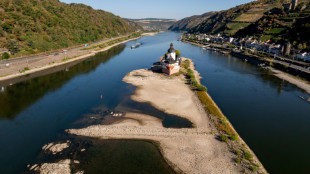
Rainfall was below normal across much of the continent, hitting agricultural production and water reserves while creating the conditions for wildfires.
The year saw the second largest burnt area in the region on record, with large fires scorching across parts of France, Spain, Portugal, Slovenia and the Czech Republic.
The Spanish water reserve decreased to less than half of capacity by July as the Iberian Peninsula saw its fourth drier-than-average year in a row in 2022.
Farmers could not irrigate their fields in parts of France, while the dry conditions hit harvests for cereals and grapes in Germany.
The drought also affected energy production, leading to reductions in hydroelectric power as well as output from some nuclear power stations which rely on water supplies for cooling.
But, in one positive sign for the future, the report noted that wind and solar power generated 22.3 percent of European Union electricity in 2022, overtaking fossil gas (20 percent) for the first time.
The report said this was due to a combination of factors, including a "significant increase" in installed solar power last year.
"Solar and wind tend to complement each other throughout the year: solar radiation is higher in late spring and summer while wind intensity is usually higher in winter," the report said.
While there has been no significant trend in wind or rain patterns in Europe over the last 30 years, the report said there was a marked increase in sunlight, with 2022 seeing the highest amount of solar radiation since records began in 1983.
A.Williams--AT