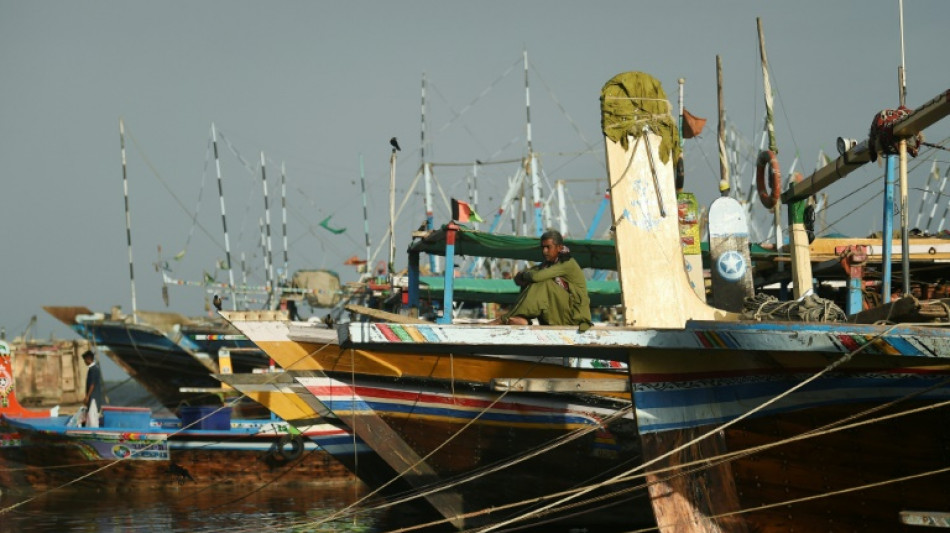
Gales lash India and Pakistan coast as cyclone approaches / Photo: Asif HASSAN - AFP

 NBA close to picking new $12-13bn Vegas team owners: report
 LA28 Olympics torch relay to visit all 50 states

 Spain brush aside Croatia in Nations League, England down Czechs

 Trump hails 'morally binding' AI self-regulation pledge

 Yamal inspires Spain to Croatia romp on World Cup homecoming

 UN to hold fourth informal poll of secretary-general candidates

 Who are the Emiratis behind crisis-hit Manchester City?

 Singer Angelique Kidjo urges Africans to 'create together'

 Alleged Rihanna mansion shooter mentally fit for trial, says judge
 Mystery over UK airbase scare as police find petrol not explosives

 OpenAI unveils low-cost AI model, a day after shelving Astra upgrade

 Premier League confirms Man City guilty of serious financial breaches
 Brazil's Lula turns to Bad Bunny tune to criticise Trump ahead of polls

 Nigerian dancer eyes world record after seven-day marathon

 Swiss regulator concludes Julius Baer bank probe

 Brazil's patron saint pulled into latest election scrap

 Football overload leaves players near 'breaking point', warns Tebas

 Paris Eiffel Tower says chief to step down after uproar over removing women staff

 Amaze Holdings (NYSE: AMZE) Executes Binding LOI to Acquire BullionFX | Alchemy, a Decentralized Gold-Backed Financial Ecosystem for Valued at US$155 Million

 Clashes between French teens, police as school blockades intensify

 Stocks move sideways despite oil moving lower
 African leaders to gather in Egypt for business summit
 UK decides against charging foreign visitors for museums

 Dallaglio to sell England World Cup winners' medal

 Brazil come from behind to beat Australia 4-2 in friendly

Howling gales and crashing waves pounded the coastline of India and Pakistan on Thursday hours before a powerful cyclone was due to make landfall, with those unable to flee seeking shelter where they could.
Nearly 150,000 people have fled the predicted path of Cyclone Biparjoy, whose name means "disaster" in Bengali, with meteorologists warning it could devastate homes and tear down power lines when it lands late Thursday.
Powerful winds and storm surges were forecast to hammer a 325-kilometre (200-mile) stretch of coast between Mandvi in India's Gujarat state and Karachi in Pakistan.
Jayantha Bhai, a 35-year-old shopkeeper in India's beach town of Mandvi, told AFP soon after dawn on Thursday that he was afraid for his family's safety.
"This is the first time I've experienced a cyclone," Bhai said, a father of three boys aged between eight and 15, who planned to wait out the cyclone in his small concrete home behind the shop.
"This is nature, we can't fight with it," he said as driving rain lashed his home.
India's Meteorological Department predicted the "very severe" storm would hit near the Indian port of Jakhau on Thursday evening, warning of "total destruction" of traditional mud and straw thatched homes.
At sea, winds were gusting at up to 180 kilometres per hour (112 miles per hour), with speeds predicted to reach 115-125 kph and gusts of up to 140 kph by the time it makes landfall.
India's meteorologists warned of the potential for "widespread damage", including the destruction of crops, "bending or uprooting of power and communication poles" and disruption of railways and roads.
- Schools turned shelters -
In India, the Gujarat state government said 75,000 people had relocated from coastal and low-lying areas to shelter.
Pakistan's climate change minister Sherry Rehman said on Wednesday 73,000 people had been moved from southeastern coastal areas and housed in 75 relief camps.
"It is a cyclone the likes of which Pakistan has never experienced," she told reporters.
Many of the areas affected are the same inundated in last year's catastrophic monsoon floods, which put a third of Pakistan under water, damaging two million homes and killing more than 1,700 people.
"These are all results of climate change," she said.
Storm surges were expected to reach 3.5 metres (11.5 feet), with flooding possible in the megacity of Karachi, home to about 20 million people.
"Our concern is when the cyclone is over, how will we feed our children?" said 80-year-old Wilayat Bibi, in a relief camp in the city of Badin.
"If our boats are gone. If our huts are also gone. We will be languishing with no resources."
- 'Terrified' -
Late on Wednesday, a short distance from India's Jakhau port, about 200 people from the Kutch district huddled together in a single-storey health centre.
Many were worried about their farm animals, which they had left behind.
Dhal Jetheeben Ladhaji, 40, a pharmacist at the health centre, said 10 men had stayed behind to look after hundreds of cattle crucial to their village's livelihood.
"We are terrified, we don't know what will happen next," Ladhaji said.
"We are praying to God that the cyclone does not come, and that these people who are staying in the shelter can go back to their homes with smiles on their faces."
Cyclones -- the equivalent of hurricanes in the North Atlantic or typhoons in the Northwest Pacific -- are a regular and deadly menace on the coast of the northern Indian Ocean, where tens of millions of people live.
Scientists have warned that storms are becoming more powerful as the world gets warmer with climate change.
burs-pjm/dva
F.Wilson--AT