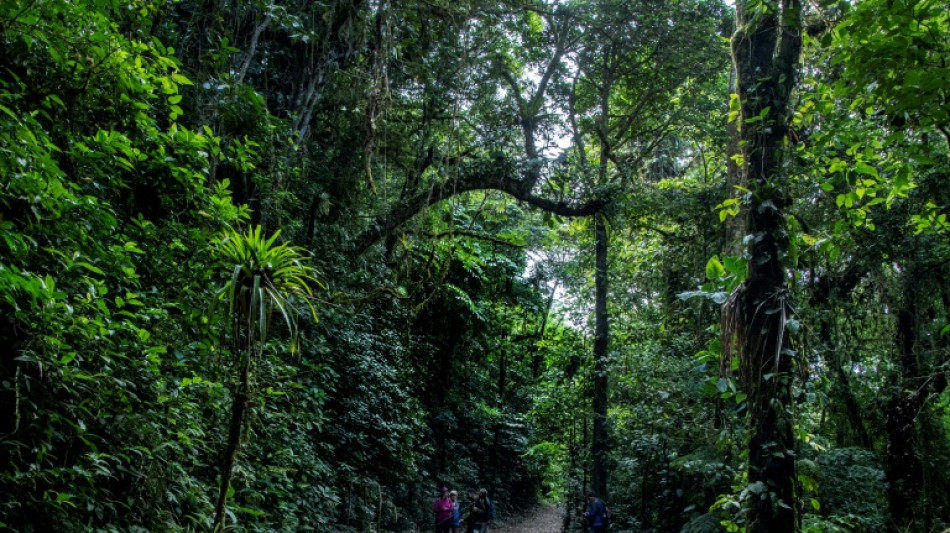
In Costa Rica, climate change threatens 'cloud forest' / Photo: Ezequiel BECERRA - AFP

 NBA close to picking new $12-13bn Vegas team owners: report
 LA28 Olympics torch relay to visit all 50 states

 Spain brush aside Croatia in Nations League, England down Czechs

 Trump hails 'morally binding' AI self-regulation pledge

 Yamal inspires Spain to Croatia romp on World Cup homecoming

 UN to hold fourth informal poll of secretary-general candidates

 Who are the Emiratis behind crisis-hit Manchester City?

 Singer Angelique Kidjo urges Africans to 'create together'

 Alleged Rihanna mansion shooter mentally fit for trial, says judge
 Mystery over UK airbase scare as police find petrol not explosives

 OpenAI unveils low-cost AI model, a day after shelving Astra upgrade

 Premier League confirms Man City guilty of serious financial breaches
 Brazil's Lula turns to Bad Bunny tune to criticise Trump ahead of polls

 Nigerian dancer eyes world record after seven-day marathon

 Swiss regulator concludes Julius Baer bank probe
 Brazil's patron saint pulled into latest election scrap

 Football overload leaves players near 'breaking point', warns Tebas

 Paris Eiffel Tower says chief to step down after uproar over removing women staff

 Amaze Holdings (NYSE: AMZE) Executes Binding LOI to Acquire BullionFX | Alchemy, a Decentralized Gold-Backed Financial Ecosystem for Valued at US$155 Million

 Clashes between French teens, police as school blockades intensify

 Stocks move sideways despite oil moving lower
 African leaders to gather in Egypt for business summit

 UK decides against charging foreign visitors for museums

 Dallaglio to sell England World Cup winners' medal

 Brazil come from behind to beat Australia 4-2 in friendly

The "cloud forest" of Monteverde, in the center of Costa Rica, will soon no longer be worthy of the name: climate change threatens this unique ecosystem, and its fauna and flora face an unclear future under a brilliant blue sky.
In the forest, what a visitor should hear is the constant drip of moisture falling from the trees. Instead, it is the sound of dead branches snapping underfoot that breaks the silence on the dry trails.
The high-altitude forest is still clinging to life, and it delights walkers with an infinite variety of greens under an uncomfortably bright sun: the fog which reigned supreme here only a short time ago dissipates as the temperature rises, explained 24-year-old forest guide Andrey Castrillo.
"The forest should be cool," he said. "You should hear the drops falling all over the forest, but that only happens during the wettest and windiest days of the rainy season."
"Here there was no sun... We had about 30 days of sunshine a year. Now we have more than 130," he said.
At 1,400 meters (4,600 feet) above sea level and 140 kilometers (86 miles) northwest of the capital San Jose, the private nature reserve extends over 14,200 hectares (35,000 acres) and is home to a hundred species of mammals, 440 bird species and 1,200 types of amphibians.
- 'Walking in the clouds' -
This exceptional type of altitude forest represents only one percent of the world's tropical and subtropical areas.
"Near-ground cloud cover forms when the humidity saturation is above 90 percent with temperatures between 14 and 18 degrees Celsius (57 to 64 degrees Fahrenheit)," researcher Ana Maria Duran, of the University of Costa Rica, told AFP.
The researcher said she had been coming here regularly for more than twenty years.
Normally, the "almost permanent" fog gives the impression of "practically walking in the middle of the clouds," with visibility down to barely a meter (three feet).
As she spoke, she stared into the forest where the temperature had risen to more than 25 degrees Celsius, under a blue sky where only a few clouds crowned the peaks.
"Coming to Monteverde to find such dry conditions and not being in the clouds like it was 20 years ago when I started coming is obviously very sad," said Duran.
Rising temperatures mean lower humidity and more sun. The mosses have dried on the tree trunks, the rivers are no more than streams, and the amphibians here have been the first victims of climate change.
"The decline of amphibians in cloud forests may serve as a wake-up call," warned biologist Andrea Vincent, who teaches at the University of Costa Rica.
Already, the species Incilius periglenes, known as the golden frog, has been considered extinct since 2019 by the International Union for Conservation of Nature (IUCN).
"A cloudless cloud forest, it will disappear, it has to," said Vincent, warning that "there will be a lot of extinctions" of various species.
But this "dispiriting scenario" can still be avoided, she said.
"Ecosystems are resilient. If we make efforts to stop climate change it is possible that cloud forests will recover... not during our lifetime but perhaps for the next generations".
M.Robinson--AT