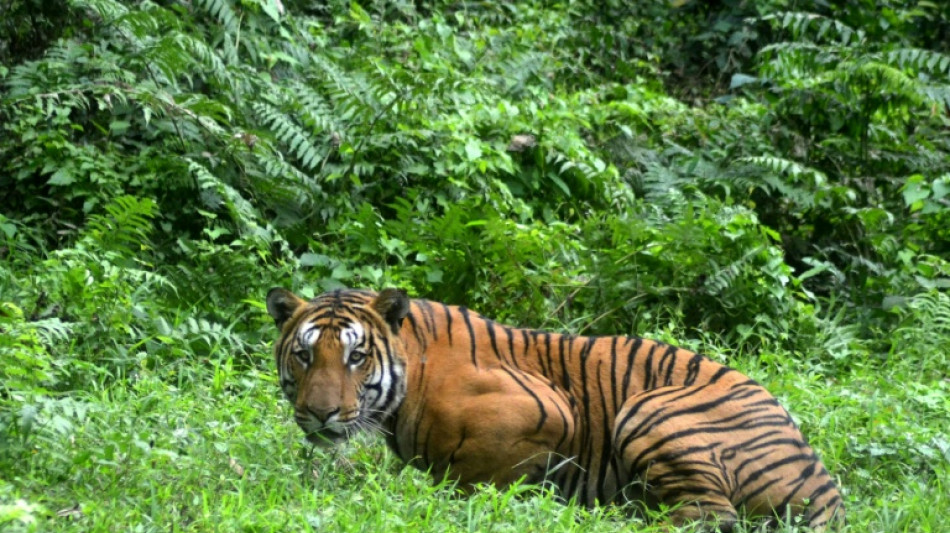
Protecting India's tigers also good for climate: study / Photo: STR - AFP/File

 Alleged Rihanna mansion shooter mentally fit for trial, says judge

 Mystery over UK airbase scare as police find petrol not explosives

 OpenAI unveils low-cost AI model, a day after shelving Astra upgrade

 Premier League confirms Man City guilty of serious financial breaches

 Brazil's Lula turns to Bad Bunny tune to criticise Trump ahead of polls

 Nigerian dancer eyes world record after seven-day marathon

 Swiss regulator concludes Julius Baer bank probe

 Brazil's patron saint pulled into latest election scrap

 Football overload leaves players near 'breaking point', warns Tebas

 Paris Eiffel Tower says chief to step down after uproar over removing women staff

 Amaze Holdings (NYSE: AMZE) Executes Binding LOI to Acquire BullionFX | Alchemy, a Decentralized Gold-Backed Financial Ecosystem for Valued at US$155 Million

 Clashes between French teens, police as school blockades intensify

 Stocks move sideways despite oil moving lower

 African leaders to gather in Egypt for business summit

 UK decides against charging foreign visitors for museums

 Dallaglio to sell England World Cup winners' medal

 Brazil come from behind to beat Australia 4-2 in friendly

 Ruthless An retains Asian Games badminton crown as Kunlavut triumphs

 Alonso to stay with F1 team Aston Martin in 2027

 China badminton 'still strong' despite Asian Games slump

 'Exceptional' Turner painting shown in Rome before sale

 European stocks climb as oil dips

 Spain aims to ban evictions until 2030 amid housing protests

 Kunlavut first Thai man to win Asian Games badminton singles gold

 French far right says antisemitism claims part of 'total war' to derail presidency bid

India's efforts to protect its endangered tigers have inadvertently helped avoid a large amount of climate change-causing carbon emissions by preventing deforestation, a study said on Thursday.
Three-quarters of the world's wild tigers live in India, but the destruction of their natural habitat have seen their numbers plummet.
The number of tigers roaming the country's forests fell from 40,000 when India gained independence in 1947 to just 1,500 in 2006.
However their number rose above 3,000 this year, according to the latest official figures.
To help their numbers rebound, India has designated 52 tiger reserves where logging and deforestation are heavily regulated.
Aakash Lamba, a researcher at the National University of Singapore and the new study's lead author, told AFP that tigers are an "umbrella species".
This "means that by protecting them we also protect the forests they live in, which are home to an incredible diversity of wildlife," he told AFP.
Forests are a "carbon sink", which mean they absorb more carbon dioxide from the atmosphere than they release, making them a crucial tool in the fight against climate change.
India, the world's third largest emitter of greenhouse gases, has pledged to lower its emissions.
- Million metric tons -
Lamba, who grew up in India, said the team of researchers sought to establish an empirical link between tiger conservation and carbon emissions.
They compared the rate of deforestation in the special tiger reserves to areas where the big cats also live, but are less strictly protected.
More than 61,000 hectares of forest was lost across 162 different areas between 2001 and 2020, according to the study.
More than three quarters of the deforestation was in areas outside of the tiger reserves.
Inside the tiger reserves, almost 6,000 hectares was saved from deforestation between 2007 to 2020. That equates to more than a million metric tons of carbon emissions avoided, the study estimated.
Lamba emphasised the economic impact of those saved emissions in a country that has been hit hard by the effects of climate change -- particularly the agricultural industry.
Taking into account the social cost of those emissions, more than $92 million had been saved, the researchers calculated.
If counted as part of an carbon offset scheme, the avoided deforestation amounted to more than $6 million, they added.
"The financial benefits of avoiding carbon emissions are more than a quarter of the annual expenditure on tiger conservation in India," Lamba said.
"This significant outcome highlights how investments in wildlife conservation not only safeguard ecosystems and wildlife but also benefit societies and economies."
The study was published in the journal Nature Ecology & Evolution.
The findings come after a study published in March suggested protecting or restoring a handful of wild animals such as whales, wolves and otters could help capture 6.4 billion tons of carbon dioxide every year.
T.Wright--AT