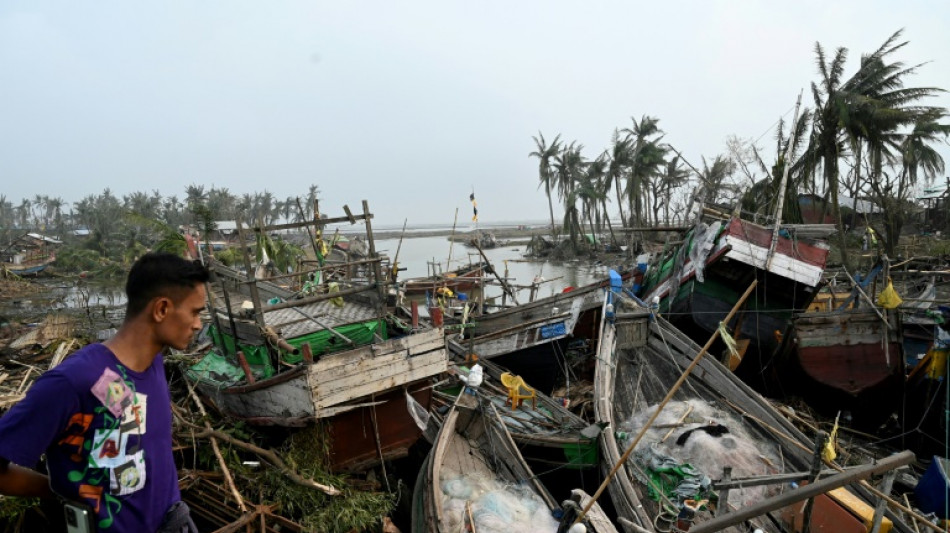
Early warning systems send disaster deaths plunging: UN / Photo: Sai Aung MAIN - AFP

 Alleged Rihanna mansion shooter mentally fit for trial, says judge
 Mystery over UK airbase scare as police find petrol not explosives

 OpenAI unveils low-cost AI model, a day after shelving Astra upgrade

 Premier League confirms Man City guilty of serious financial breaches
 Brazil's Lula turns to Bad Bunny tune to criticise Trump ahead of polls

 Nigerian dancer eyes world record after seven-day marathon

 Swiss regulator concludes Julius Baer bank probe
 Brazil's patron saint pulled into latest election scrap

 Football overload leaves players near 'breaking point', warns Tebas
 Paris Eiffel Tower says chief to step down after uproar over removing women staff

 Amaze Holdings (NYSE: AMZE) Executes Binding LOI to Acquire BullionFX | Alchemy, a Decentralized Gold-Backed Financial Ecosystem for Valued at US$155 Million
 Clashes between French teens, police as school blockades intensify
 Stocks move sideways despite oil moving lower
 African leaders to gather in Egypt for business summit
 UK decides against charging foreign visitors for museums

 Dallaglio to sell England World Cup winners' medal

 Brazil come from behind to beat Australia 4-2 in friendly

 Ruthless An retains Asian Games badminton crown as Kunlavut triumphs

 Alonso to stay with F1 team Aston Martin in 2027
 China badminton 'still strong' despite Asian Games slump

 'Exceptional' Turner painting shown in Rome before sale

 European stocks climb as oil dips

 Spain aims to ban evictions until 2030 amid housing protests

 Kunlavut first Thai man to win Asian Games badminton singles gold

 French far right says antisemitism claims part of 'total war' to derail presidency bid

Weather-related disasters have surged over the past 50 years, causing swelling economic damage even as early warning systems have meant dramatically fewer deaths, the United Nations said Monday.
Extreme weather, climate and water-related events caused 11,778 reported disasters between 1970 and 2021, new figures from the UN's World Meteorological Organization (WMO) show.
Those disasters killed just over two million people and caused $4.3 trillion in economic losses.
"The most vulnerable communities unfortunately bear the brunt of weather, climate and water-related hazards," WMO chief Petteri Taalas said in a statement.
The report found that over 90 percent of reported deaths worldwide due to disasters over the 51-year-period occurred in developing countries.
But the agency also said improved early warning systems and coordinated disaster management had significantly reduced the human casualty toll.
WMO pointed out in a report issued two years ago covering disaster-linked deaths and losses between 1970 and 2019, that at the beginning of the period the world was seeing more than 50,000 such deaths each year.
By the 2010s, the disaster death toll had dropped to below 20,000 annually.
And in its update of that report, WMO said Monday that 22,608 disaster deaths were recorded globally in 2020 and 2021 combined.
- 'Early warnings save lives' -
Cyclone Mocha, which wreaked havoc in Myanmar and Bangladesh last week, exemplifies this, Taalas said.
Mocha "caused widespread devastation... impacting the poorest of the poor," he said.
But while Myanmar's junta has put the death toll from the cyclone at 145, Taalas pointed out that during similar disasters in the past, "both Myanmar and Bangladesh suffered death tolls of tens and even hundreds of thousands of people".
"Thanks to early warnings and disaster management these catastrophic mortality rates are now thankfully history. Early warnings save lives."
The UN has launched a plan to ensure all nations are covered by disaster early warning systems by the end of 2027.
Endorsing that plan figures among the top strategic priorities during a meeting of WMO's decision-making body, the World Meteorological Congress, which opens Monday.
To date, only half of countries have such systems in place.
- Surging economic losses -
WMO meanwhile warned that while deaths have plunged, the economic losses incurred when weather, climate and water extremes hit have soared.
The agency previously recorded economic losses increased sevenfold between 1970 and 2019, rising from $49 million per day during the first decade to $383 million per day in the final one.
Wealthy countries have been hardest hit by far in monetary terms.
The United States alone incurred $1.7 trillion in losses, or 39 percent of economic losses globally due to disasters since 1970.
But while the dollar figures on losses suffered in poorer nations were not particularly high, they were far higher in relation to the size of their economies, WMO noted.
Developed nations accounted for over 60 percent of losses due to weather, climate and water disasters, but in more than four-fifths of cases, the economic losses were equivalent to less than 0.1 percent of gross domestic product (GDP).
And no disasters saw reported economic losses greater than 3.5 percent of the respective GDPs.
By comparison, in seven percent of the disasters to hit the world's least developed countries, losses equivalent to more than five percent of their GDP were reported, with several disasters causing losses equivalent to nearly a third of GDP.
And for small island developing states, one fifth of disasters saw economic losses of over five percent of GDP, with some causing economic losses above 100 percent.
O.Ortiz--AT