'Big sponge': new CO2 tech taps oceans to tackle global warming / Photo: Patrick T. Fallon - AFP

 Alleged Rihanna mansion shooter mentally fit for trial, says judge
 Mystery over UK airbase scare as police find petrol not explosives

 OpenAI unveils low-cost AI model, a day after shelving Astra upgrade
 Premier League confirms Man City guilty of serious financial breaches
 Brazil's Lula turns to Bad Bunny tune to criticise Trump ahead of polls

 Nigerian dancer eyes world record after seven-day marathon

 Swiss regulator concludes Julius Baer bank probe
 Brazil's patron saint pulled into latest election scrap

 Football overload leaves players near 'breaking point', warns Tebas

 Paris Eiffel Tower says chief to step down after uproar over removing women staff

 Amaze Holdings (NYSE: AMZE) Executes Binding LOI to Acquire BullionFX | Alchemy, a Decentralized Gold-Backed Financial Ecosystem for Valued at US$155 Million

 Clashes between French teens, police as school blockades intensify
 Stocks move sideways despite oil moving lower
 African leaders to gather in Egypt for business summit

 UK decides against charging foreign visitors for museums

 Dallaglio to sell England World Cup winners' medal

 Brazil come from behind to beat Australia 4-2 in friendly

 Ruthless An retains Asian Games badminton crown as Kunlavut triumphs

 Alonso to stay with F1 team Aston Martin in 2027

 China badminton 'still strong' despite Asian Games slump

 'Exceptional' Turner painting shown in Rome before sale

 European stocks climb as oil dips

 Spain aims to ban evictions until 2030 amid housing protests

 Kunlavut first Thai man to win Asian Games badminton singles gold

 French far right says antisemitism claims part of 'total war' to derail presidency bid

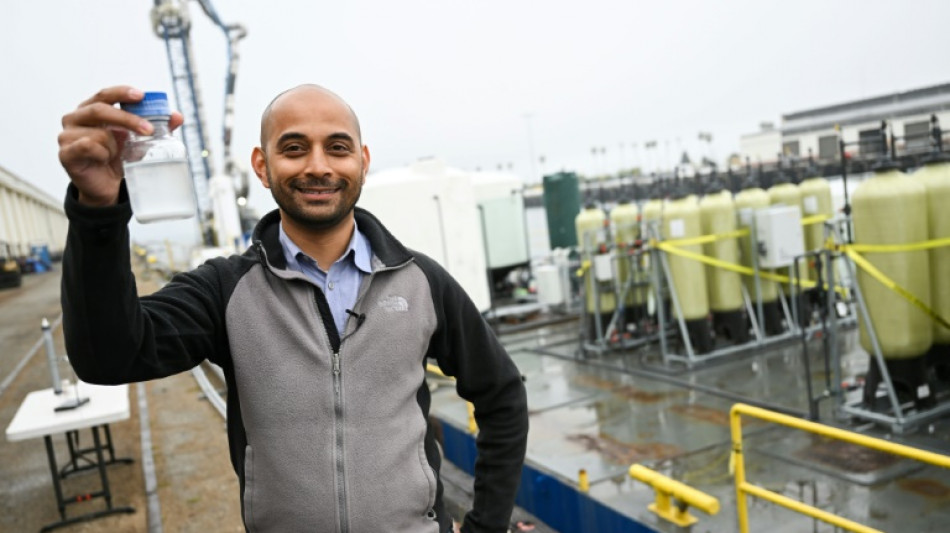
Floating in the port of Los Angeles, a strange-looking barge covered with pipes and tanks contains a concept that scientists hope to make waves: a new way to use the ocean as a vast carbon dioxide sponge to tackle global warming.
Scientists from University of California Los Angeles (UCLA) have been working for two years on SeaChange -- an ambitious project that could one day boost the amount of CO2, a major greenhouse gas, that can be absorbed by our seas.
Their goal is "to use the ocean as a big sponge," according to Gaurav Sant, director of the university's Institute for Carbon Management (ICM).
The oceans, covering most of the Earth, are already the planet's main carbon sinks, acting as a critical buffer in the climate crisis.
They absorb a quarter of all CO2 emissions, as well as 90 percent of the warming that has occurred in recent decades due to increasing greenhouse gases.
But they are feeling the strain. The ocean is acidifying, and rising temperatures are reducing its absorption capacity.
The UCLA team wants to increase that capacity by using an electrochemical process to remove vast quantities of CO2 already in seawater -- rather like wringing out a sponge to help recover its absorptive power.
"If you can take out the carbon dioxide that is in the oceans, you're essentially renewing their capacity to take additional carbon dioxide from the atmosphere," Sant told AFP.
- Trapped -
Engineers built a floating mini-factory on a 100-foot (30-meter) long boat which pumps in seawater and subjects it to an electrical charge.
Chemical reactions triggered by electrolysis convert CO2 dissolved in the seawater into a fine white powder containing calcium carbonate -- the compound found in chalk, limestone and oyster or mussel shells.
This powder can be discarded back into the ocean, where it remains in solid form, thereby storing CO2 "very durably... over tens of thousands of years," explained Sant.
Meanwhile, the pumped water returns to the sea, ready to absorb more carbon dioxide from the atmosphere.
Sant and his team are confident the process will not damage the marine environment, although this will require further testing to confirm.
A potential additional benefit of the technology is that it creates hydrogen as a byproduct. As the so-called "green revolution" progresses, the gas could be widely used to power clean cars, trucks and planes in the future.
Of course, the priority in curbing global warming is for humans to drastically reduce current CO2 emissions -- something we are struggling to achieve.
But in parallel, most scientists say carbon dioxide capture and storage techniques can play an important role in keeping the planet livable.
Carbon dioxide removal (CDR) could help to achieve carbon neutrality by 2050 as it offsets emissions from industries which are particularly difficult to decarbonize, such as aviation, and cement and steel production.
It could help to tackle the stocks of CO2 that have been accumulating in the atmosphere for decades.
- 'Promising solution' -
Keeping global warming under control will require the removal of between 450 billion and 1.1 trillion tons of CO2 from the atmosphere by 2100, according to the first global report dedicated to the topic, released in January.
That would require the CDR sector "to grow at a rate of about 30 percent per year over the next 30 years, much like what happened with wind and solar," said one of its authors, Gregory Nemet.
UCLA's SeaChange technology "fits into a category of a promising solution that could be large enough to be climate-relevant," said Nemet, a professor at the University of Wisconsin-Madison.
By sequestering CO2 in mineral form within the ocean, it differs markedly from existing "direct air capture" (DAC) methods, which involve pumping and storing gas underground through a highly complex and expensive process.
A start-up company, Equatic, plans to scale up the UCLA technology and prove its commercial viability, by selling carbon credits to manufacturers wanting to offset their emissions.
In addition to the Los Angeles barge, a similar boat is currently being tested in Singapore.
Sant hopes data from both sites will quickly lead to the construction of far larger plants that are capable of removing "thousands of tons of carbon" each year.
"We expect to start operating these new plants in 18 to 24 months," he said.
W.Nelson--AT