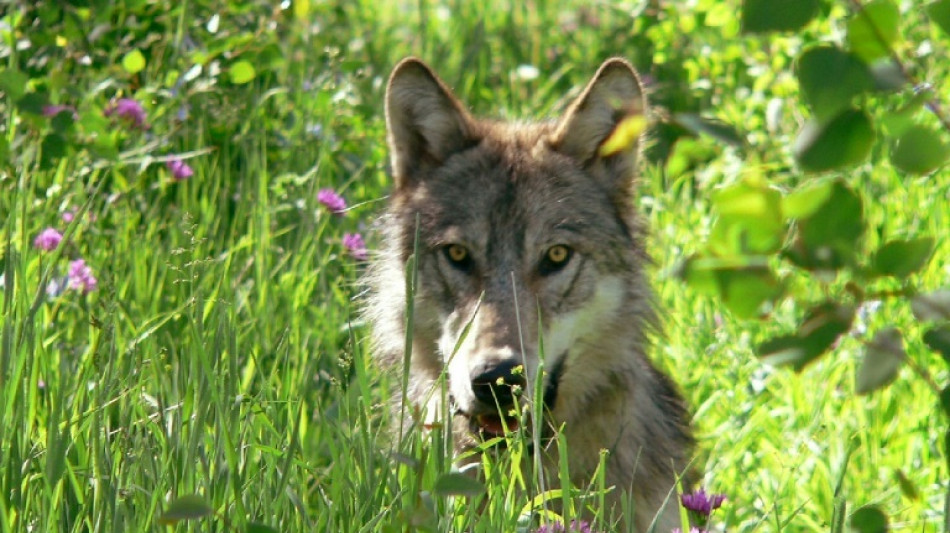
Wolves emboldened by parasite more likely to lead pack: study / Photo: - - Montana Fish, Wildlife & Parks/AFP/File

 Argentina begin life after Messi with Bolivia friendly

 Helen Mirren delves into Patricia Highsmith's mind in 'A Talent for Murder'

 Sanders, Bannon warn of AI dangers in rare US left-right alignment

 US Senate crypto bill collapses amid partisan deadlock

 Raptors confirm Leonard return after Clippers salary cap scandal

 Empty benches as schools reopen in Venezuela's quake-hit Guaira

 US judge rules Trump's name must remain off Kennedy Center

 Samson fires India to T20 series win over Afghanistan

 Carney sells Canada to global investors but says US ties still key

 Tiny English village holds 'independence' vote over asylum seeker housing

 Trump slams Supreme Court over 'horrible' mail-in ballot ruling

 Protesting shepherds, farmers clash with Romanian police

 Saudi, Egypt demand open Red Sea, as Riyadh vows to hit back against Houthis

 Foundation Lets Ledger Users Switch to Open Source Without Starting Over

 Canada remains 'most important partner' for US in 'key areas': Carney

 Carrick urges Man Utd to use derby pain as fuel against Brighton

 Turkey police detain dozens over pro-LGBTQ Istanbul rally

 'Kenya's moment' as Nairobi to host 2029 world athletics champs in African first

 China warns against space 'battlefield' after US says weapons deployed

 Denmark says Russian frigate fired flares at helicopter

 EU to propose curbing social media, online games for under 15s

 FX Junction Reaches 40,600 Members and 26 Million Trades

 Prominent Greek neo-Nazi exits prison, vows return to politics

 'Obsessed': explosive state crime inquiry grips South Africa

 Sri Lanka's javelin champ returns to 'broken' welcome

Wolves infected with a common parasite are far more likely to become the leader of their pack, according to a new study, suggesting that the brain-dwelling intruder emboldens its host to take more risks.
The single-celled parasite, Toxoplasma gondii, only sexually reproduces in cats but can infect all warm-blooded animals.
Between 30-50 percent of people worldwide are estimated to be infected with the parasite, which remains for life as dormant tissue cysts. However people with a healthy immune system rarely have any symptoms.
While some studies have reported an association between people having the parasite in their brain and increased risk-taking, other research has disputed these findings and no definitive link has been proven.
The new study, published in the journal Communications Biology on Thursday, took advantage of 26 years' worth of data on grey wolves living in the Yellowstone National Park in the United States to investigate how the parasite could affect their behaviour.
The researchers from the Yellowstone Wolf Project analysed the blood samples of nearly 230 wolves and 62 cougars -- the big cats are known spreaders of the parasite.
They found that infected wolves were more likely to foray deeper into cougar territory than uninfected wolves.
Infected wolves were also 11 times more likely to leave their pack than wolves without the parasite, the study said, indicating a higher rate of risk-taking.
And an infected wolf is up to 46 times more likely to become pack leader, the researchers estimated, adding that the role is normally won by more aggressive animals.
Study co-author Kira Cassidy told AFP that while "being bolder is not necessarily a bad thing," it can "lower survival for the most bold animals as they might make decisions that put them in danger more often."
"Wolves do not have the survival space to take too many more risks than they already do."
Cassidy said it was only the second study on T. gondii's effect on a wild animal, after research last year found increased boldness in infected hyena cubs made them more likely to get closer to -- and killed by -- lions in Kenya.
Laboratory research has also found that rodents with the parasite lose their instinctual fear of cats -- driving them into the hands of the only host where T. gondii can reproduce.
William Sullivan, a professor of pharmacology and toxicology at the Indiana University School of Medicine who has been studying T.gondii for more than 25 years, called the wolf paper "a rare gem".
However he warned that such an observational study could not show causation.
"A wolf that is a born risk-taker may simply be more likely to venture into cougar territory and contract Toxoplasma," he said.
But "if the findings are correct, they suggest we may be underestimating the impact Toxoplasma has on ecosystems around the world," he added.
- What about humans? -
"That's the million-dollar question," Sullivan said, adding that "no one knows for sure and the literature is mixed".
Ajai Vyas, a T. gondii expert at Singapore's Nanyang Technological University, warned against inferring that infection could increase risk-taking in people.
"There is a lot about human behaviour that is different from other animals," he told AFP.
People often get infected by T. gondii from eating undercooked meat -- or via their pet cat, particularly when cleaning out their litter boxes.
In some cases, especially in people with weakened immune systems, T. gondii can lead to toxoplasmosis, a disease that can cause brain and eye damage.
T.Perez--AT