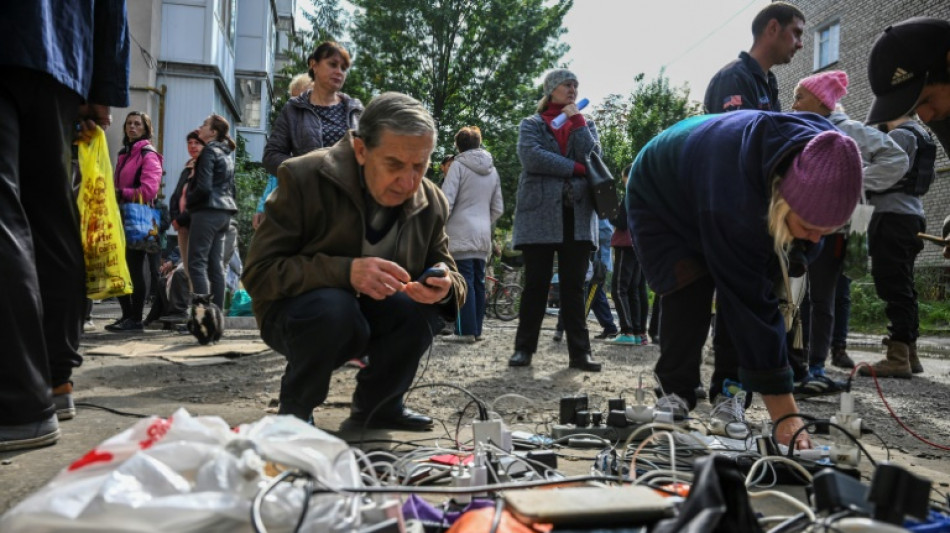
Makeshift wifi spot reconnects shattered Ukraine city / Photo: Juan BARRETO - AFP

 The "Everlasting Battery" Inside Your Joints:UConn Professor's Self-Powered Healing Material just Got Acquired

 Visionary or conman? Elon Musk enigmatic star of Venice documentary

 Trial opens in France over deadliest Channel migrant crossing disaster

 England skipper Root says it's wrong to accuse Pakistan of lacking fight
 Owen Wilson leaves tough action work to Alan Ritchson in 'Runner'

 France's BIC sees high potential in US pot smokers

 WHO says needs 5,000 more healthworkers to tackle Ebola in DRC

 Napoli's McTominay has successful heart procedure

 Two Renoir paintings missing after break-in at France museum

 Oil prices jump, stocks drop as Mideast war flares

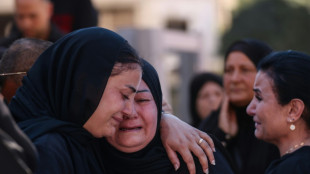 South Lebanon town buries its dead after Israeli strike
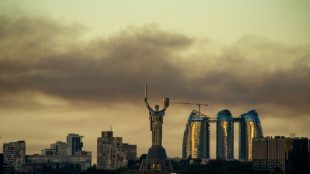
 Singapore to bump cabinet wages, already world's highest

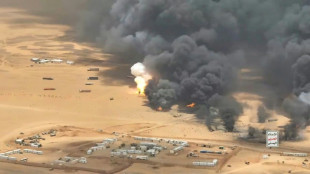 Saudi vows response as Houthis hit oil sites in worst attack in years

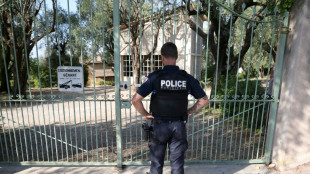 Thieves steal Renoir paintings from France museum
 Nicaragua accuses Germany of multiple violations of law in Gaza genocide case

 Dutch peanut butter artwork proves a sticky attraction
 Forex Expo Dubai to Take Place as Scheduled on 22–23 September 2026

 Russia pounds Kyiv, ending three-day halt for US talks
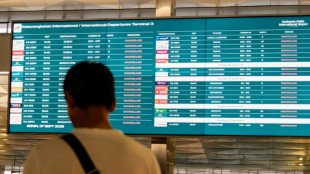 Flights resume gradually in Indonesia after volcanic eruption

 French AI firm Mistral valued at 21 bn euros after latest funding

 Sweden heads to the polls in close election race

 Australia's Big Bash T20 teams face sale to private investors

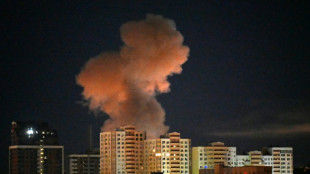 Russia resumes strikes on Kyiv after three-day halt

 Canada's counter-tariffs take effect on various US goods

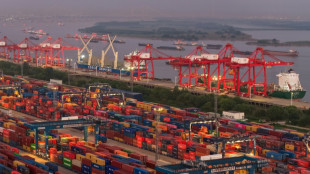 China's trade booms as focus turns to expected Trump-Xi summit

Starved of news and contact with the outside world during six months of occupation by Russian forces, residents of recently liberated Izyum are grateful for a makeshift wifi spot in the shattered Ukrainian city.
Outside an apartment block dozens of people queue before a sign that reads "15 minutes of wifi", where an aid worker takes each phone and enters the password.
Izyum, a predominantly Russian-speaking city of about 50,000 people before the war, had been fully occupied since April until it was recaptured earlier this month during Kyiv's lightning counter-offensive.
Soon after the liberation, investigation teams found what they said were 447 bodies buried during the occupation.
Residents told AFP Thursday that with electricity and mobile infrastructure networks badly damaged during the fighting, and still not restored, lack of information has kept them in the dark about what was happening.
But thanks to a power generator provided by the army, they can now reconnect to the internet -- at least for a brief window each day.
"From 8:00 am to 7:00 pm, some three to four thousand per day can connect," Seraphim, a soldier, told AFP.
"If too many people get connected at the same time the internet goes down, hence the 15-minute limit," explained resident Olga German.
"After zero minutes a day, 15 is quite a lot. Now we can check the news online, and compare sources, and keep in touch with our families," the 34-year-old English teacher said.
The eight-storey block is one of the few buildings in the devastated town to have escaped relatively unscathed, although many windows are broken, with the sound of sawing and hammers emanating from many floors.
A TV screen on a stand beside the queue showed a Ukrainian channel broadcasting news about the war, while people huddled on the ground charging their telephones from extension cables connected to the generator.
Residents ate borshch beetroot soup cooked on a nearby campfire, as children chopped firewood.
Around the corner a half-torn poster hung from a billboard: "Russia for ever", it said.
- Information vacuum -
German said the six-month period of occupation felt like "purgatory".
"We were living in an information vacuum, we couldn't get in touch with our relatives, and we could feel that the information we got from the Russians was not objective.
"So we lived only on gossip, and the stories got twisted".
Nadezda Oleksandrivna, a 64-year-old dog-trainer waiting her turn in the queue, said being deprived of news and contact with friends felt "like having a bag on my head".
It could have a serious impact on mental health, she added.
Oleksandrivna said she stayed in Izyum during the occupation because she did not want to abandon her two dogs.
Before the war she was an avid internet-user, keeping up with relatives, bloggers, politics and international news.
Now, she said she gets around the 15-minute wifi limit by returning to the back of the line when her time is up.
For a group of teenagers scrolling their phones in the corner, the wifi spot is an opportunity to catch up with friends on Viber and Telegram.
"Everyone started messaging me, including friends I have in Germany and the Czech Republic, they were really worried about me," said 16-year-old resident Anton.
"When I first got connection back I didn't know what to do, I noticed that my TikTok really changed.
"Now it's only about the war," he said.
A.Anderson--AT