Faraday Copper Reports Near-Surface Copper Mineralization in 14 Drill Holes, Increasing Confidence in Future Resource Growth

 Putin denies plan for new Russia military call up
 Caruana Galizia: 'one-woman WikiLeaks' who exposed Malta's shady side

 Kuwait's Iranians under pressure since start of war

 EU lawmakers demand Brussels force Meta to 'protect' European children
 Clooney turns AFP photographer in jokey red carpet switch
 Retirement Income Planning Florida Launches No-Cost 'Income Gap Analysis' Program for Pre-Retirees

 Iraola hails Barcola mentality after blockbuster Liverpool move
 Michelsen shocks Nakashima in US Open clash of rising Americans

 US govt sides with OpenAI in New York Times copyright lawsuit

 Grammy-Winning Jazz Vocalist Cassandra Wilson Dies at 70

 Maui Wildfire Survivors Report Major Losses to Troubled Rebuilding Contractors

 WMO Says Powerful El Niño Is Likely to Persist Into February 2027

 Honda Presses Suppliers for Deep Cost Cuts in $9.4 Billion Savings Drive

 Philadelphia Festival Revisits the Signing and Legacy of the U.S. Constitution

 Russia to close branches of Germany's Goethe Institute

 Spacecraft bound for Mercury faces 'tricky' arrival

 Philippines holds drills to safeguard students from armed intruders

 In Ghana, larger-than-life coffins tell the stories of the dead

 Menoncello, Reece headline Top 14 new-season signings

 Families descend on Nepal in search of missing tourists

 Far-right AfD eyes huge win in east German state vote

 Brazil-Japan to play World Cup rematch at Singapore tournament

 Defence chiefs back boosting US military presence in Australia

 Nepal seeks climate justice after Himalayan disaster

 Stocks rise, yields ease as oil slips on Trump hint at short bombing campaign

VANCOUVER, BC / ACCESS Newswire / September 3, 2026 / Faraday Copper Corp. ("Faraday" or the "Company") (TSX:FDY)(OTCQX:CPPKF) is pleased to announce the results of 23 drill holes from its Phase IV drill program at the Copper Creek Project, located in Arizona ("Copper Creek"). Eight holes were drilled near Copper Giant and targeted near-surface copper mineralization; five holes were drilled in the American Eagle area targeting near-surface mineralization and one previously undrilled breccia trend; three holes were drilled in the Old Reliable area targeting structural trends west and north of the known mineralization; six holes were drilled near Mammoth and Childs Aldwinkle and had infill and geotechnical objectives; and one hydrogeological hole was drilled in the southern part of the property, near the Sunrise trend (Figure 1).
Paul Harbidge, President and CEO, commented, "These results from our Phase IV drill program continue to support the potential to expand near-surface mineralization at Copper Creek. This is highlighted by intercepts at the American Eagle area, including mineralization in a previously undrilled breccia and porphyry trend. Additionally, the copper oxide mineralization intersected east of Copper Giant further supports the potential for additional near-surface oxide resources, which could enhance the opportunity for future copper cathode production. With resource definition drilling now complete, we will incorporate these results into our next mineral resource update planned for next year."
Highlights
Intersected near-surface mineralization in 14 drill holes, expanding both oxide and sulphide mineralization.
Four drill holes at American Eagle intersected chalcocite and chalcopyrite mineralization, including:
19.00 metres ("m") at 0.55% copper from 42.00 m in drill hole FCD-26-192 in a previously undrilled breccia and porphyry trend 350 m south of the American Eagle breccia, highlighting potential for resource expansion.
20.00 m at 0.52% copper from 149.00 m in drill hole FCD-26-184 and 31.00 m at 0.25% copper from 28.00 m in drill hole FCD-26-183. Both holes were drilled at a shallow angle and identified mineralization above the high-grade Banjo breccia.
Four shallow drill holes east of the Copper Giant breccia define an extensive area of near-surface oxide mineralization, with intercept lengths ranging between ~50 m and ~100 m.
Additional mineralized intercepts in infill holes include 14.33 m at 0.56% copper from surface in FCD-26-185 near the Pole breccia and 40.00 m at 0.32% copper from 20.00 m in hole FCD-26-163 north of Childs Aldwinkle.
(For true width information see Table 1)
Figure 1: Plan View Showing Surface Geology and Location of Drill Holes
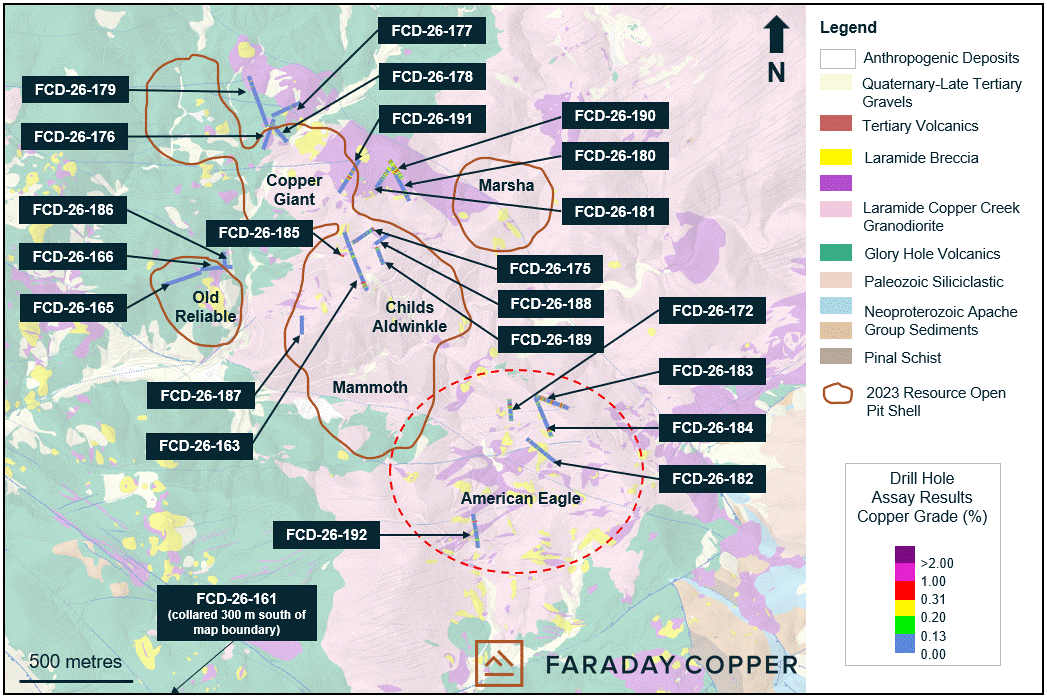
Note: The open pit shells are based on constraints used in the Mineral Resource Estimate ("MRE") as presented in the Copper Creek Project Technical Report1.
American Eagle area
The American Eagle area, as mapped on surface, covers approximately 800 m by 1,000 m and is host to numerous prospective breccias and porphyries. These surface expressions are located above the large underground porphyry mineral resource1. Previous drilling resulted in the discovery of the Banjo, Winchester and Prada breccias. The approval of the Exploration Plan of Operations by the Bureau of Land Management in June 2025, together with a drill rig capable of shallow angle drilling, allows testing for near-surface mineralization.
Drill hole FCD-26-172 was collared north of the American Eagle breccia and drilled to the north. The hole intersected granodiorite, except for a breccia domain from 18 m to 33 m and porphyry from 89 m to 95 m. The breccia domain is characterized by quartz-sericite alteration with pyrite cement and minor chalcocite. The granodiorite hosts porphyry style veins with copper mineralization in chalcopyrite and chalcocite together with pyrite.
Drill hole FCD-26-182 was collared northeast of American Eagle breccia and drilled to the southeast, targeting the shallow part of the Boomerang breccia. The hole starts in granodiorite and intersected porphyry from 34 m to 43 m followed by breccia to 56 m. After another interval of granodiorite the hole entered breccia from 83 m to 117 m before going back into granodiorite. The breccia domains are characterized by intense sericitic alteration, pyrite occurring in breccia cement and disseminated. Trace chalcopyrite and chalcocite are observed both in breccia cement and porphyry-style veins. The sulphide mineralogy suggests the Boomerang breccia was intersected in the pyrite domain, above potential copper mineralization.
Drill hole FCD-26-183 was collared northwest of Banjo and drilled to the southeast targeting near-surface mineralization above the high-grade Banjo breccia. The hole intersected granodiorite for its entire length except for a short breccia interval from 45 m to 50 m. Mineralization occurs as chalcocite with chalcopyrite together with pyrite in porphyry-style veins and to a lesser extent in breccia cement or disseminated.
Drill hole FCD-26-184 was collared at the same location as FCD-26-183 and drilled to the south, targeting near-surface mineralization. The hole intersected granodiorite except for a short porphyry interval from 4 m to 6 m and breccia from 11 m to 13 m. Mineralization consists of chalcocite and chalcopyrite hosted in porphyry-style veins.
Drill hole FCD-26-192 was collared 350 m southwest of the American Eagle breccia and drilled to the south, targeting a breccia and porphyry trend. The hole starts in porphyry to 24 m and enters a zone of alternating hydrothermal breccia, granodiorite and porphyry to 100 m. Granodiorite with porphyry intervals dominates to 171 m, followed by a zone of porphyry and hydrothermal breccia to 217 m. The hole terminates in granodiorite. Quartz-sericite-pyrite alteration is moderate to intense in breccia and porphyry intervals. Mineralization occurs as chalcopyrite and chalcocite together with pyrite in porphyry style veins and as breccia cement.
Copper Giant East
Recent drilling (drill hole FCD-26-173 reported in a news release dated June 24, 2026) in an area approximately 300 m east of Copper Giant demonstrated the presence of copper oxide mineralization associated with a porphyry intrusion characterized by localized breccia. This constitutes a previously unknown area of copper oxide mineralization, herein referred to as Copper Giant East. Four holes detailed below contain copper oxide mineralization over 48 m to 100 m downhole length, defining an extensively mineralized area exposed at surface.
Drill hole FCD-26-180 was collared east of Copper Giant and drilled to the southeast, testing a previously undrilled area for copper oxide mineralization. The hole intersected porphyry to 164 m and granodiorite to the end of the hole. Within the porphyry, which is largely oxidized, a variety of breccia domains are observed. Copper occurs as chrysocolla, malachite and tenorite as fracture coatings and disseminated at the start of the hole and as trace chalcopyrite with chalcocite near the end of the hole.
Drill hole FCD-26-181 was collared at the same location as hole FCD-26-180 and drilled to the southwest. The hole intersected porphyry for the first 19 m with granodiorite to 132 m and igneous cemented breccia to the end of the hole. Copper mineralization occurs as chrysocolla, malachite and tenorite as fracture coatings in the first 74 m of the hole. Trace chalcocite and chalcopyrite are observed below that depth.
Drill hole FCD-26-190 was collared east of Copper Giant and drilled to the northwest, targeting near-surface oxide mineralization. The hole intersected porphyry for its entire length. Mineralization is present as black copper-manganese oxides, as well as malachite and chrysocolla as fracture coatings over the entire length of the drill hole.
Drill hole FCD-26-191 was collared east of the Hilltop breccia, near Copper Giant and drilled to the southwest. The hole intersected porphyry with intervals of igneous breccias from 59 m to 69 m, 108 m to 114 m, 136 m to 144 m, and 165 m to 171 m. Mineralization occurs in porphyry style veins as malachite, chrysocolla, black manganese-copper oxides and trace chalcocite.
Copper Giant West
The area to the west and north of Copper Giant is characterized by local occurrences of breccia and copper oxide, as well as widespread moderate hydrothermal alteration affecting porphyry and glory hole volcanics. A series of holes were drilled to test the potential of this area.
Drill hole FCD-26-176 was collared west of Copper Giant and drilled to the southwest. The hole starts in Glory Hole volcanics and drilled alternating volcanics, porphyry and igneous breccia to 145 m. From there to the end of the hole, it intersected granodiorite. Mineralization occurs as trace chalcopyrite together with pyrite in porphyry-style veins.
Drill hole FCD-26-177 was collared at the same location as FCD-26-176 and drilled to the northeast. The hole starts in Glory Hole volcanics to 42 m, followed by granodiorite to 65 m. From there to the end of the hole, different breccia types alternate with volcanics and porphyry. Mineralization occurs over short intervals as chalcopyrite with pyrite and minor chalcocite in porphyry-style veins and disseminated.
Drill hole FCD-26-178 was collared west of Copper Giant approximately 40 m south of hole FCD-26-176 and drilled to the southeast. The hole started in breccia to 3 m, followed by porphyry to 14 m and again breccia to 23 m. Ather that, the hole entered Glory Hole volcanics to 120 m and granodiorite to the end of the hole. Copper mineralization occurs as malachite, tenorite and chrysocolla within the breccia domain at the start of the hole. Trace chalcopyrite and pyrite are present in porphyry style veins within the granodiorite.
Drill hole FCD-26-179 was collared at the same location as FCD-26-178 and drilled to the northwest. After a short interval of breccia to 9 m, the hole entered porphyry to 94 m, followed by Glory Hole volcanics and local occurrence of breccia to the end of the hole. Tenorite and chalcocite are observed in the first 10 m of the hole. Trace chalcopyrite and pyrite are present for the remainder of the hole, with narrow intervals of chalcopyrite-rich porphyry-style veins.
Old Reliable West
West-trending veins with locally intense sericite alteration and local breccia occurrences are observed west of the Old Reliable breccia. This area has been tested by three drill holes and only pyrite with minor chalcopyrite mineralization was intersected.
Drill hole FCD-26-165 was collared west of Old Reliable and drilled to the southwest. The hole starts in porphyry and enters a zone of hydrothermal breccia with domains of Glory Hole volcanics at 46 m to the end of the hole. Pyrite occurs with minor chalcopyrite in veinlets, breccia cement and disseminated.
Drill hole FCD-26-166 was collared west of Old Reliable and drilled to the east. After 5 m of granodiorite the hole entered breccia to 56 m, followed by porphyry and short breccia intervals to 123 m before entering Glory Hole volcanics to the end of the hole. Pyrite occurs together with trace chalcopyrite in porphyry-style veins and to lesser degree disseminated.
Drill hole FCD-26-186 was collared north of Old Reliable and drilled to the north. The intersected Glory Hole Volcanics to 35 m, followed by granodiorite. Breccia is present from 53 m to 58 m. Sulphides include trace chalcopyrite and chalcocite which occur together with pyrite in porphyry style veins.
Drill holes in the Mammoth and Childs Aldwinkle area
In addition to the Mammoth and Childs Aldwinkle breccias, several smaller breccia occurrences and vein zones, some with copper oxide at surface, are observed in this area. Several holes were drilled to increase drill data between the principal breccia bodies.
Drill hole FCD-26-163 was collared northwest of Childs Aldwinkle and drilled to the north. The hole was designed to test a previously undrilled area south of the Pole breccia. The hole started in granodiorite and intersected porphyry from 12 m to 45 m and breccia to 58 m, before entering granodiorite to the end of the hole. Mineralization is present as chalcopyrite which occurs together with pyrite and trace chalcocite, both disseminated and in porphyry style veins.
Drill hole FCD-26-175 was collared approximately 200 m north of Childs Aldwinkle and drilled to the southwest, targeting an area with limited drilling. The hole intersected granodiorite to 60 m, followed by a short breccia intercept to 65 m, before entering granodiorite again to 134 m. A series of short breccia intercepts alternate with porphyry and granodiorite to the end of the hole. Copper mineralization occurs as chrysocolla and tenorite near the start of the hole and as chalcopyrite, with pyrite and minor chalcocite in breccia cement and in porphyry style veins.
Drill hole FCD-26-185 was collared at the Pole breccia and drilled to the northeast. The hole intersected granodiorite in the first 14 m before the hole was abandoned due to encountering underground workings. Abundant porphyry style veins are present with copper contained in chalcopyrite and chalcocite as well as chrysocolla and tenorite.
Drill hole FCD-26-187 was collared west of White Bear and drilled to the north, as an infill hole. The hole intersected granodiorite with short intervals of porphyry. Low abundance of pyrite with chalcopyrite is present in porphyry style veins.
Drill hole FCD-26-188 was collared north of Childs Aldwinkle and drilled to the northeast as an infill hole. The intersected granodiorite over its entire length. Mineralization consists of trace chrysocolla and black copper manganese oxides.
Drill hole FCD-26-189 was collared at the same location as FCD-26-188 and drilled to the southeast as an infill hole. The hole intersected granodiorite over its entire length. Chrysocolla and malachite on fracture coatings are present near the top of the hole.
Other locations
Drill hole FCD-26-161 was collared south of the Sunrise trend and drilled to the southwest, across the Range Front fault. The main objective for this hole was to perform hydraulic permeability testing (Packer testing) for incorporation into future hydrological models. It intersected fault breccia, alternating with Glory Hole volcanics. While no significant copper mineralization is present, silver values are locally elevated.
Drill Program: Next Steps
Including the drill results released today, the Company has now released results from 19,496 m drilled in 76 holes. A total of 22,510 m was completed during the current portion of the drill program. In addition to resource definition, core samples from this drill program will be used for metallurgical test work and tailings characterization ahead of future technical studies. The assay results for the remaining drill holes will be released as they are received, analyzed and confirmed by the Company.
Drilling is expected to commence at the San Manuel project in the fall of 2026 once the proposed acquisition is closed (see news releases dated July 2, 2026 and August 25, 2026).
Table 1: Selected Drill Results
Drill Hole ID | From | To | Length | True Width | Cu | Sol Cu | Sol Cu/t Cu | Ag | Mo |
(m) | (m) | (m) | (m) | (%) | (g/t) | (%) | |||
FCD-26-163 | 20.00 | 60.00 | 40.00 | 40 | 0.32 | N/A | N/A | 0.92 | 0.0037 |
including | 38.56 | 60.00 | 21.44 | 21 | 0.46 | N/A | N/A | 1.41 | 0.0064 |
And | 219.00 | 245.00 | 26.00 | 26 | 0.14 | N/A | N/A | 0.43 | 0.0010 |
FCD-26-172 | 60.00 | 80.00 | 20.00 | 20 | 0.25 | N/A | N/A | ||
FCD-26-175 | 0.00 | 12.00 | 12.00 | 12 | 0.28 | 0.20 | 0.71 | 0.83 | 0.0001 |
And | 133.82 | 144.00 | 10.18 | 10 | 0.43 | N/A | N/A | 2.98 | 0.0002 |
FCD-26-178 | 0.00 | 22.77 | 22.77 | 22 | 0.14 | 0.09 | 0.64 | 0.72 | 0.0019 |
FCD-26-179 | 0.00 | 10.00 | 10.00 | 10 | 0.12 | 0.04 | 0.33 | 1.03 | 0.0014 |
FCD-26-180 | 0.00 | 56.00 | 56.00 | 56 | 0.20 | 0.11 | 0.55 | 0.55 | 0.0001 |
Including | 18.00 | 44.00 | 28.00 | 28 | 0.28 | 0.20 | 0.71 | 0.80 | 0.0001 |
FCD-26-181 | 0.00 | 74.00 | 74.00 | 74 | 0.16 | 0.11 | 0.69 | 0.44 | 0.0001 |
Including | 45.00 | 59.00 | 14.00 | 14 | 0.20 | 0.15 | 0.75 | 0.57 | 0.0001 |
FCD-26-183 | 28.00 | 59.00 | 31.00 | 31 | 0.25 | N/A | N/A | 0.54 | 0.0004 |
and | 82.00 | 92.00 | 10.00 | 10 | 0.35 | N/A | N/A | 0.77 | 0.0006 |
And | 130.00 | 152.00 | 22.00 | 22 | 0.28 | N/A | N/A | 0.79 | 0.0002 |
FCD-26-184 | 17.00 | 27.00 | 10.00 | 10 | 0.14 | 0.07 | 0.51 | 0.50 | 0.0007 |
And | 149.00 | 169.00 | 20.00 | 20 | 0.52 | N/A | N/A | 0.78 | 0.0005 |
FCD-26-185 | 0.00 | 14.33 | 14.33 | 14 | 0.56 | N/A | N/A | 1.50 | 0.0016 |
FCD-26-189 | 0.00 | 20.18 | 20.18 | 20 | 0.15 | 0.11 | 0.70 | 1.26 | 0.0002 |
FCD-26-190 | 0.00 | 100.80 | 100.80 | 100 | 0.22 | 0.15 | 0.68 | 0.39 | 0.0001 |
FCD-26-191 | 67.09 | 115.43 | 48.34 | 48 | 0.21 | 0.10 | 0.47 | 0.64 | 0.0387 |
FCD-26-192 | 42.00 | 61.00 | 19.00 | 19 | 0.55 | N/A | N/A | 1.00 | 0.0020 |
And | 179.00 | 191.56 | 12.56 | 12 | 0.16 | N/A | N/A | 0.73 | 0.0005 |
FCD-26-161 | Hydrogeology and condemnation hole | ||||||||
FCD-26-165 | No significant intercepts | ||||||||
FCD-26-166 | No significant intercepts | ||||||||
FCD-26-176 | No significant intercepts | ||||||||
FCD-26-177 | No significant intercepts | ||||||||
FCD-26-182 | No significant intercepts | ||||||||
FCD-26-186 | No significant intercepts | ||||||||
FCD-26-187 | No significant intercepts | ||||||||
FCD-26-188 | No significant intercepts | ||||||||
Note: All intercepts are reported as downhole drill widths. Mineralization includes bulk porphyry style and breccia mineralization. True widths are approximate due to the irregular shape of mineralized domains. N/A: Not applicable.
Table 2: Collar Locations from the Drill Holes Reported Herein
Drill Hole ID | Easting | Northing | Elevation | Azimuth | Dip | Target | Depth | Depth |
(m) | (°) | (°) | (ft) | (m) | ||||
FCD-26-161 | 547511 | 3622023 | 1201 | 230 | 45 | Range Front fault | 1260.1 | 413.43 |
FCD-26-163 | 548409 | 3624072 | 1306 | 338 | 45 | Childs Aldwinkle North | 1233.7 | 404.77 |
FCD-26-165 | 547669 | 3624158 | 1279 | 250 | 45 | Old Reliable West | 788.8 | 258.78 |
FCD-26-166 | 547668 | 3624156 | 1279 | 085 | 58 | Old Reliable west | 832.4 | 273.10 |
FCD-26-172 | 549046 | 3623496 | 1308 | 355 | 20 | Banjo | 326.0 | 106.95 |
FCD-26-175 | 548429 | 3624350 | 1313 | 235 | 45 | Childs Aldwinkle North | 516.5 | 169.47 |
FCD-26-176 | 547984 | 3624827 | 1271 | 200 | 45 | Copper Giant West | 628.0 | 206.04 |
FCD-26-177 | 547986 | 3624831 | 1271 | 065 | 45 | Copper Giant West | 611.3 | 200.56 |
FCD-26-178 | 547975 | 3624798 | 1270 | 140 | 55 | Copper Giant West | 601.1 | 197.21 |
FCD-26-179 | 547970 | 3624793 | 1270 | 340 | 45 | Copper Giant West | 1107.9 | 363.47 |
FCD-26-180 | 548503 | 3624608 | 1338 | 150 | 45 | Copper Giant East | 720.6 | 236.43 |
FCD-26-181 | 548496 | 3624616 | 1339 | 213 | 45 | Copper Giant East | 470.7 | 154.44 |
FCD-26-182 | 549101 | 3623412 | 1309 | 130 | 10 | Boomerang | 511.4 | 167.79 |
FCD-26-183 | 549139 | 3623597 | 1335 | 110 | 25 | Banjo | 537.0 | 176.17 |
FCD-26-184 | 549138 | 3623594 | 1335 | 158 | 12 | Banjo | 582.1 | 190.99 |
FCD-26-185 | 548297 | 3624215 | 1246 | 020 | 45 | Pole Breccia | 43.7 | 14.33 |
FCD-26-186 | 547785 | 3624169 | 1219 | 355 | 45 | Old Reliable | 315.4 | 103.48 |
FCD-26-187 | 548123 | 3623876 | 1278 | 000 | 25 | White Bear | 283.7 | 93.09 |
FCD-26-188 | 548442 | 3624268 | 1311 | 055 | 25 | Childs Aldwinkle N | 255.8 | 83.91 |
FCD-26-189 | 548437 | 3624258 | 1311 | 160 | 25 | Childs Aldwinkle N | 281.5 | 92.35 |
FCD-26-190 | 548565 | 3624568 | 1335 | 325 | 10 | Copper Giant East | 307.2 | 100.80 |
FCD-26-191 | 548363 | 3624651 | 1348 | 212 | 25 | Copper Giant East | 596.7 | 195.77 |
FCD-26-192 | 548861 | 3623085 | 1330 | 172 | 50 | American Eagle South | 739.0 | 242.47 |
Note: Coordinates are given as World Geodetic System 84, Universal Transverse Mercator Zone 12 north (WGS84, UTM12N).
Sampling Methodology, Chain of Custody, Quality Control and Quality Assurance
All sampling was conducted under the supervision of the Company's geologists and the chain of custody from Copper Creek to the independent sample preparation facility, ALS Laboratories in Tucson, AZ, was continuously monitored. The samples were taken as ½ core, over 2 m core length. Samples were crushed, pulverized and sample pulps were analyzed using industry standard analytical methods including a 4-Acid ICP-MS multielement package and an ICP-AES method for high-grade copper samples. Copper mineralized samples were also analyzed for acid and cyanide soluble copper. A certified reference sample was inserted every 20th sample. Coarse and fine blanks were inserted every 20th sample. Approximately 5% of the core samples were cut into ¼ core and submitted as field duplicates. On top of internal QA-QC protocol, additional blanks, reference materials and duplicates were inserted by the analytical laboratory according to their procedure. Data verification of the analytical results included a statistical analysis of the standards and blanks that must pass certain parameters for acceptance to ensure accurate and verifiable results.
Qualified Person
The scientific and technical information contained in this news release has been reviewed and approved by Faraday's VP Exploration, Dr. Thomas Bissig, P. Geo., who is a Qualified Person under National Instrument 43-101 - Standards of Disclosure for Mineral Projects ("NI 43-101").
Notes
1 The Mineral Resource Estimate and cutoff grades are presented in the report titled "Copper Creek Project NI 43-101 Technical Report and Preliminary Economic Assessment" with an effective date of May 3, 2023, available on the Company's website at www.faradaycopper.com and on the Company's SEDAR+ profile at www.sedarplus.ca.
About Faraday Copper
Faraday Copper is an exploration company focused on advancing its flagship copper project in Arizona, U.S. The Copper Creek Project is one of the largest undeveloped copper projects in North America with significant district scale exploration potential. Faraday has entered into a definitive purchase and sale agreement with a wholly owned subsidiary of BHP Group Limited for the acquisition of BHP's San Manuel Project, adjacent to the Copper Creek Project. Faraday is well-funded to deliver on its key milestones and benefits from a management team and board of directors with senior mining company experience and expertise. Faraday trades on the TSX under the symbol "FDY".
For additional information please contact:
Stacey Pavlova, CFA
Vice President, Investor Relations & Communications
Faraday Copper Corp.
E-mail: [email protected]
Website: www.faradaycopper.com
To receive news releases by e-mail, please register using the Faraday website at www.faradaycopper.com
Cautionary Note on Forward Looking Statements
Some of the statements in this news release, other than statements of historical fact, are "forward-looking statements" and are based on the opinions and estimates of management as of the date such statements are made and are necessarily based on estimates and assumptions that are inherently subject to known and unknown risks, uncertainties and other factors that may cause actual results, level of activity, performance or achievements of Faraday to be materially different from those expressed or implied by such forward-looking statements. Such forward-looking statements and forward-looking information specifically include, but are not limited to, statements concerning the exploration potential of the Copper Creek property and closing of the San Manuel project acquisition.
Although Faraday believes the expectations expressed in such forward-looking statements are based on reasonable assumptions, such statements should not be in any way construed as guarantees of future performance and actual results or developments may differ materially. Accordingly, readers should not place undue reliance on forward-looking statements or information.
Factors that could cause actual results to differ materially from those in forward-looking statements include without limitation: market prices for metals; the conclusions of detailed feasibility and technical analyses; lower than expected grades and quantities of mineral resources; receipt of regulatory approval; receipt of shareholder approval; mining rates and recovery rates; significant capital requirements; price volatility in the spot and forward markets for commodities; fluctuations in rates of exchange; taxation; controls, regulations and political or economic developments in the countries in which Faraday does or may carry on business; the speculative nature of mineral exploration and development, competition; loss of key employees; rising costs of labour, supplies, fuel and equipment; actual results of current exploration or reclamation activities; accidents; labour disputes; defective title to mineral claims or property or contests over claims to mineral properties; unexpected delays and costs inherent to consulting and accommodating rights of Indigenous peoples and other groups; risks, uncertainties and unanticipated delays associated with obtaining and maintaining necessary licenses, permits and authorizations and complying with permitting requirements, including those associated with the Copper Creek property; and uncertainties with respect to any future acquisitions by Faraday. In addition, there are risks and hazards associated with the business of mineral exploration, development and mining, including environmental events and hazards, industrial accidents, unusual or unexpected formations, pressures, cave-ins, flooding and the risk of inadequate insurance or inability to obtain insurance to cover these risks as well as "Risk Factors" included in Faraday's disclosure documents filed on and available at www.sedarplus.ca
This press release does not constitute an offer to sell or a solicitation of an offer to buy any securities in any jurisdiction to any person to whom it is unlawful to make such an offer or solicitation in such jurisdiction. This press release is not, and under no circumstances is to be construed as, a prospectus, an offering memorandum, an advertisement or a public offering of securities in Faraday in Canada, the United States or any other jurisdiction. No securities commission or similar authority in Canada or in the United States has reviewed or in any way passed upon this press release, and any representation to the contrary is an offence.
SOURCE: Faraday Copper Corp.
View the original press release on ACCESS Newswire
Y.Baker--AT