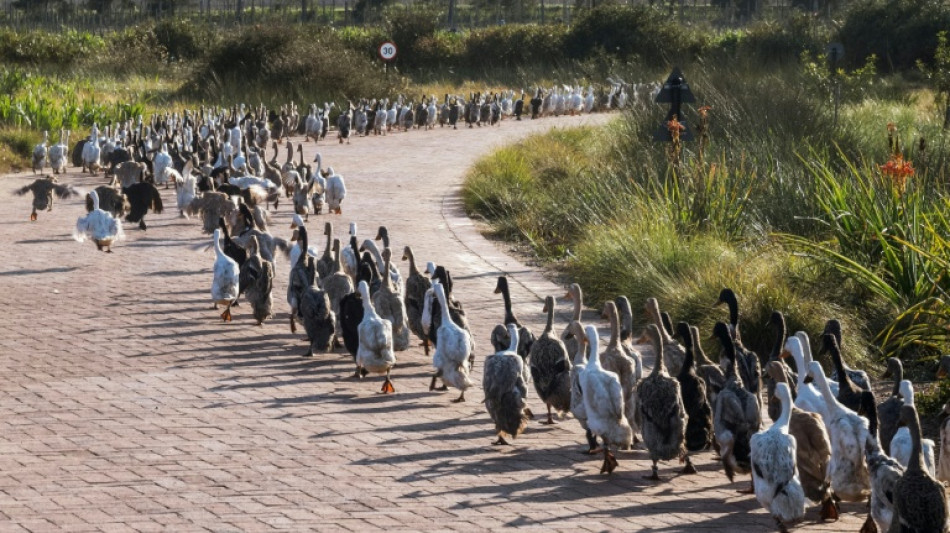
'Duck run' pest control catching on in S.Africa's winelands / Photo: RODGER BOSCH - AFP

 Galloway accuser could not foresee publishing-sector fallout, lawyer argues

 New York City Center revives In the Heights as a timely community story

 Godzilla Minus Zero shifts focus toward postwar human drama

 Mehbooba Mufti urges dialogue and renewed Central Asia links for Kashmir

 Seacliff Healthcare Seeks Specialist GP in Thirroul

 US stocks fall before midterm Election Day as technology shares weaken

 BLS Polymers makes strong market debut at ₹248 per share

 Petrol and diesel prices remain broadly steady across major Indian cities

 Reliance shares remain in focus after near-12% surge

 2026 Arizona Midterms: Key Races, Ballot Measures, and Voter Deadlines

 Coal India prepares possible $1 billion Mahanadi Coalfields listing

 Julia Stiles and Ezra Sosa Share Emotional Farewell After 'DWTS' Elimination

 US Buildings Threatened by Wildfires Could Triple by 2060

 Why Pregnancy Cost Estimates Fail: A Family’s $9,000 Surprise

 US Strikes Iranian Targets in Strait of Hormuz Ahead of Midterms

 Brodeur’s Overtime Goal Secures Bethlehem’s Second Consecutive Sectional Title

 Rare 1970 Plymouth ‘Cuda 426 Hemi Listed for $400,000

 The Digital Burden: Why Instant Messaging Feels Like a Full-Time Job

 Alberta Tabled Controversial Riding Boundary Maps Amid Gerrymandering Accusations

 Hong Kong court set to sentence activist Joshua Wong in security case

 Australia raises benchmark rate to highest level in 18 years

 'The Remarried Empress' Cast Discusses Bringing Fantasy Royal Drama to Life
 Asian stocks retreat as AI worries outweigh steep oil-price drop

 Hamad International Airport stages emergency drills during WATAN 2026

 Global failure to punish attacks leaves journalists at continuing risk

Every morning, around 1,000 long-necked ducks are let loose on a South African wine farm to gobble up insects in an environmentally friendly method of pest control that is gaining popularity.
At 9:00 am the upright and flightless Indian Runner ducks charge out of their pens on a farm near the Stellenbosch wine-producing area outside Cape Town and head to work.
After a rapid but brief forage for aphids, worms and snails near the homestead and restaurant, they move into the vineyards for the rest of the day.
"Using the ducks instead of pesticides is obviously better for the ecology," said Vergenoegd Low Wine Estate and farm manager, Christiaan Cloete.
"When you use chemicals, you sometimes kill a lot of beneficial insects. We are trying to create a more biodiverse ecology in the vineyards," Cloete told AFP.
The farm introduced the practice around 40 years ago.
"It's beginning to pick up in popularity," he said, as farmers seek more sustainable and biologically friendly methods, including "regenerative farming" which aims to restore degraded soil.
Now between five and 10 surrounding farms purchase ducks from the farm, Cloete said.
- Looking after the soil -
There are around 890 ducks on the property with 400 hatchlings expected over the breeding season from mid-July to the end of October, Cloete said.
Half will be sold and the rest will replace the more senior ducks on the farm's own fleet.
Indian Runner ducks were originally bred in Indonesia to control pests in rice paddies, said the farm's ecology ranger, Milan Germishuizen.
Their long necks allow them to reach pests on the raised, trellised vines.
They are also handy in breaking down the manure of the 220 sheep and nearly 100 cattle that graze in the vineyard, another regenerative farming practice that leaves the soil nutrient-rich.
"The more pesticides and artificial fertilisers you put onto your soil, eventually your soil will degenerate," he said.
"So by using natural methods ... we are really looking after our soils, which eventually does give us a much better product at the end of the day."
When there are grapes on the vines, the ducks are kept away to avoid them being tempted by the fruit, and diverted to the four irrigation dams.
As they forage there, their droppings enrich the water in a process called "fertigation", Germishuizen said.
"A lot of our neighbours have gotten on board with regenerative farming," said Tessa Kleynhans, the commercial manager of the on-site hotel.
The impressive daily duck run has also become a draw for visitors, she told AFP.
"We're trying to set the precedent for regenerative farming. We are trying to make a use case that, if you invest the capital in the beginning, even though it's a long, tedious process, it is worth it in the end," she said.
T.Perez--AT