Mineral Reserve Highlights:
Total Proven and Probable Mineral Reserves of 597,744 oz gold ("Au") and 6.30 Moz silver ("Ag") contained within 56.8 million tonnes ("Mt") grading 0.327 grams per tonne ("g/t") Au and 3.45 g/t Ag.
Mineral reserves have been estimated using metal prices of US$3,500/oz gold and US$50/oz silver and are based on the mining and processing methods currently in use at Moss-conventional open pit mining using truck-and-shovel method and processing by crushing, heap leaching and Merrill-Crowe recovery.
Project Economics Highlights:
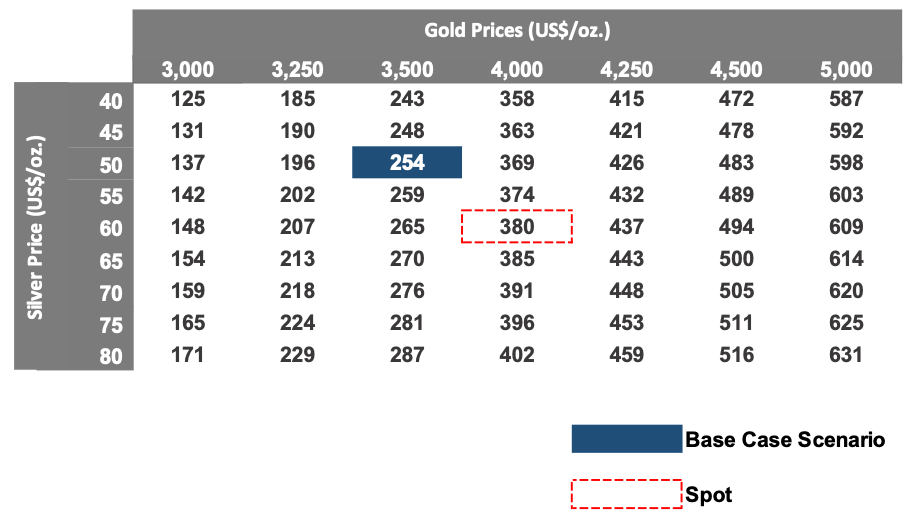
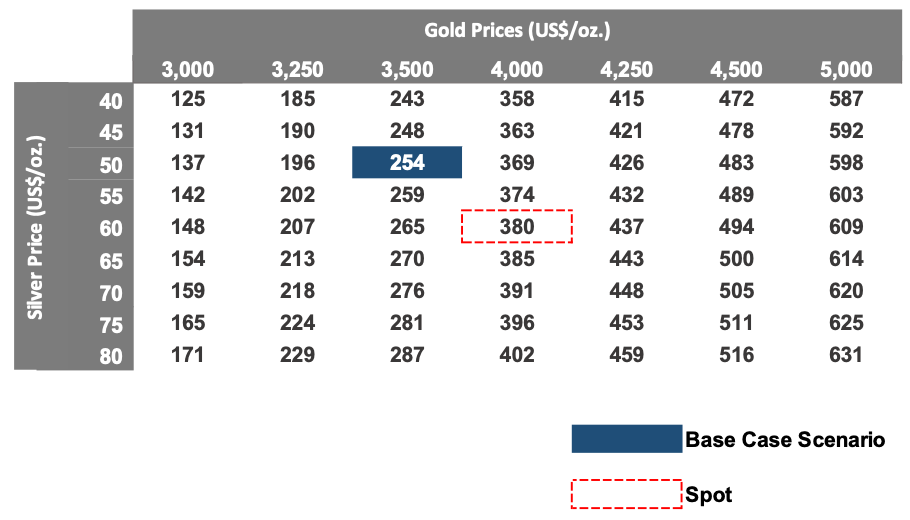
After-tax net present value discounted at 5% of US$254 million ("M") at the base-case gold price of US$3,500/oz and silver price of US$50/oz.
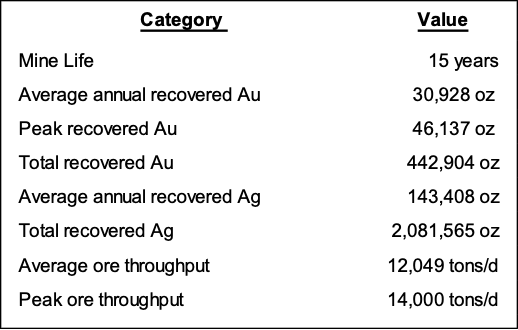
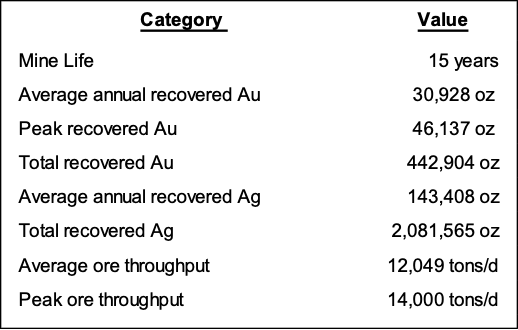
442,904 ounces of recovered gold and 2.1 million ounces of recovered silver expected over a 15-year life of mine ("LOM") assuming recoveries of 75% and 33% for Au and Ag, respectively. Projected average annual production of 30.9k oz Au (2026-2039) with peak production of 46.1 koz Au estimated in 2031.
Mineral Reserve Estimate
The Moss Mine contains Proven and Probable Mineral Reserves of 56.8 million tonnes (62.6 million short tons) grading 0.327 g/t gold and 3.45 g/t silver, containing 597,744 ounces of gold and 6.30 million ounces of silver (Table 2). The mineral reserve estimate was prepared in accordance with NI 43-101 and the 2014 CIM Definition Standards following the application of all applicable Modifying Factors. The Proven and Probable Mineral Reserves provide the basis for a 15-year mine plan and the updated project economics presented in this news release. Mineral reserve tonnages and grades are reported in metric units, with the corresponding imperial units presented in Table 3.
Table 1: Moss Mine After Tax NPV @ 5% (in US$ millions)
Akiba Leisman, CEO of Mako states: "the Moss mineral reserve declaration and updated project economics is an important milestone for Mako. While the Company began mining operations at San Albino over 6 years ago, and mining at Moss 12 months ago, these are the first mineral reserves the Company has declared. Going forward, this will unlock opportunities to lower our cost of capital, as the Company's lack of mineral reserves has previously been a constraint. Mako acquired Moss in March of 2025 for a net purchase price of approximately US$2 million. Multiples of the acquisition price have already been returned to the Company through cash flow, and management believes that the economics reported today, based on real operating economics from the mine, reflect one of the highest return on invested capital acquisitions made during this commodity cycle. Over the course of this quarter, Mako will announce additional opportunities to lower the cost of its capital so that we can continue to make highly accretive acquisitions in the future."
Table 2: Mineral Reserve Estimate - Metric units (Effective date June 30th, 2026)

Table 3: Mineral Reserve Estimate Summary - Imperial units (Effective date June 30th, 2026)

Notes for Tables 2 & 3:
Mineral Reserves have been estimated in accordance with the 2014 CIM Definition Standards for Mineral Resources and Mineral Reserves, as adopted by the Canadian Securities Administrators in National Instrument 43-101 Standards of Disclosure for Mineral Projects.
The Mineral Reserve estimate was prepared by Mohsin Hashmi P.Eng., a Qualified Person as defined by National Instrument 43-101, with an effective date of June 30th, 2026.
The Mineral Reserve estimate is based on the Mineral Resource estimate with an effective date of December 18, 2025, after the application of all relevant Modifying Factors, including mining, metallurgical, economic, processing, infrastructure, environmental, legal, social, and governmental considerations.
Mineral Reserves are reported using a cut-off grade of 0.14 g/t Au, which was determined using the economic assumptions applied to the Mineral Reserve estimate, including metal prices, metallurgical recoveries, operating costs and processing assumptions.
Mineral Reserves are reported within the mine design and are based on the mine plan and economic assumptions applicable as of the effective date of the estimate.
Mineral Reserve tonnage and grade estimates are reported on a diluted basis where applicable. Contained metal has been calculated from tonnage and grade and is reported prior to metallurgical recovery unless otherwise stated.
Mineral Reserve tonnages and contained metal have been rounded to reflect the precision of the estimate. Totals may not sum exactly due to rounding.
Mineral Reserves are reported exclusive of Mineral Resources.
Mineral Reserves have been estimated using metal prices of US$3,500/oz gold and US$50/oz silver.
The Mineral Reserve estimate assumes average life-of-mine metallurgical recoveries of approximately 75% for gold and 33% for silver.
Mineral Reserves are based on conventional open pit mining using truck-and-shovel methods.
Mineral Reserves assume processing by crushing, heap leaching and Merrill-Crowe recovery.
Mineral Reserves reflect mining depletion to Jan 1, 2026.
Tonnages are estimated using variable bulk densities assigned according to lithology, alteration and oxidation state.
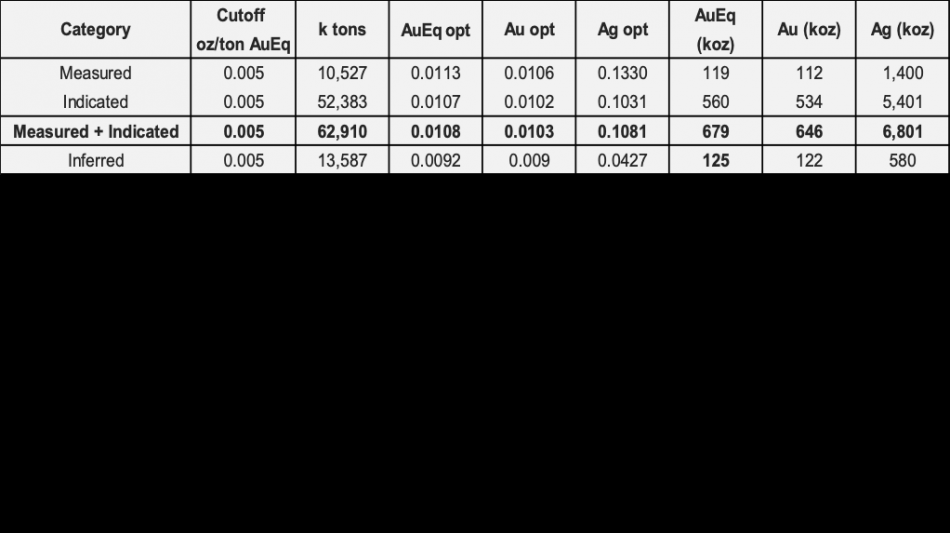
The following tables show the previously released mineral resources estimate:
Table 4: Mineral Resource Estimate Summary - Metric units (Effective date December 18th, 2025)
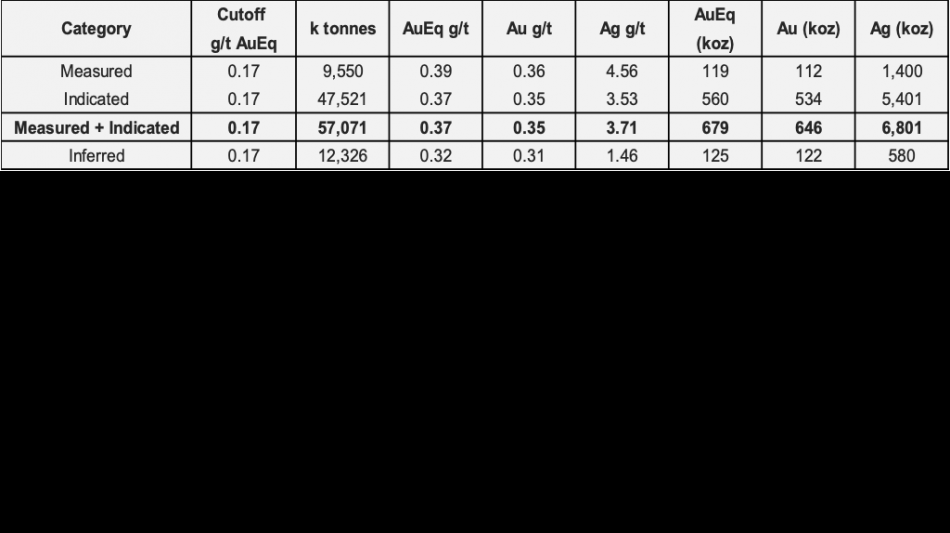
Table 5: Mineral Resource Estimate Summary - Imperial units (Effective date December 18th, 2025)
Notes for Tables 4 & 5:
Numbers have been rounded to reflect the precision of a Mineral Resource Estimate. Totals may vary due to rounding.
Mineral Resource Estimates conform to NI 43-101, and the 2019 CIM Estimation of Mineral Resources & Mineral Reserves Best Practice Guidelines and 2014 CIM Definition Standards for Mineral Resources & Mineral Reserves.
AuEq is calculated using a silver-to-gold ratio of 194.6:1, derived from assumed metal prices (US$2,500/oz Au and US$29.20/oz Ag) and assumed metallurgical recoveries (75% for Au) and 33% for Ag).
Mineral Resources are constrained within an optimized open-pit shell using a 0.17 g/t AuEq cut-off grade. Pit optimization assumptions include US$2,500/oz gold, US$29.20/oz silver, 75% gold recovery, and 33% silver recovery.
Mineral Resources are not Mineral Reserves as they do not have demonstrated economic viability. The quantity and grade of reported Inferred Resources in this Mineral Resource Estimate are uncertain in nature and there has been insufficient exploration to define these Inferred Resources as Indicated or Measured Resources, however, it is reasonably expected that the majority of Inferred Mineral Resources could be upgraded to Indicated Mineral Resources with continued exploration.
The Company is not aware of any environmental, permitting, legal, title, taxation, socio-economic, marketing or political factors that might materially affect these Mineral Resource Estimates.
Updated Project Economics
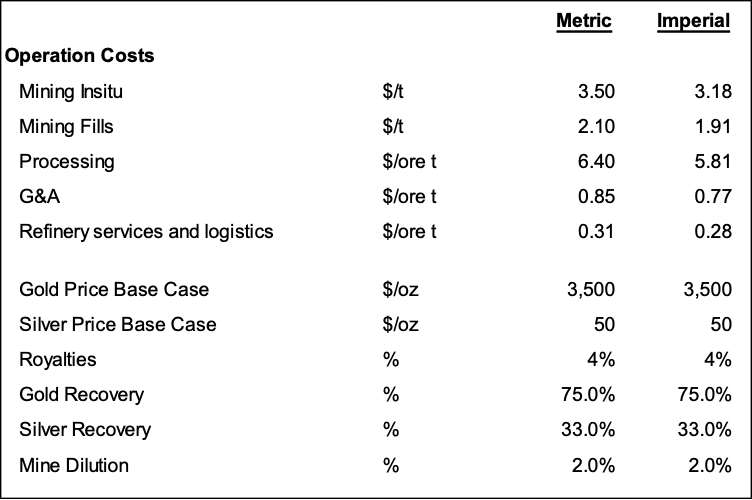
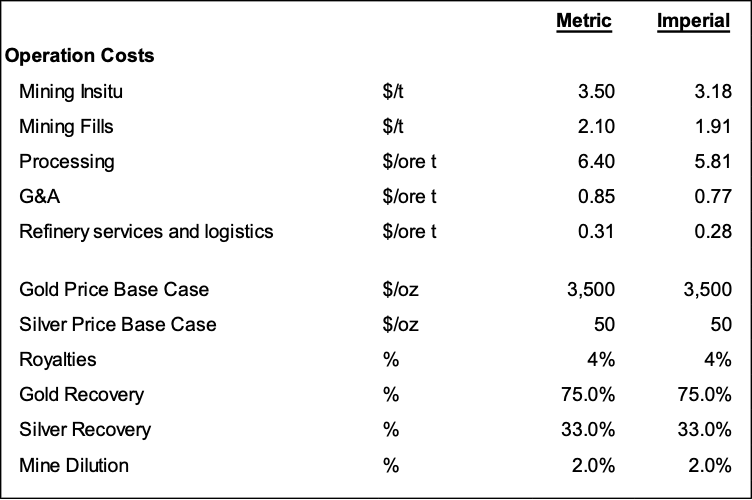
The Mineral Reserve forms the basis of a discounted cash flow model prepared using the reserve mine plan and the economic assumptions summarized below.
Economic Assumptions
Production Profile and Reserve Development Strategy
The table below provides a summary of production over the estimated 15-year LOM;
Production summary table
The Mineral Reserve mine plan reflects a staged development profile. Current mining activities are focused on the initial phases of the Reynolds and Central pits, which contain lower than average grades relative to the 15 year LOM plan. Pre-stripping activities have commenced at the East and North pits with LOM average grades expected by January 2027.
The mine plan incorporates a phased expansion of mining and processing capacity designed to maximize the value of the Mineral Reserve. After final 2026 plant debottlenecking exercises are complete, the plant is expected to produce approximately 3.3 million tonnes per year (3.5 million short tons per year) from 2027 to 2030, corresponding to a nominal processing capacity of approximately 8,200 tonnes per day (9,000 short tons per day). A second planned expansion increases nominal processing capacity to approximately 12,700 tonnes per day (14,000 short tons per day) beginning in 2031, with this capacity maintained through most of the remaining LOM.
A key driver of the improved production profile is the scheduled transition to mining the East Pit. Early production is sourced predominantly from the Reynolds and Central pits, where mineral reserve grades generally range from approximately 0.27 to 0.31 g/t Au (0.008 to 0.009 oz/short ton Au). East Pit Phase 1 contributes higher-grade ore for processing, averaging approximately 0.48 g/t Au (0.014 oz/short ton Au), with localized mineral reserve grades of up to approximately 0.65 g/t Au (0.019 oz/short ton Au). The introduction of this higher-grade material improves the average processing feed grade during the middle years of the LOM and supports increased gold production.
The higher mineral reserve grades in the East Pit reflect differences in the style and distribution of gold mineralization recognized in the current geological model. Mineralization east of the north-northwest-trending Canyon Fault is interpreted to be hosted predominantly within well-developed epithermal quartz vein systems characterized by greater vein continuity and higher gold grades. In contrast, mineralization west of the Canyon Fault, which includes the Reynolds and Central pits, is hosted primarily within broad zones of diffuse, fine-grained quartz stockwork and veinlets that generally exhibit lower average gold grades. These contrasting mineralization styles result in a higher average reserve grade within the East Pit and are an important factor underlying the improved production profile as mining progresses eastward.
The combined effects of increased processing capacity and higher reserve grades are reflected in the recovered gold production profile. Annual recovered gold production increases from approximately 18,000 to 24,000 ounces during the initial years of production to approximately 33,600 ounces in 2030 as higher-grade East Pit ore contributes a higher proportion of plant feed. Following the expansion to approximately 12,700 tonnes per day (14,000 short tons per day), annual recovered gold production increases to approximately 47,100 ounces in 2031 and remains robust throughout the balance of the LOM, generally ranging between 27,000 and 43,000 recovered ounces per year. Over the LOM, the Mineral Reserve is expected to produce approximately 442,904 recovered ounces of gold.
The increase in recovered gold production is supported by both improved mineral reserve grades and increased processing throughput. While annual contained gold varies with the mining sequence and mineral reserve grade, recovered gold production reflects the application of the metallurgical recovery assumptions incorporated into the mineral reserve estimate and therefore provides the appropriate basis for evaluating expected operating performance.
Exploration Upside
Beyond the current mineral reserve, the project hosts additional Inferred Mineral Resources, representing a meaningful near-term exploration opportunity. Importantly, exploration to date has been concentrated along the Moss and Ruth vein systems, which occupy only a small portion of Mako's approximately 16,900-hectare (41,760-acre) land package. The vast majority of the property remains untested despite the presence of numerous prospective structural and geochemical targets identified through surface prospecting. To accelerate target generation, the Company is currently completing a property-wide hyperspectral survey that will help prioritize drill targets across the broader concession package, underscoring the significant exploration potential beyond the known deposits.
Note: Inferred Mineral Resources are considered too speculative geologically to have economic considerations applied that would enable them to be categorized as Mineral Reserves, and there is no certainty that Inferred Mineral Resources will be converted to Measured or Indicated Resources or Mineral Reserves.
Corporate Update
A royalty litigation settlement has been reached with Patriot Gold Corp. ("Patriot") with respect to its 3% royalty interest on Moss. Mako has paid all accrued royalties to Patriot since Moss was acquired by an affiliate of Mako on December 31st, 2024 and will pay Patriot an additional US$1.55 million of the remaining ~US$3.7 million controlled by the bankruptcy monitor pending approval by the Arizona Court. All royalties due to Patriot have been accrued since Mako and affiliates acquired Moss, and management believes the remaining collateral held by the bankruptcy monitor, which Mako has a priority interest in, will be in excess of its current carrying value on Mako's balance sheet. Mako was unsuccessful in discharging this royalty last year (see press release dated November 20th, 2025) and is glad that this matter is resolved. Litigation with affiliates of Royal Gold Inc. continues with respect to their (up to 1%) royalty on a portion of the Moss property.
Qualified Persons
The Mineral Reserve Estimate contained in this news release has been prepared by Mohsin Hashmi, P.Eng. Richard Gowans, P.Eng is responsible for metallurgy, recovery methods and process plant operating costs. Christopher Keech, P.Geo. is responsible for drilling, sampling and the mineral resource estimate. Mohsin Hashmi, P.Eng. is responsible for the mining methods and capital and operating costs related to the open pit mining. Garth Luikko, P.Eng. is responsible for the economic analysis. William Lewis, P.Geo., is responsible for the property description, geology, environment and permitting aspects. All of the aforementioned persons are considered "Qualified Persons" for the purposes of NI 43-101 and have reviewed and approved the scientific and technical disclosure contained in this news release.
On behalf of the Board,
Akiba Leisman
Chief Executive Officer
About Mako
Mako Mining Corp. is a publicly listed gold mining, development and exploration company. The Company operates the high-grade San Albino gold mine in Nueva Segovia, Nicaragua, which ranks as one of the highest-grade open pit gold mines globally and offers district-scale exploration potential. Mako also owns two assets in the US: the Moss Mine in Arizona, an open pit gold mine in northwestern Arizona and the Mt. Hamilton Project, a heap leach project in Nevada. Mako also holds a 100% interest in the PEA-stage Eagle Mountain Project in Guyana, South America. Eagle Mountain is the subject of engineering, environmental and mine permitting activity.
For further information: Mako Mining Corp., Akiba Leisman, Chief Executive Officer, Telephone: 917-558-5289, E-mail: [email protected] or visit our website at www.makominingcorp.com and SEDAR www.sedarplus.ca.
Cautionary Note for U.S. Investors Concerning Mineral Resources and Reserves
This news release has been prepared in accordance with the requirements of Canadian NI 43-101 and the Canadian Institute of Mining, Metallurgy and Petroleum guidelines, which differ from the requirements of U.S. securities laws. NI 43-101 is a rule developed by the Canadian Securities Administrators that establishes standards for all public disclosure an issuer makes of scientific and technical information concerning mineral projects.
Canadian public disclosure standards, including NI 43-101, differ from the requirements of the U.S. Securities and Exchange Commission ("SEC"), and information concerning mineralization, deposits, mineral reserve and mineral resource information contained or referred to herein may not be comparable to similar information disclosed by U.S. companies. The requirements of NI 43-101 for identification of "reserves" are not the same as those of the SEC, and may not qualify as "reserves" under SEC standards. U.S. investors are cautioned not to assume that any part of an "indicated mineral resource" will ever be converted into a "reserve". U.S. investors should also understand that "inferred mineral resources" have a great amount of uncertainty as to their existence and great uncertainty as to their economic and legal feasibility. It cannot be assumed that all or any part of "inferred mineral resources" exist, are economically or legally mineable or will ever be upgraded to a higher category. Accordingly, information concerning mineral deposits set forth herein may not be comparable with information made public by companies that report in accordance with U.S. standards.
Non-IFRS Financial Measures
Mako has included certain forward-looking non-IFRS financial measures in this news release, such as development capital expenditures and sustaining capital expenditures, which are not measures recognized under IFRS and do not have a standardized meaning prescribed by IFRS. As a result, these measures may not be comparable to similar measures reported by other companies. Each of these measures used are intended to provide additional information to the user and should not be considered in isolation or as a substitute for measures prepared in accordance with IFRS. Non-IFRS financial measures used in this news release and common to the gold mining industry are defined below.
Development capital expenditures: represents the spending at new projects and/or expenditures at an existing operation that is undertaken with the intention to increase production levels or increase the mine life.
Sustaining capital expenditures: are expenditures incurred during a production phase to sustain and maintain the existing assets so they can achieve constant expected levels of production from which the Company will derive economic benefits. Sustaining capital expenditures include expenditure for assets to retain their existing productive capacity as well as to enhance performance and reliability of the operations.
Forward-Looking Information: Statements contained herein, other than historical fact, may be considered "forward-looking information" within the meaning of applicable securities laws. Forward-looking information can be identified by words such as, without limitation, "estimate", "project", "believe", "anticipate", "intend", "expect", "plan", "predict", "may" or "should" or variations thereon or comparable terminology. The forward-looking information contained herein reflects the Company's and current beliefs and expectations, based on management's reasonable assumptions. Such forward-looking information includes, without limitation, the timing for completion and filing of the updated technical report for the Moss Mine, the assumptions related to the Mineral Resource Estimate, projected economics for the Moss Mine, and the Company's development plans and strategies with respect to the Moss Mine stated herein, expected announcement of future capital reduction opportunities, expected exploration upside, and the outstanding Moss Mine royalty litigation with Royal Gold Inc. Forward-looking information is subject to a variety of risks and uncertainties which could cause actual events or results to differ materially from those reflected in the forward-looking information, including, without limitation, unexpected impediments to the completion and filing of the updated technical report within the timeframe stated, risks relating to the exploration and development of mineral properties, including but not limited to adverse environmental and climatic conditions, unusual and unexpected geologic conditions and equipment failures; health, safety and environmental risks and hazards to which the Company's operations are subject; access to financing; increases in costs of labour and other consumables; availability of workforce and equipment; risks relating to the acquisition, holding and renewal of title to mineral property rights and permits; changes to the mining legislative and regulatory regimes; limitations on insurance coverage; risks relating to illegal and artisanal mining; the Company's compliance with anti-corruption laws; cost overruns; competition in the precious metals mining industry; fluctuations in gold and silver prices; potential legal disputes; potential labour disputes; risks related to labour and employment relations; risks related to third-party contractor arrangements; the impact of global financial, economic and political conditions, global liquidity, interest rates, inflation and other factors on the Company's results of operations; force majeure events, and other risks and uncertainties as disclosed in the Company's Annual Information Form filed on SEDAR+ at www.sedarplus.ca and annual report on Form 40-F filed on EDGAR at www.sec.gov. Any forward-looking information contained herein represents management's best judgment as of the date hereof and is provided for the purposes of assisting investors in understanding the Company's development plans for the Moss Mine based on the current Mineral Reserve estimate and Mineral Resource estimate and related matters and may not be appropriate for other purposes. Mako does not undertake to update any forward-looking information, except in accordance with applicable securities laws.
Neither the TSX Venture Exchange nor its Regulation Services Provider (as that term is defined in the policies of the TSX Venture Exchange) accepts responsibility for the adequacy or accuracy of this release.
SOURCE: Mako Mining Corp.
View the original press release on ACCESS Newswire
A.Ruiz--AT