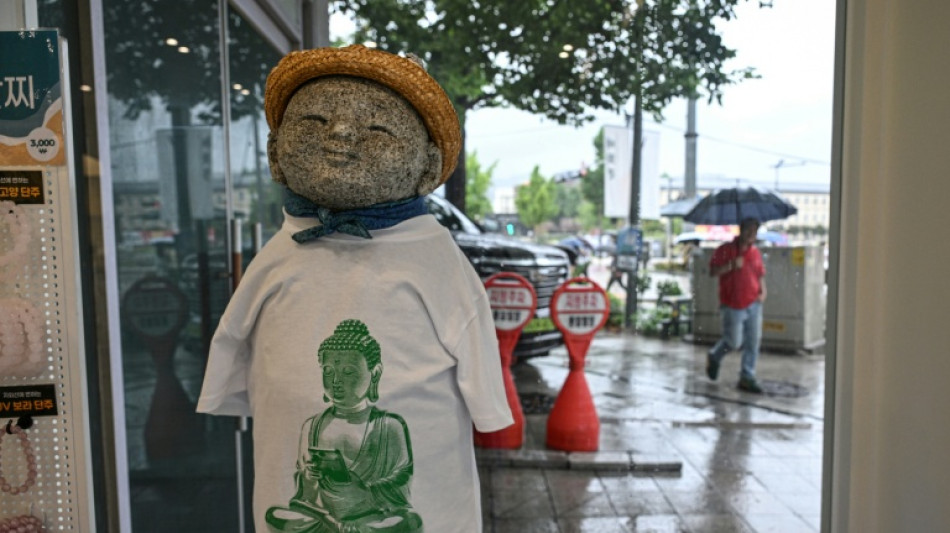
As South Korean Buddhism woos Gen Z, how hip is too hip? / Photo: Jade GAO - AFP

 Galloway accuser could not foresee publishing-sector fallout, lawyer argues

 New York City Center revives In the Heights as a timely community story

 Godzilla Minus Zero shifts focus toward postwar human drama

 Mehbooba Mufti urges dialogue and renewed Central Asia links for Kashmir

 Seacliff Healthcare Seeks Specialist GP in Thirroul

 US stocks fall before midterm Election Day as technology shares weaken

 BLS Polymers makes strong market debut at ₹248 per share

 Petrol and diesel prices remain broadly steady across major Indian cities

 Reliance shares remain in focus after near-12% surge

 2026 Arizona Midterms: Key Races, Ballot Measures, and Voter Deadlines

 Coal India prepares possible $1 billion Mahanadi Coalfields listing

 Julia Stiles and Ezra Sosa Share Emotional Farewell After 'DWTS' Elimination

 US Buildings Threatened by Wildfires Could Triple by 2060

 Why Pregnancy Cost Estimates Fail: A Family’s $9,000 Surprise

 US Strikes Iranian Targets in Strait of Hormuz Ahead of Midterms

 Brodeur’s Overtime Goal Secures Bethlehem’s Second Consecutive Sectional Title

 Rare 1970 Plymouth ‘Cuda 426 Hemi Listed for $400,000

 The Digital Burden: Why Instant Messaging Feels Like a Full-Time Job

 Alberta Tabled Controversial Riding Boundary Maps Amid Gerrymandering Accusations

 Hong Kong court set to sentence activist Joshua Wong in security case

 Australia raises benchmark rate to highest level in 18 years

 'The Remarried Empress' Cast Discusses Bringing Fantasy Royal Drama to Life

 Asian stocks retreat as AI worries outweigh steep oil-price drop

 Hamad International Airport stages emergency drills during WATAN 2026

 Global failure to punish attacks leaves journalists at continuing risk

In fast-secularising South Korea, Buddhism is regaining popularity thanks to a "hip" trend wooing Gen Z with festivals, fashion, robots and DJs, even as some fear for the fundamentals of the faith.
Just down the street from a 14th-century Seoul temple where worshippers make offerings and bow at the feet of three giant golden Buddha statues, a store named Buddhz sells statuettes, prayer bead bracelets, hats and t-shirts.
One depicts the Buddha scrolling on a smart phone.
A postcard shows the Buddha blowing a bubble in a relaxed pose with the words: "Blow it. Pop it. Forget it."
"It's a lot more commercialised here than I expected," Canadian tourist Teja Manabotula, 34, told AFP.
Marvin Zhang, a 19-year-old German, said his curiosity about Buddhism was part of the reason for his visit, but seeing the marketing methods targeting his generation, he could understand how it may be "seen as disrespectful".
Either way, the pop culture approach appears to be working.
The Seoul International Buddhist Expo, for example, drew a record 250,000 people this year -- about two-thirds of them Gen Z and half non-religious, according to organisers.
And even as the number of South Koreans who identify as Buddhist has remained static, Buddhism was viewed the most favourably of four belief systems polled in a 2025 "Religion Perception Survey" by Korea Research.
Buddhism-themed tourism is thriving and tens of thousands of locals and foreigners sign up every year for "temple stay" retreats where they eat simple monastic food, do chores and meditate.
Some pair their stays with concerts or events such as the International Expo, where visitors can join prayer sessions and talk to monks, browse among a dizzying array of trinkets on sale, and attend a "Heat Sutra Gong Party" with electronic dance and hip-hop sets.
Sun Min-ji, a 23-year-old South Korean university student and Buddhist, said the religion's hip image has attracted many of her friends.
"I believe there is absolutely nothing wrong with this 'hip' image of Buddhism, as it lowers the barrier to entry and attracts many young people," she told AFP.
But some critics point to the risk of a religion defined by non-attachment to worldly goods becoming tainted by consumerism.
"If Buddhism is consumed merely as a 'good image', its newfound hipness may prove to be little more than a passing trend," said an editorial in the Hyunbulnews newspaper, a Buddhist outlet.
- 'Adapted form' -
The Jogye Order, South Korea's main Buddhist order and a driving force behind the trend, is looking to make religion more "approachable", spokesman Monk Myojang told AFP.
"The way younger generations engage with religion is changing... We've tried to meet them where they are and communicate in a way that resonates with them."
The order faced particular backlash when a humanoid robot "monk" took part in an ordination ceremony in May, pledging to "devote" itself to Buddhism.
Critics argued this trivialised the monkhood.
While defending the use of the robot as a tool to convey Buddhist teachings, Myojang said the order was mindful of the risks and plans "to establish clearer guidelines about where the boundaries lie".
Comedian-turned-DJ Yoon Seong-ho, who performs under the stage name NewJeansNim in monk robes and mixes electronic music with chants, agrees there is a delicate balance.
His goal, with the order's support, is "to communicate Buddhist values to the public, especially to younger people who may not usually visit temples", the musician told AFP.
The hip, non-preachy image has given Buddhism a cultural boost, but it does not seems to have attracted new believers.
A poll last year found no change in South Koreans' religious affiliations, with 16 percent identifying as Buddhist.
People with no religion remain in the majority, most of them aged 18 to 29.
Jo Yang-ok, a 78-year-old Buddhist, said she did not object to anything that would bring young people into the fold.
"People of my generation often can't come out to temples anymore because of illness or because they have passed away," she told AFP.
Brian Somers, an assistant professor of Buddhist studies at Seoul's Dongguk University, said religions have always adapted as younger followers replace older ones.
"Hip Buddhism is Buddhism in an adapted form, as long as the teachings are maintained," he said.
D.Johnson--AT