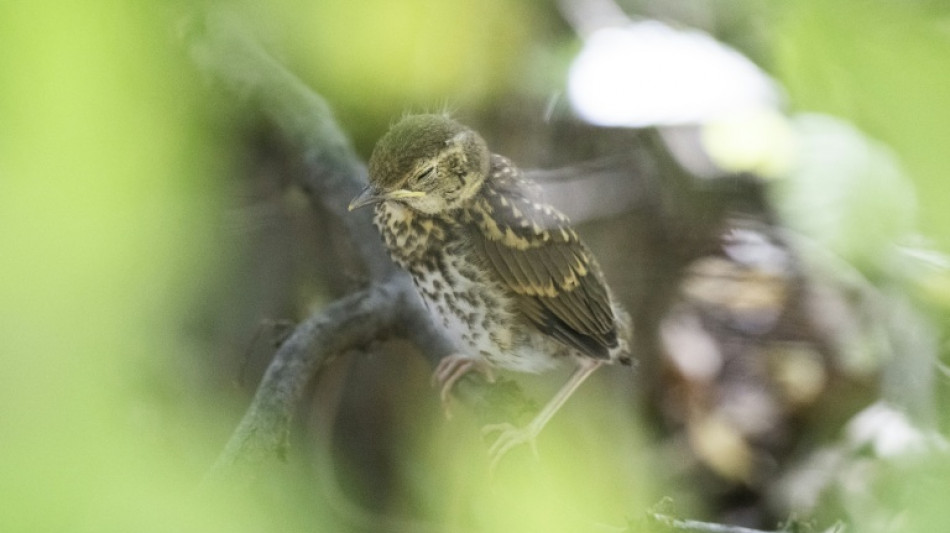
From birds to fish, how extreme heat causes wildlife to suffer / Photo: Martin LELIEVRE - AFP/File

 Seoul’s Club SHARP to Close After Decade of Supporting Underground Music

 Florida woman charged after deputies report finding cocaine and sales ledger

 Heat end Knicks’ NBA Cup defence with 108-105 victory

 Black Friday laptop promotions cover Apple, Lenovo, HP and gaming models

 Black Friday fashion sales bring discounts of up to 80 percent

 Shark reduces prices on top-rated stick and robot vacuums

 Shark Depuffi stock dwindles as Black Friday skincare discounts begin

 Chevrolet Blazer EV SS tested against decades of Super Sport models

 Calgary builder draws on decades of DIY work to increase Ford engine power

 Record-setting Hemi Plymouth Superbird heads to auction

 Calgary dancer describes stripping as a career built on independence and community

 Calgary Catholic schools report strong results and growing classroom complexity

 Business phone systems gain AI tools, but human oversight remains essential

 Workday weighs South African public-sector demand while keeping data in EU

 iOCO acquires procurement software specialist Intellection

 EasyEquities faces pressure for clearer answers after security outage

 US patent disputes involving Korean chipmakers reach record level

 SK hynix doubles daily share purchases after steep stock decline

 Former soldier stopped with blank round at Incheon Airport

 NYC Mayor Zohran Mamdani Undergoes Successful Achilles Surgery

 Korea Post breach exposes data of at least 113,855 customers

 Verso Books Releases Free Online Edition of The Encyclopedia of the American Left

Like humans, wildlife is increasingly vulnerable as climate change fuels longer and more intense heatwaves, disrupting feeding and breeding, and in extreme cases proving fatal.
The human toll of heatwaves is well documented but their ecological impacts have received less attention.
A study published in March in the journal Nature Ecology and Evolution found that three-quarters of land and ocean species assessed were "negatively impacted" during a major 2021 heatwave across western North America.
Heatwaves can be "brutal" on wildlife, said Gregoire Lois, an ornithologist at the National Museum of Natural History in Paris, which is withering under its second heatwave of the year.
Animals have fewer opportunities to adapt during sudden heatwaves than under gradual warming, he told AFP.
- Birds -
Birds are particularly vulnerable to heat, with a body temperature of between 39C and 42C that rises further during flight or when foraging.
They also lack sweat glands, making it harder to dissipate heat when temperatures soar.
Instead, they cool down through evaporation via their respiratory tracts, a water-intensive mechanism that increases the risk of heat stress and dehydration.
Young birds, still in the nest and unable to fly during the summer heat, are particularly vulnerable.
"The young, suffocating from the heat, sometimes fall from the nest whilst searching for air," said the League for the Protection of Birds, a French wildlife NGO.
Birds that nest under eaves -- such as swifts and swallows -- are most at risk, added.
- Mammals -
Vertebrates regulate their body temperature through panting or sweating but that process "results in greater water loss the smaller the animal is", said Lois.
Anne-Laure Dugue, from the league's 'fauna in distress' programme, said the risk of hyperthermia or dehydration was particularly significant among hedgehogs and certain small rodents.
Mass bat die-offs have been recorded during heatwaves as animals become disoriented and dehydrated.
In January 2026, thousands of flying foxes perished during a heatwave in south-eastern Australia.
Large mammals are not spared either: for species adapted to the cold -- such as bears, bison, reindeer and moose -- their thick fur becomes a hindrance when temperatures rise.
Exposure to even a week of 27C daytime highs greatly increases the chance of koala illness or death, concluded a study of 20 years of observational data published in Biology Letters in May.
Other species like foxes can suffer burns to their paws when they come into contact with scalding surfaces such as tarmac or sand.
- Invertebrates -
Most invertebrates are ectothermic, meaning that their body temperature depends largely on their environment.
Lois said the consequences can be "severe" when their thermal tolerance limit is exceeded.
This is particularly true as their movement is often limited, and sometimes nonexistent. In 2021, during a widespread heatwave in the North Pacific, more than a billion mussels, clams and starfish perished.
- Fish -
In fish, high temperatures reduce the oxygen available in the water while increasing their physiological needs, which can lead to heat stress, disease, reproductive disruption and, in some cases, mass mortality.
During a heatwave across Europe in August 2018, a tonne of fish was found dead in the River Rhine across three Swiss cantons.
- Amphibians and reptiles -
Highly dependent on moisture, frogs, toads and newts suffer during heatwaves, particularly if their watery habitats are parched by drought.
Their permeable skin makes them highly susceptible to dehydration. During heatwaves, they lose water more easily and risk drying out if the humid conditions necessary for their survival are no longer present.
Their reproduction can also be severely affected, particularly when spawning grounds dry out prematurely.
Reptiles like lizards and snakes are not immune either.
They do not regulate their body temperature internally, so must severely restrict their activities during hot spells, threatening their ability to hunt for food.
"Sometimes, as an adaptation strategy, they will become nocturnal... The problem is that prey and food resources are not necessarily active at the same times," said Lois.
K.Hill--AT