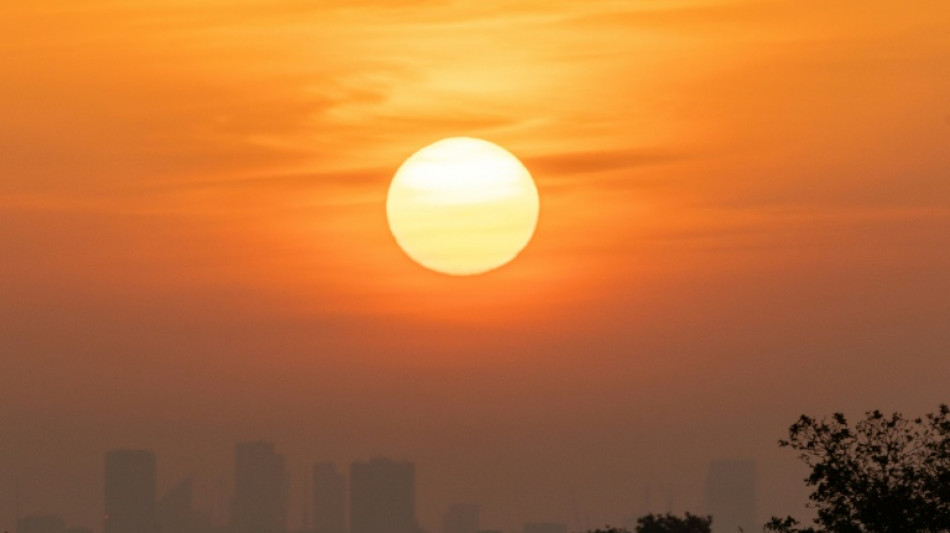
Temperatures likely to remain at record levels in 2026-2030: UN / Photo: Brook Mitchell - AFP

 South Africa’s sovereign satellite plan remains stalled despite higher cost

 EasyEquities says small group of client accounts targeted in attack

 Regulator examines E9Pay after hacking losses reach 2.5 billion won

 North Korea and Russia agree to expand joint economic projects

 Seoul monitors reports of possible Kim Jong-un visit to China

 Gabe Sanchez on Dallas Bars, Sherry, and the Reality of Opening a Venue

 Lee joins launch of 2.4-gigawatt AI data centre project in Gangwon

 Nottinghamshire Councillor Urges Mayor to Spend £350m on Transport Projects

 Bathroom and Kitchen Updates That Make a Difference

 Six North Korean Fishermen Repatriated After Drifting Near Ulleungdo

 Jennifer Lopez Reunites with Twins Max and Oskar for First College Thanksgiving

 Black Friday E-Reader Deals: Kindle Paperwhite, Scribe, and Kobo Discounts
Global average temperatures are likely to continue at or near record levels this year and for the next four years afterwards, the United Nations warned Thursday.
The 11 hottest individual years ever recorded all happened from 2015 onwards and the UN's weather and climate agency said the trend was set to continue, with a new hottest-ever year "likely" before 2031.
There is a 75 percent chance that the 2026-2030 five-year mean temperature will surpass the key threshold of 1.5C above the 1850-1900 pre-industrial average, the World Meteorological Organization said.
The WMO outlook comes as western Europe swelters under a "heat dome" of warm air, breaking temperature records for May in Britain and France.
"Global average temperatures are likely to continue at or near record levels in the next five years," the agency said.
"It is likely (86 percent chance) that one year between 2026 and 2030 will surpass 2024 as the warmest year on record."
- El Nino effect on 2027 -
"There is an El Nino predicted for the end of 2026, which increases the chances of the following year, 2027, being the next record-breaking year," said Leon Hermanson, lead author of the WMO's Global Annual-to-Decadal Update.
The last El Nino contributed to making 2023 the second-hottest year on record and 2024 the all-time high at around 1.55C above the pre-industrial average.
El Nino is a natural climate phenomenon that warms surface temperatures in the central and eastern equatorial Pacific Ocean, bringing worldwide changes in winds, pressure and rainfall patterns.
It typically takes place every two to seven years and lasts around nine to 12 months.
- 1.3C to 1.9C range -
The 2015 Paris climate accords aimed to limit global warming to well below 2C above pre-industrial levels -- and preferably below 1.5C.
The targets are calculated relative to the 1850-1900 average, before humanity widely began industrially burning coal, oil and gas, which emit carbon dioxide -- the greenhouse gas largely responsible for climate change.
"Annual global mean near-surface temperatures during 2026-2030 are predicted to range between 1.3C and 1.9C above the 1850-1900 average," the WMO update said.
The WMO said there was a 91-percent chance that global average temperatures will temporarily exceed 1.5C above the pre-industrial baseline for at least one year between 2026 and 2030.
Furthermore, there is a 75-percent chance that the entire 2026-2030 five-year mean will exceed 1.5C above the 1850-1900 average.
However, it is considered exceptionally unlikely -- less than one percent -- that any single year will exceed 2C above the pre-industrial baseline in the next five years.
- Arctic heat warning -
The 1.5C barrier is expected to be broken with increasing frequency.
The 1.5C and 2C limits in the Paris accords refer to sustained long-term warming -- typically over 20 years -- so temporary breaches do not necessarily mean the long-term goal is out of reach.
Last year was one of the three warmest years on record, with the globally averaged near-surface temperature estimated at more than 1.43C above the 1850-1900 baseline.
The report was produced by Britain's Met Office national weather service and the WMO's lead centre for annual to decadal climate prediction. It compiles forecasts from 13 different institutes.
The report said Arctic temperatures over the next five northern hemisphere winters (November to March) were predicted to be 2.8C above average temperatures for 1991-2020 -- more than triple the global temperature anomaly for the same period.
Predicted precipitation patterns for May to September from 2026 to 2030 forecast wet anomalies in the Sahel, northern Europe, Alaska and Siberia, as well as dry anomalies over the Amazon.
O.Gutierrez--AT