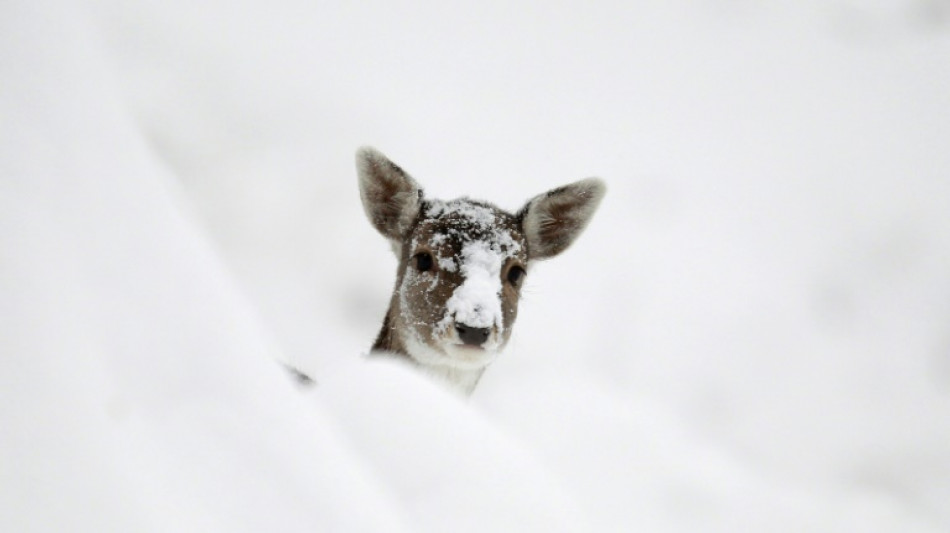
Mammals became warm-blooded later than thought: study / Photo: IAN KINGTON - AFP/File

 Missing passengers likely went down with sunken ferry: N.Cyprus official

 Premier League clubs splash cash to smash transfer record

 Melting glaciers an 'immediate' climate risk: author of UN report

 Folarin Balogun's move to Everton collapses

 Pacific islands to face food shortages over global warming: scientists
 Venice jury head Maggie Gyllenhaal questions lack of women directors

 Stocks drop, bond yields rally on Mideast flare-up
 China expands Egypt investments in first Xi visit in a decade

 Messi departure leaves Argentina facing rebuild after golden era
 Ourbit SuperCEX Launches "Cosmic Wheel Season 3. Oracle Realm" on September 2 with 3M USDT Prize Pool

 Ebola death toll passes 3,000 in DR Congo: official data
 Hong Kong democracy activist Wong pleads guilty to foreign collusion

 World record prize winner Romantic Warrior retires from horse racing

 5,000 US sailors arrive in Thailand after months at sea

 Joshua Wong, Hong Kong's pro-democracy poster child

 Nepal tunnel rescuers seek trapped workers but hit dead ends
 Zverev wins wild five-setter, Rybakina and Gauff ease through at US Open

 US energy secretary arrives in Venezuela to discuss oil deal

 Meloni government becomes Italy's longest-lasting

 Funerals in Nepal for missing, a week after deadly floods

 US aircraft carrier arrives in Thailand after months at sea

 US aircraft carrier approaches Thai port after months at sea

 Nepal's young PM faces gravest test after flood catastrophe

 What rainbow? LGBTQ Indonesians on edge as hostility mounts

 O'Connor eyes Wallabies World Cup swansong after Force return

The ancestors of mammals started to become warm-blooded around 20 million years later than previously thought, researchers suggested Wednesday, after analysing inner-ear fossils hoping to solve "one of the great unsolved mysteries of palaeontology".
Warm-bloodedness is one of the quintessential characteristics of mammals, along with fur, but exactly when they first evolved the feature has long been a subject of debate.
Previous research has indicated that the ancestors of mammals began evolving warm-bloodedness, or endothermy, around 252 million years ago -- around the time of the Permian extinction, known as the "Great Dying".
However figuring out the timeline has proved difficult.
"The problem is that you cannot stick thermometers in your fossils, so you cannot measure their body temperature," said Ricardo Araujo of the University of Lisbon, one of the authors of a new study in the journal Nature.
He was part of an international team of researchers that found a new way to determine how body heat changed throughout time, by examining the semicircular canals in the inner ears of 56 extinct species of mammal ancestors.
Fluid runs through the tiny ear canals, which help animals keep their balance.
The researchers realised that as body temperatures warmed up, so did the ear fluid.
Araujo gave the example of oil used to fry hot chips.
Before you warm the oil up, it is "very viscous, very dense," he told AFP.
"But then when you heat it up, you'll see that the oil is much runnier, it flows much more easily."
The runnier ear fluid led to animals evolving narrower canals -- which can be measured in fossils, allowing the researchers to track body temperature over time.
Unlike previous research on this subject, the team developed a model that not only works on extinct mammal ancestors, but also living mammals, including humans.
"It can look at your inner ear and tell you how warm-blooded you are -- that's how accurate the model is," lead study author Romain David of London's Natural History Museum told AFP.
Using the model, they traced the beginnings of warm-bloodedness to around 233 million ago, in the Late Triassic period.
- 'Not a gradual, slow process' -
Michael Benton, a palaeontologist at Britain's University of Bristol who was not involved in the study, said the new metric "seems to work well for a wide array of modern vertebrates".
"It doesn't just provide a yes-no answer, but actually scales the 'degree' of endothermy in terms of actual typical body setpoint temperature," he told AFP.
Benton, whose previous research had given the 252 million years date, said the transition to warm-bloodedness likely took place in stages, and "there were several significant prior steps before this semicircular canal switch".
Araujo said the new research suggested that warm-bloodedness came about simply and "very quickly in geological terms, in less than a million years".
"It was not a gradual, slow process over tens of millions of years as previously thought".
David said it seemed unlikely that warm-bloodedness would begin around the extinction event 252 million years ago, because global temperatures were extremely hot then.
That would have been a disadvantage for warm-blooded animals -- but they could have thrived as temperatures cooled in the following millions of years.
"Being an endotherm allows you to be more independent of the whims of the climate, to run faster, run longer, explore different habitats, explore the night, explore polar regions, make long migrations," Araujo said.
"There were a lot of innovations at the time that started to define what a mammal is -- but also ultimately what a human being would be."
M.Robinson--AT