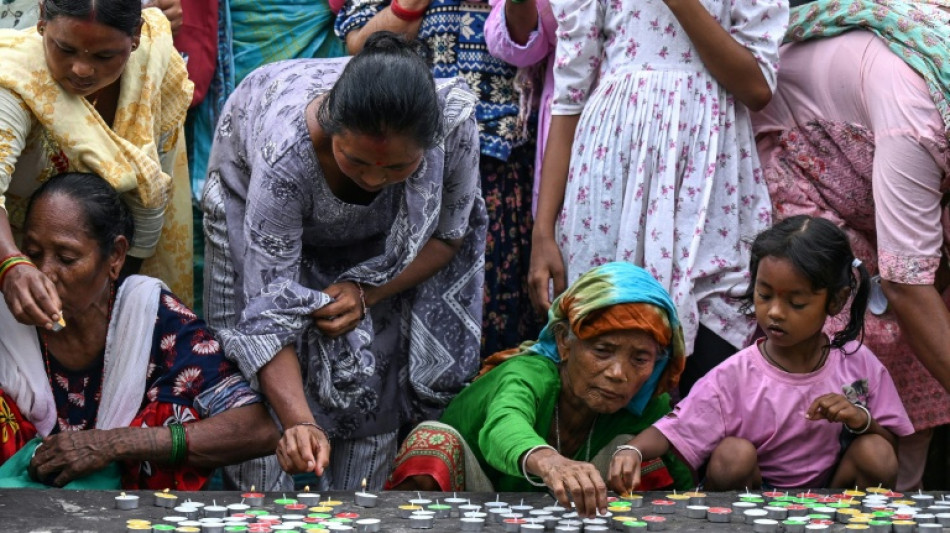
Nepal's war victims watch political changes with fragile hope / Photo: Prakash MATHEMA - AFP

 In Bangladesh, Pakistan's Jinnah photo stirs anger

 Two New Zealand naval ships transit Taiwan Strait

 Zidane gets down to work as France start new era
 Inside the Venezuelan prison meant to 'drive you insane'
 UK king braces as memoir by Diana's brother goes on sale
 No green light to lift EU sanctions on Russian oligarchs, talks to resume

 UK agrees support for Saudi in struggle with Houthis: reports

 EU foreign policy chief calls for continued sanctions on Russia

 Flights scrapped, evacuations urged as Typhoon Dujuan wallops Japan

 Fonseca to take break from tennis
 A Cuban zoo, and its animals, in epic battle for survival

 Infantino proposes consulting federations to reform FIFA

 El Nino weather pattern enters record territory: scientist
 OpenAI calls for US to lead global effort on AI standards

 South African ostriches plucked alive for luxury fashion: report
 US networks halt Trump coverage in revolt over White House ban

 Paramount settles with US states to clear Warner Bros. mega-merger

 Climate crisis a job for world leaders, not just activists: UK FM

 US networks halt Trump coverage over White House ban
 French singer accuses Miley Cyrus of plagiarism

 EU fines Google 403 mn euros for location data breach

 'Best is yet to come,' says De la Fuente after Spain extension

 Why diesel prices are rising more than crude oil

 COP31 host says AI's climate footprint to be a summit priority

 Renewables hit record in 2025, but world must move faster: report
When families of those killed in Nepal's deadly September protests that toppled the government demanded justice, the anguish felt painfully familiar to Sunamati Chaudhari.
Her husband, an English teacher, was taken by security forces 22 years ago at the height of a decade-long civil war. He never returned.
Chaudhari, 62, has been searching for the truth about her husband's disappearance ever since.
"We left no stone unturned in search of my husband. We went to court, sought help of many organisations -- and even reached Geneva," she told AFP, referring to her bid to seek help from the United Nations. "But nothing happened."
She is among the thousands of relatives waiting for closure since a 2006 peace deal ended a conflict in which more than 16,000 people were killed and 1,400 remain missing.
Abuses were committed by both Maoist rebels and state forces.
"I would dream of him every night," Chaudhari said.
Justice has been glacial in the Himalayan nation.
Nepal's authorities have long been criticised for failing to adequately probe wartime abuses.
Two transitional justice commissions set up in 2015 have yet to resolve a single case, despite receiving more than 65,000 complaints of rape, murder and enforced disappearances.
- 'Culture of impunity' -
Nepal is now reeling from fresh political upheaval.
Youth-led demonstrations against a social media ban, worsening economic woes and corruption erupted nationwide in September, leaving at least 76 people dead in a violent crackdown.
Parliament, courts and civil service buildings were torched, and the government collapsed.
Former chief justice Sushila Karki, 73, was named interim prime minister to steer Nepal until elections in March 2026.
For many families still haunted by the civil war, the political shake-up has stirred a fragile mix of hope and anxiety.
Preeti Tharu, 22, whose father was abducted by rebels before she was born, fears history will repeat itself.
"The previous government only showed assurances," she said. "And I know, with this changing situation, the state's priority might be something else."
Gita Rasaili, who heads the Conflict Victim Women National Network, said she hoped they could find common cause with the new generation demanding government action.
"We worried that our agenda was over, because there are now new victims' families and new martyrs," she told AFP.
"But we are all fighting against a culture of impunity."
- 'Volatile' -
In August, before the uprising, families gathered to mark the International Day of the Disappeared at a new memorial park in western Nepal's Bardiya district.
Families of some of the 258 missing people from the district planted trees and lit candles.
Park coordinator Niranjan Kumar Chaudhari, whose father was taken away by the army, said the new crop of politicians in the interim government were among the few who had taken action to support their cause.
"The current prime minister and home minister are both advocates for victims of war crimes," Chaudhari said.
"But the political situation is volatile."
It was under Karki's watch as chief justice that a court in 2017 sentenced three soldiers to 20 years in jail for the murder of a teenage girl.
At the time, it was only the second conviction for crimes committed during the war.
The Commission of Investigation on Enforced Disappeared Persons says its work will continue regardless of the political situation.
"We have received 2,610 complaints so far," said commission chief Lila Devi Gadtaula, who aims to complete investigations within four years, with progress slowed by limited forensic resources.
But for families like Chaudhari's, time has already run out.
In July, she and her two sons performed her husband's death rites.
"It's already too late," she said. "Many prime ministers have come and gone, but nobody addressed our problem."
A.Williams--AT